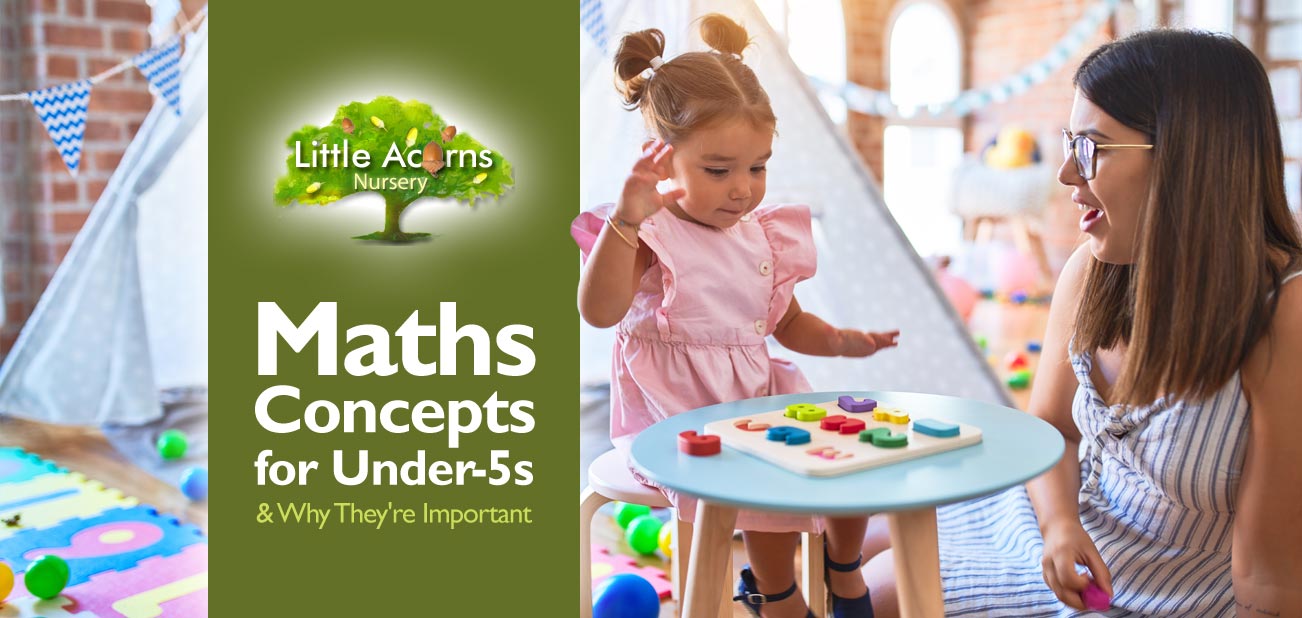
 Once babies have transformed into toddlers, it’s never too early to introduce them to maths-based concepts and language. Indeed, introducing under-fives to such concepts in the earliest years will benefit them hugely as it lays the foundations for future learning. That’s one of the main reasons it is a part of the EYFS curriculum. Continuing this learning at home will also help them instinctively understand that mathematics is a normal and integral part of everyday life. As such, there is no need for it to be perceived as a daunting topic. With all that in mind, today’s guide explores why the early introduction of mathematics is so beneficial to under-fives and how parents and caregivers play a vital role in encouraging their mathematical curiosity, knowledge, and confidence.
The Benefits of Understanding Maths Concepts in the Early Years
As well as the obvious advantage of improving numeracy skills, learning mathematical language and concepts at an early age has several key benefits for under-fives.
Enhanced Vocabulary Development & Language Skills
Children exposed to rich mathematical language will naturally have stronger vocabularies. This, in turn, will facilitate enhanced communication skills, for example, through the mastering of such things as descriptive, comparative, and positional words.
Improved Cognitive Skills
Learning numeracy skills is like a subtle workout for the mind. Such activity is known to stimulate brain development and improve memory, attention, and critical thinking skills. Each of these benefits will allow children to make connections and solve problems more easily.
Stimulated Creativity & Imagination
Mathematics isn’t just about numbers; it also involves creativity. For example, children can explore patterns, shapes, and spatial relationships, each of which has maths at their heart. Indeed, maths is integral to design, art, music, dance, and many other creative areas that children can immerse themselves in.
“Studies show a direct correlation between early mathematical skills and later educational achievement.”
A Foundation for School Success
 Familiarity with mathematical terms and concepts also helps to prepare children for formal education, including in many areas other than pure mathematics. Understanding maths concepts from an early age will allow them to confidently engage in number-related exercises and discussions, greatly enhancing their school readiness across multiple topics. Such preparation will allow them to take maths-based challenges in their stride right from the moment they begin Reception Year in primary school. What’s even more striking is that studies show a direct correlation between early mathematical skills and later educational achievement.
What Kind of Maths Concepts Can Parents Teach Tots?
As you’ll see below, there are many different types of maths-related words and concepts that parents can help children grasp. As we said before, maths is all around us, so there are many opportunities to help little ones master mathematical concepts and language — even from an early age. Aside from learning the actual numbers, some examples include the following:
 Counting is the most obvious example. Counting can be introduced and practised by your little one in many, many situations, from counting how many more mouthfuls of food a child should eat, to the number of Lego blocks in a tower they’re creating.
- Size is another maths-based concept where, given some parental guidance, little ones can soon begin to understand whether something is tiny, medium-sized, big, gigantic, tall, short, thin, or wide.
- Measurement is another maths-related concept for children to grasp, so encouraging them to learn when something is full, empty, long, heavy, light, etc., will stand them in good stead both linguistically and in terms of mathematics.
- Similarly, comparatives will be useful for children to understand. It’s essential for them to grasp concepts and language like more, less, equal, different, the same, identical, and so on.
- Shapes also have roots in maths, so children should get familiar with 3-sided triangular shapes, 4-sided shapes like squares and rectangles, and so on.
- Positions are also founded in mathematics, so children should be encouraged to recognise when something is on, off, inside, outside, up, down, and suchlike.
- Finally, time also has its roots in numbers and mathematics. Therefore, it will help children to not only tell the time eventually but also understand the meaning behind words like early, late, now, later, soon, etc.
 Counting is the most obvious example. Counting can be introduced and practised by your little one in many, many situations, from counting how many more mouthfuls of food a child should eat, to the number of Lego blocks in a tower they’re creating.
 Shapes also have roots in maths, so children should get familiar with 3-sided triangular shapes, 4-sided shapes like squares and rectangles, and so on.
How to Go About It
Parents, caregivers and relatives can help children under five learn about these mathematical concepts and the language that surrounds them. Games, books, and even songs, for example, often include facets of maths and maths language that adults can draw children’s attention to and get them involved in. Counting fingers, toes, and objects like building blocks is another obvious example and one which can be extended to include much of the maths-related vocabulary that we mentioned earlier (numbers, comparatives, positions, shapes, etc.).  Creative endeavours can also be vehicles through which supervising adults can highlight elements of mathematics that are built into designs and creations that children may generate. Patterns and shapes are obvious examples of that. Last but not least, parents can involve children in maths facets which are integral to everyday life, for instance, counting items when out shopping, or measuring when putting ingredients together for a meal. Children will love being more involved in such activities and will learn about maths in a fun, natural, and engaging way. Doing so will create the strongest foundations for their future learning.
We may follow up at a later date with some in-depth activity ideas that will help children learn more about maths and the language surrounding it, so watch this space!
Little Acorns: an Outstanding Nursery in Clayton-le-Woods, Chorley
Award-Winning Childcare in Central Lancashire

Little Acorns gives babies, toddlers and preschoolers the very best start in life at their Clayton-le-Woods nursery near Chorley. That’s backed up by being rated an Outstanding Provider by Ofsted and a prestigious National Nursery Award too. So, if you want the very best for your child, choose Little Acorns Day Nursery for their weekday childcare and we’ll ensure they absolutely thrive and are prepared for success.
Get in touch today to register your child for a nursery place, set a date for a guided tour of the setting, or ask any questions:
Little Acorns is an outstanding nursery and preschool located in Clayton-le-Woods, Chorley, near Clayton Brook, Clayton Green, Thorpe Green, Pippin Street, Buckshaw Village, Whittle-le-Woods, Farington, Bamber Bridge, Lostock Hall, Euxton, Leyland and Penwortham.


 Children and parents, let’s go minibeast spotting! Whether you have a garden, neighbourhood park, or just a few potted plants, there are bound to be minibeasts visiting or living there. What’s more, summer is the perfect time to spot them. Spending time in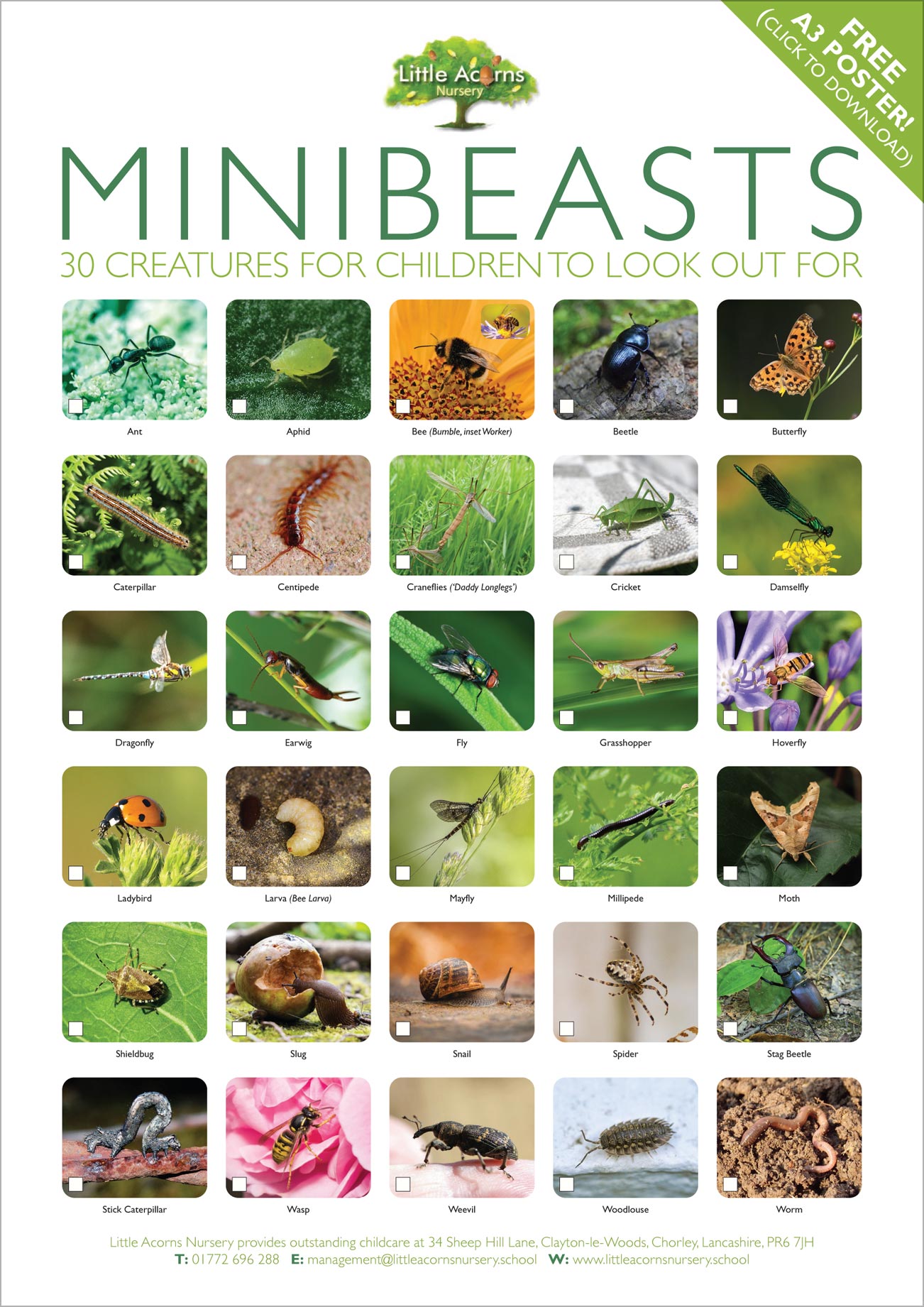
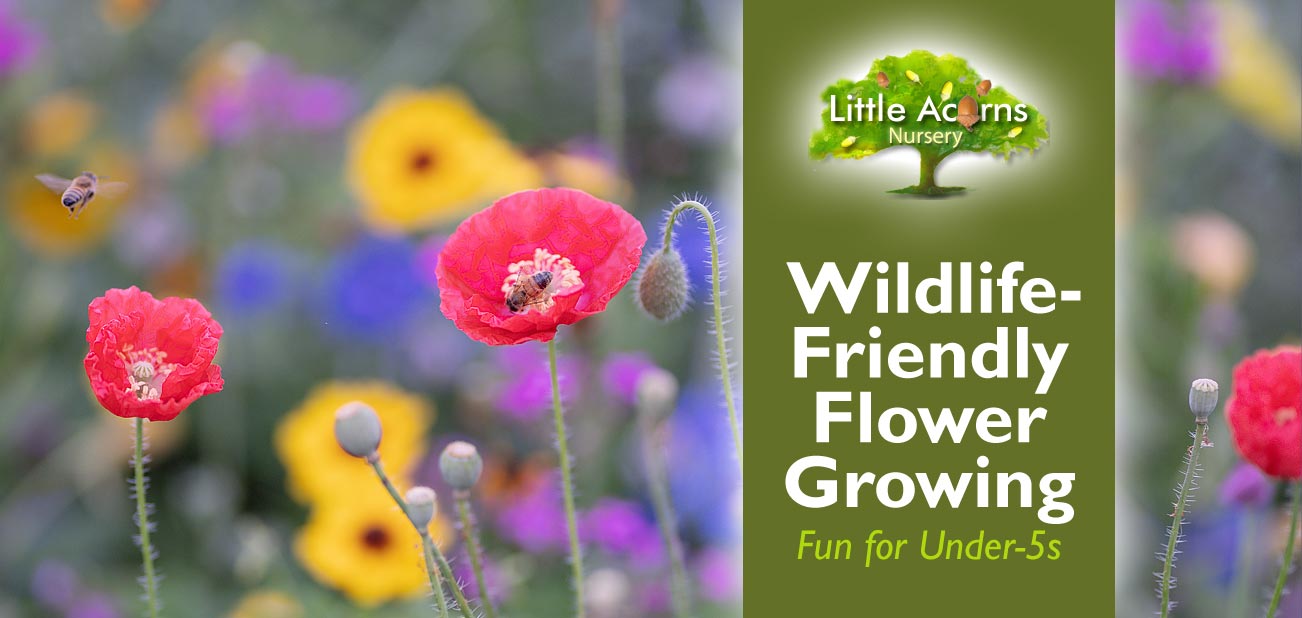
 Today’s flower-growing children’s activity follows on nicely from last month’s
  It’s possible to sow wildflower seeds from March right through to mid-October or, at a push, early November so long as snow or frost is not forecast. Those sown closer to March and April will generally flower in late spring/early summer. Those sown very late in the year will flower the following year, from spring onwards. Any sown up to and including the middle period, for example during July, should still flower in the same year — wildflowers usually bloom some 60 to 80 or so days later if they’re timed to grow in the same year as they’re sown.
 There are several ways for children and families to source wildflower seeds. The most obvious way is to buy them commercially, in seed packets. These are available from any number of different outlets including nurseries, supermarkets,
  If you buy your child commercially-available wildflower seeds, the information on the packet will often say if the resulting flowers are bee-friendly, butterfly-friendly, good for pollinators, and so on. So, if you’re sourcing seeds that way, much of the decision-making criteria around which actual flowers to grow is made clear and therefore the choice is easy.
 By their very nature, wildflowers are generally not very picky in regard to the type of soil they are happy to grow in. Therefore you/your child will have a greater choice of where to sow the wildflower seeds. A fairly clear sunny area is good, whether that’s garden beds, flower pots, window boxes, grow bags on a balcony, or even the lawn itself if you want a wild ‘meadow’ type lawn. Whatever the choice, it’s best if it’s somewhere that won’t be disturbed by you/the family though, as you wouldn’t want the wildflowers trampled once they do arrive.
 With regard to sowing the seeds, follow any seed-specific instructions on packets in relation to timing and spacing. If you’re using self-harvested seeds or there are no instructions, simply sprinkle the seeds so they’re spaced, fairly evenly, i.e. not too densely sown. This will avoid the wildflower plants having to compete with one another once they start growing. A tip is to sprinkle from a height as this will naturally scatter them more widely. Once scattered, your child can help* to pat the soil surface down, either by hand or using the back of a tool like a spade or a trowel, so that the seeds are secured in the soil. Children can even ‘walk’ them in if they prefer. Once complete, ensure that you/your child keep the soil damp over the coming weeks. The preparation stage really is as simple as that!
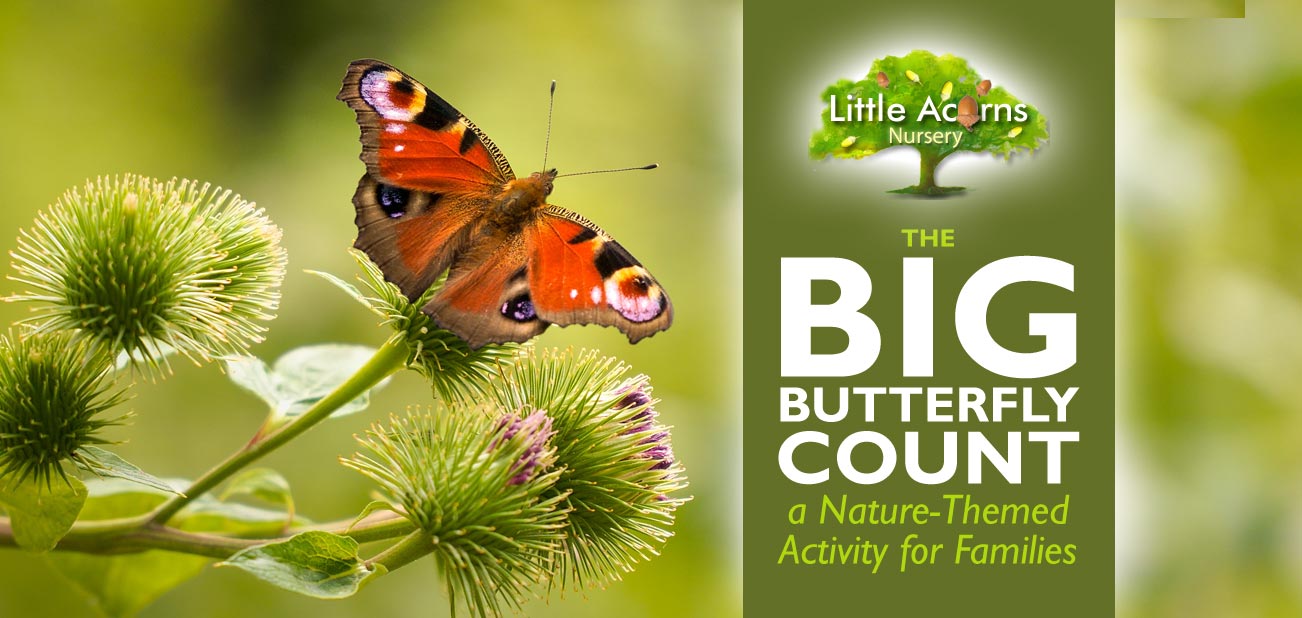
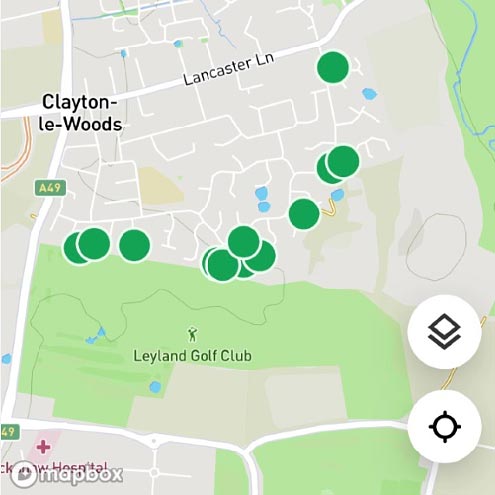
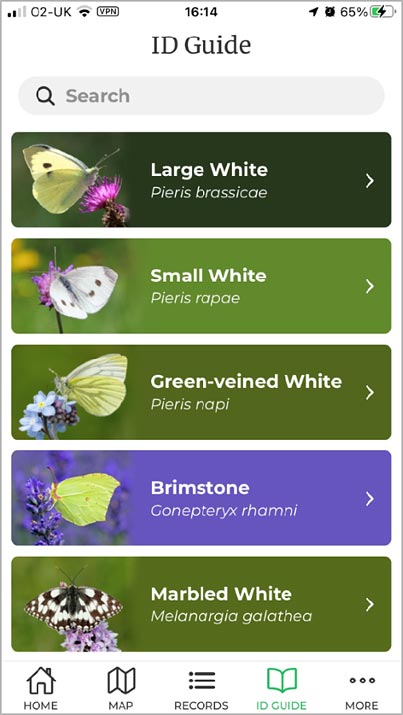
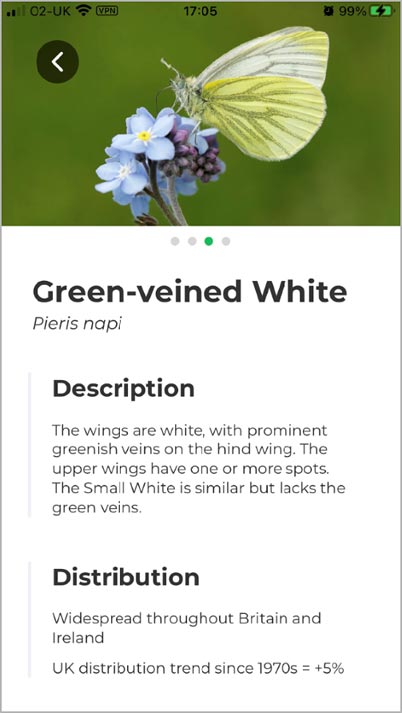
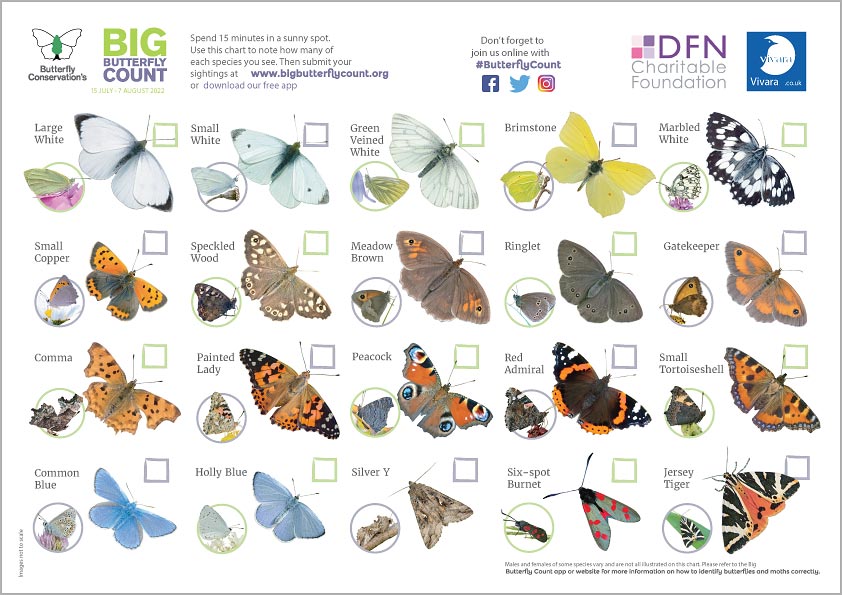
 Many will have heard of the Big Garden Birdwatch that takes place every year in January. However, fewer are aware of a similar activity called The Big Butterfly Count that takes place in July and early August. As well as being extremely worthwhile, it’s a wonderful activity for both children and adults to get involved in as citizen scientists. The activity helps with butterfly conservation, is educational for those taking part, and encourages families to get outdoors, closer to nature. And, as we know,


 parents to return to the workplace sooner after the birth of their child if they so choose;
 children aged 2 from eligible working families will be able to claim 570 hours of free childcare each year. This is typically taken as 15 hours of free childcare each week over 38 weeks, although exactly how it’s taken may be agreed otherwise between the family and the childcare provider.
 Until now, 87% of those eligible to claim childcare support through Universal Credit were not doing so. One of the main reasons for this was that it’s geared towards low-income families yet required them to pay childcare fees in advance — and later claim them back. Paying in advance is not so easy when household income is low, as is typically the case for households that would otherwise be eligible. For this reason, another of the Chancellor’s initiatives announced in the Spring Budget 2023 is to roll out the following improvements:
 The final childcare-related initiative in the Chancellor’s Spring Budget aims to fix another key problem for parents: how to juggle their own longer working hours with their child’s shorter school hours. When a child attends school, they often finish their school day several hours before their parent is finished at work, for example. There is therefore a childcare requirement to bridge the gap and this may be required both at the start and end of the child’s school day. In view of this, the Chancellor announced the piloting of a new Wraparound Pathfinder Scheme, which would fund childcare hours from 8 am until the start of the school morning and, later in the day, fund childcare for the mismatched afternoon hours up to 6 pm. The pilot will test the scheme to see how well it works. If successful, the Chancellor aims to roll it out to the whole of the UK from September 2024.

 Are you are a parent or carer of a child under five? If so, you could learn a lot about childcare, parenting and early years learning and development by following Little Acorns Nursery on social media. We’re active across multiple social channels including Twitter, Facebook, Pinterest and Instagram and share high quality content useful to parents of under-fives. That includes parents of children at Little Acorns although, actually, parents anywhere will find the content educational and useful. Our high quality content includes unusually informative ‘early years’ articles and information. For example, a whole range of guides, the findings from various studies, suggested activities for kids and overviews of things like childcare funding schemes with eligibility guidelines. Also, of course, the social media channels include posts relating to the exciting activities happening at the nursery in Clayton-le-Woods, Chorley.
 Follow Little Acorns Nursery on Twitter. There, you’ll see links to some great topics that relate to early years education. You’ll also see regular tweets and posts showing the exciting play and activities that children are taking part in at the nursery.
 On Facebook, we share our ‘bigger’ guides and articles from
  We love Pinterest! Its simple, pictorial approach makes it easy to just pick out something that interests you and save it to your own Pinterest pin board, so you can simply save it or share with others. We’ve got lots of pin ‘boards’ on our Pinterest profile, where we’ve pinned images and links to articles that interest us as early years practitioners. We think you’ll like them too. Board topics include nature activities, sensory activities for under-5s, early years parenting, Forest School, outdoor play, preschool, nursery school activities and, of course, Little Acorns Nursery itself.
 If you’re on Instagram, check out our photo gallery on our own Instagram profile. It shows images of the children playing and learning at the nursery as well as featured images that link to our highly interesting blog posts.
 Little Acorns Nursery is @LittleAcornsNurseryChorley on Google and;
 If you have used our childcare service and were pleased, please
  We’re active here on our Little Acorns blog too. Here, you’ll find larger articles that tend to cover the ‘bigger’ topics that parents and carers of children under five will find useful. These are well-researched, detailed and often very educational articles that will keep parents well-informed. For example, we cover topics like

 Today, we look at how early years childcare providers like Little Acorns Nursery can help children under five if they have special educational needs and disabilities. This is often referred to as ‘SEND’ or in longer forms like ‘SEN and disabilities’. Let’s explore the topic to get an overview of some of the help available.
 Actually identifying an area of special need or disability is, of course, the first, crucial step in being able to help a child. If an area of special need is suspected, early years providers can work with parents and sometimes other professionals, for example health visitors, speech and language therapists, paediatricians and so on. Involving such professionals will help with any diagnosis.
 This is important. Early years providers can create an inclusive environment that welcomes and supports children of all abilities. Encouraging the inclusion of children in social groups and in the making of friends, for example, is of huge benefit to children’s well-being. Childcare settings can also provide special equipment or adapt the environment to make it more accessible for children with specific physical needs.
 Early years providers like Little Acorns Nursery adapt the individual learning and development plans and activities to suit each child. In this way, they’re custom-designed to meet the needs of every child individually, including those with special needs. This is done as a matter of course as part of
  Later, each child will similarly have an ‘EYFS profile’ completed during the final term of reception year. However, as we’re focusing this article on children under five, we’ll not go into detail about that here.
 It may be useful for parents and carers to note that local authorities have a duty to publish what’s known as a ‘Local Offer’. This outlines the help available in the area for children with SEND, including how to access that support.
 One of the first challenges when considering childcare for your little one is how to fund it. If you’re an affluent family, then great. However, if childcare costs will be a more significant hurdle to overcome, the good news is that there are lots of options available. Either way, it will help to be well-informed about the various childcare funding schemes on offer from the Government. There are quite a few of them and some are extremely generous and surprisingly easy to obtain. Today’s Quick Guide to Childcare Funding Options in England will give you an at-a-glance overview of what’s available, the key eligibility criteria and how to apply. Note, though, that they generally fund in-person childcare only from approved providers (like Little Acorns). Take a look at the many options …
 You’ve no doubt heard of, or read about, childcare ‘vouchers’. They sound great, but what are they and how do you get them?
 Tax-Free Childcare is a great scheme which, in contrast to childcare vouchers, is widely available to working families — even for those with relatively high earnings.
 Certain 2-year-olds are eligible for 15 hours of free childcare each week, through another Government scheme. This one is to help primarily those families on benefits.
 3 and 4-year-olds in England are very well catered for when it comes to free childcare funding. This is aimed to help them receive that all-important early years education and to help those parents wishing to return to the workplace.
 Tax Credits specifically for childcare are only available to existing claimants under the scheme, through ‘Working Tax Credits’. New claimants should instead refer to the ‘Childcare Funding through Universal Credit’ section below.
 For those who are eligible, this is quite a generous scheme that allows them to reclaim* as much as 85% of their childcare costs. The maximum available, however, is £646.35* each month for one child, or it’s £1108.04* for more than one.
 This is a grant that does not need to be repaid and is in addition to any undergraduate Student Finance.
 Learner Support is a type of financial support designed for students who are suffering financial hardship. It can be used to fund childcare for eligible students who are also parents.
 Care to Learn may suit if you are a parent who is not yet 20 and are studying on a publicly-funded course, although see caveats below.

 As promised in our recent
  Microgreens, also known as micro leaves, are the young shoots of growing plants that are edible. Examples include the seedlings of herbs like basil and coriander, red cabbage micro leaves and the shoots from root vegetables like beetroot. When growing, the seedlings form a thick and rich ‘carpet’ of shoots that, when ready, can be snipped off en masse and used in meals as salads or garnishes. What’s more, they’re delicious, highly nutritious and make meals look amazing. The entire activity can also be accomplished indoors in any home. You do not need to have a garden because a well-lit windowsill or counter top will more than suffice.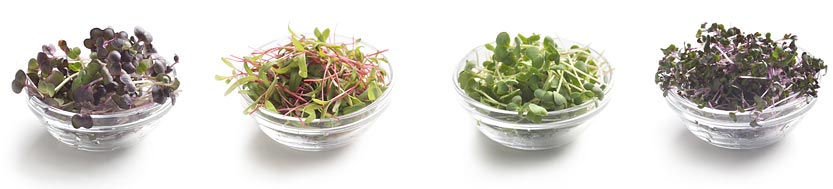
 Microgreen seeds. These are available inexpensively online or at places like garden centres and even some supermarkets. You can buy microgreen mixed seeds or choose seeds for rocket, beetroot, spinach, red cabbage, fennel, broccoli, radish or mustard. Each has a distinctive look, when growing, and flavour, when eaten. Read the packets for more detail or just have fun and experiment!
 Different microgreen seeds grow at different rates but usually a dense carpet of growing shoots and tiny leaves will cover the trays or pots within one or two weeks. Generally speaking, when you can see small, immature leaves at the top of shoots about 1 to 1¼ inches tall, they are about ready to be harvested. For young children in particular, snipping them off is best done by parents, to avoid injury. The carpet of microgreens can be snipped off, using scissors, low down near where the shoots begin. It’s best to snip them off rather than to pull them up by the roots because then they have the chance to regrow and give you/your child a second crop later on. The microgreens can then be washed in a fine colander, under a cold tap, to remove any remnants of soil.
 Your child can then continue the fun by helping with meal preparation (with adult supervision for safety). Microgreens make wonderful garnishes, are lovely in salads and sandwiches and can also be added to things like soup, risotto, pasta, baked potatoes and burgers. They are incredibly attractive to look at, jazzing up any meal and also giving children extra nutrients to consume. They are also a great way to encourage children to try new tastes and food textures.

 Each year, around 1 million families miss out on thousands of pounds in free childcare funding — despite being eligible through the Government’s Tax-Free Childcare scheme. Are you one of them?
 Families, including single parent families, are usually eligible for tax-free childcare scheme if they meet the following criteria:
 The Tax-Free Childcare contribution from the Government can only be used to pay for childcare provided by approved childcare providers that have signed up to the scheme. Such providers must be registered with either the Early Years Register, the Childcare Register or Ofsted in order to be approved. However, they can be nurseries, childminders, nannies, play schemes or even after school clubs. Little Acorns Nursery is, of course, such an approved childcare provider and would be happy to assist families to make the most of this very useful, free childcare funding opportunity.