Today, we look at how early years childcare providers like Little Acorns Nursery can help children under five if they have special educational needs and disabilities. This is often referred to as ‘SEND’ or in longer forms like ‘SEN and disabilities’. Let’s explore the topic to get an overview of some of the help available.
Childcare Help for Children with Special Educational Needs & Disabilities
Early years and childcare providers can support children under five in a variety of ways if they have special educational or developmental needs, and/or a disability. Indeed, helping affected children as early as possible in their lives is of paramount importance:
“Early identification of needs and the timely provision of appropriate support, together with high aspirations, can help ensure that the vast majority of children who have SEN or disabilities can achieve well and make a successful transition into adulthood.” (DfE)*
The specific strategies used will depend on the child’s individual needs and the resources available to any particular provider. That said, typical examples of ways that early years childcare providers — and others — can support children with special needs include the following:
Identifying Children with Special Needs
Actually identifying an area of special need or disability is, of course, the first, crucial step in being able to help a child. If an area of special need is suspected, early years providers can work with parents and sometimes other professionals, for example health visitors, speech and language therapists, paediatricians and so on. Involving such professionals will help with any diagnosis.
It’s worth bearing in mind that the presence of a special need may not be crystal clear in many cases, especially when children are very young. As an example, it would not be possible to diagnose dyslexia until a point when a child’s understanding of language is sufficiently developed to actually begin the process of reading text. However, the involvement of such external expertise may make the initial identification of a child’s special need or disability more feasible.
Following such a diagnosis, the various parties surrounding the child can then, together, develop a plan of how best to support that child during their early years and potentially beyond. For our part as a nursery and childcare provider, we will also ensure that we regularly review the support that an affected child receives, making adjustments and taking further actions etc. when appropriate.
Creating an Inclusive and Supportive Environment
This is important. Early years providers can create an inclusive environment that welcomes and supports children of all abilities. Encouraging the inclusion of children in social groups and in the making of friends, for example, is of huge benefit to children’s well-being. Childcare settings can also provide special equipment or adapt the environment to make it more accessible for children with specific physical needs.
Creating a positive and responsive culture is also crucial, so that children feel comfortable to express themselves, irrespective of any differences or abilities/disabilities that they may have.
Additional Support and Resources Through Funding
In some circumstances, childcare providers can access special funding in order to provide additional support and resources to children with special educational needs or disabilities. Examples include the hiring of additional staff to provide one-to-one support, providing extra resources to support learning, or offering additional activities to extend children’s experiences. Access to the specific funding will, though, require eligibility criteria to be met. Often, such funding applications may require a team effort between parents/carers, childcare settings and potentially other types of early years professional mentioned above.
Tailoring Learning & Development Plans & Activities to Meet Individual Needs
Early years providers like Little Acorns Nursery adapt the individual learning and development plans and activities to suit each child. In this way, they’re custom-designed to meet the needs of every child individually, including those with special needs. This is done as a matter of course as part of the Early Years Foundation Stage (EYFS) approach to early years education and development. The tailored approach helps to level-up the playing field and, in effect, encourage equal opportunities for each child. It also helps them to reach their own personal bests in every area of their learning and development.
Progress Checks
The EYFS approach means that our early years practitioners use a continuous assessment approach in regard to every child’s progress, whether or not they have special needs or any disabilities. However, for those affected by SEN or disabilities, such an approach is even more crucial.
Special education provision for children, including those with SEN or disabilities, follows four stages of action: “Assess, Plan, Do and Review.”
In tandem with this, all children receive a Progress Check at 2 and this will highlight whether progress is on track, additional support is appropriate and indeed whether there is a SEND-related issue. Either way, tailored activities and strategies will be planned and put in place to address any issues and help optimise every child’s progress.
Later, each child will similarly have an ‘EYFS profile’ completed during the final term of reception year. However, as we’re focusing this article on children under five, we’ll not go into detail about that here.
The SENCo
As well as having a ‘Key Person’ allocated to each child, early years providers like Little Acorns have a Special Educational Needs Coordinator (SENCo). The SENCo oversees the setting’s tailored support for children, under their care, who have special educational needs or disabilities. Similarly, the local authority will have an Area SENCO. They will advise and help coordinate support for children with special needs between the local authority itself, the child’s parents, early years and education settings, health and social care services and so on. The Area SENCO will also help when the time comes to transition the under-five child to school.
Communicating with Parents and Other Professionals
Communication is key. Childcare providers like Little Acorns Nursery will communicate regularly with parents/carers and, when appropriate, local authorities, health visitors, paediatricians and other healthcare professionals. This is to ensure that everyone is aware of the child’s progress and any additional support that may be needed. Ensuring that all parties are pulling in the same direction is crucial to outcomes for each child, particularly if they have special needs and/or disabilities.
“When a child is very young, or SEN is first identified, families need to know that the great majority of children and young people with SEN or disabilities, with the right support, can find work, be supported to live independently, and participate in their community.” (DfE)*
EHC Assessments and Plans
In the event that a child does not make the expected progress despite everyone’s best efforts and high quality support, there is recourse to request an Education, Health and Care (EHC) needs assessment via the local authority. If such a request is made by a childcare setting, it would only be done with the knowledge of the child’s parent(s) and after discussion with them. Basically, such an assessment may result in a brand new plan to support the child, if that’s deemed appropriate. It’s a big topic in its own right, so we may follow up separately to explain more about EHCs in due course.
The ‘Local Offer’ from the Local Authority
It may be useful for parents and carers to note that local authorities have a duty to publish what’s known as a ‘Local Offer’. This outlines the help available in the area for children with SEND, including how to access that support.
A good example is the Local Offer published by our own local authority (Lancashire County Council), which can be found here. (Note that the early years childcare section of that particular Local Offer can be found here). A quick search there for SEND services will indeed reveal Little Acorns Nursery as an outstanding provider of childcare services, including for children with special educational needs and disabilities.
Free Funded Childcare Places for Children with SEND
While all 3- and 4-year-olds in England have access to free childcare provision each week, 2-year-olds with SEND may also be eligible for a significant number of free childcare hours if they get a Disability Living Allowance (‘DLA’), have a valid Education, Health and Care (‘EHC’) plan or have been referred through the local authority’s Portage service. Follow the bold links or speak to us at Little Acorns Nursery if you are local to Clayton-le-Woods, Chorley, and would like to learn more more about the options.
Outstanding Childcare in Clayton-le-Woods, Chorley

 Children get the very best start at Little Acorns Nursery. Little Acorns is an outstanding nursery and pre-school in Clayton-le-Woods, Chorley, Central Lancashire (PR6). We are also close to Clayton Brook, Clayton Green, Thorpe Green, Pippin Street, Buckshaw Village and Whittle-le-Woods. Farington, Bamber Bridge, Lostock Hall, Euxton, Leyland and Penwortham, so may suit those living/working in any of those nearby locations. Trust your child’s early years education and childcare to an award-winning nursery/pre-school and a nursery recognised by Ofsted as an Outstanding Provider —
To register your child for a place at Little Acorns Nursery, to ask a question or to see the nursery in action, please contact us:
* Quotation references: DfE, ‘Early Years: Guide to the 0 to 25 SEND Code of Practice’


 Children and childcare staff at Little Acorns Nursery love nature. So, with World Wildlife Day coming earlier this month and Spring now upon us, it’s the perfect opportunity to release our free Wild Mammals poster. Shown in full colour and printable in high resolution at A3 or A4, it features 20 British¹ wild land mammals that young children can learn to identify and look out for. Some can be seen when on walks, on holiday, or even perhaps at the local park, while others are rather more elusive — but that just makes it more exciting for children when they finally spot them! The poster is perfect for displaying on the wall at home — and is a fun way to both intrigue and educate children, including under-fives. With that in mind, why not download your free land mammals poster today, print it out, and get your little ones closer to nature?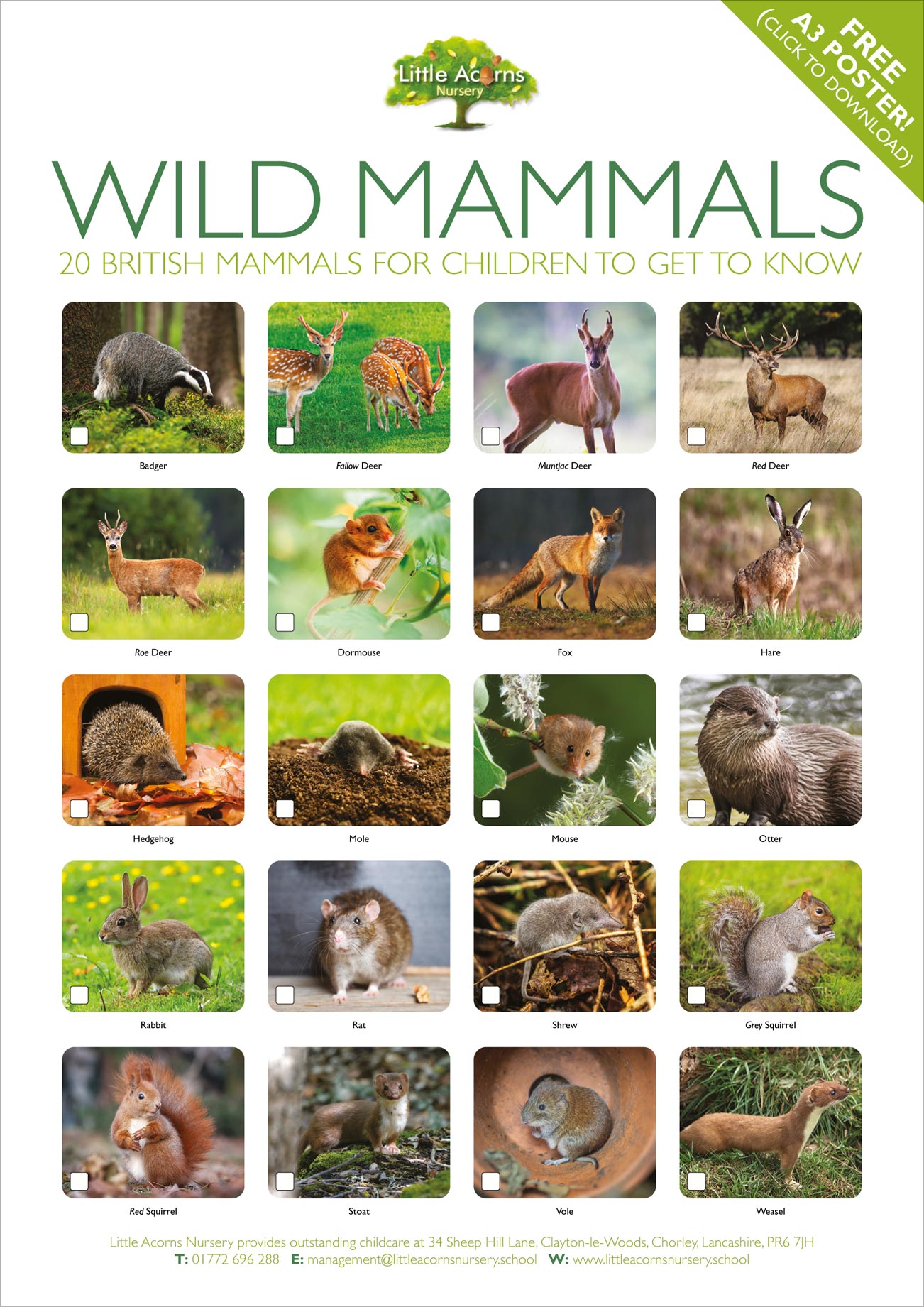



 As we discussed in our recent post
  Designate an area in your home for play. It doesn’t need to be elaborate — even a corner with a few age-appropriate toys, books, and art supplies may be sufficient. Ensure, of course, that the space is safe and free from hazards before your child embarks on their play activities.
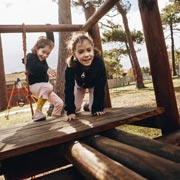 Outdoor play also offers a wealth of learning opportunities. It promotes physical health, stimulates the senses, and allows for unstructured exploration, which all contribute to holistic development. Take your child to the park, explore nature, or simply play with them in the back garden if you have one. Outdoor activities will also foster an appreciation for the natural world. Indeed, we wrote a whole post about
  Reading is a wonderful way to support learning through play. Choose age-appropriate books, of course, and be sure to engage in interactive storytelling. Ask and encourage questions about the story, encourage your child to predict what might happen next, and ask them what they might do if it were them in the story. Books and reading teach children so many things and, like pretend play above, truly encourage their imaginations and get their creative juices flowing.
  Arrange play dates with other children or involve siblings in play activities at home. Social play helps children learn essential social skills like cooperation, sharing, and conflict resolution. It’s also a great way to make new friendships, learn from each other, and become a closer member of friendship circles.
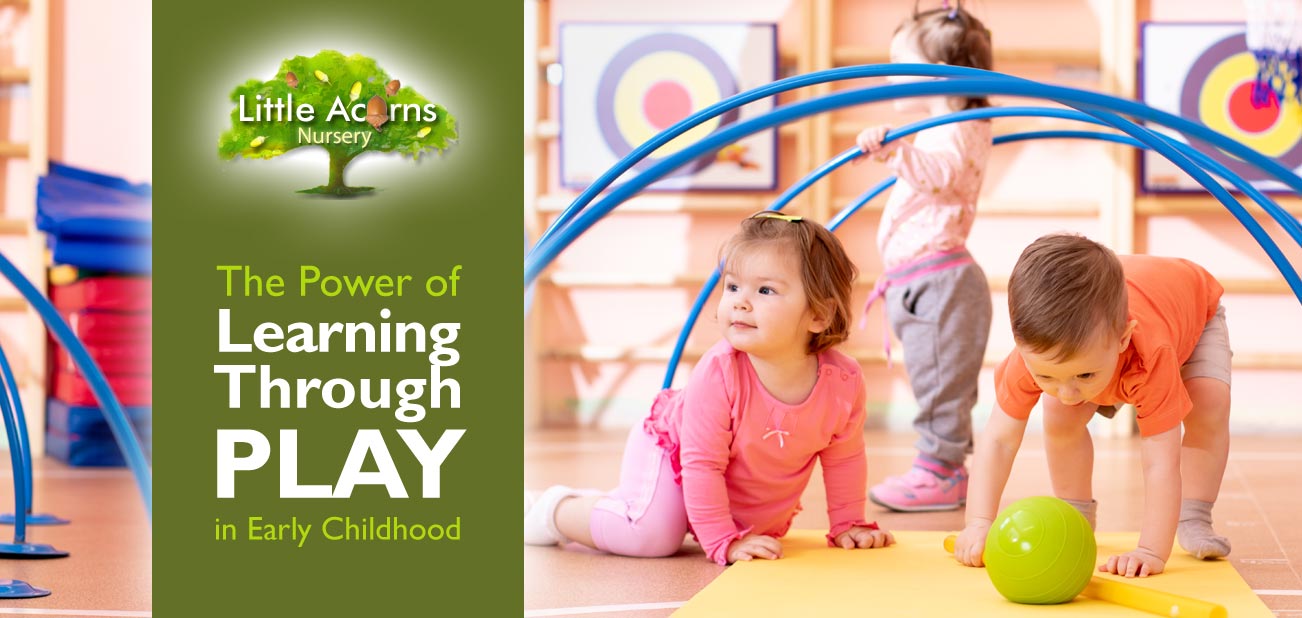
 In the world of child development and early education, there is a simple yet profound truth: children learn best when they are learning through play. Play is the universal language of childhood and, indeed, it transcends both borders and cultures. Whether it’s building sand castles on a sunny beach or arranging blocks on the floor at home, play is the gateway through which children explore, discover, and grow.
 As adults, we often associate learning with classrooms, textbooks, and structured lessons. However, for children, the process of learning is a dynamic and ever-evolving adventure, with play being their very best companion during the journey.
 Do babies benefit from play? Absolutely. Play is the first way through which infants start understanding their world. They use their senses to explore toys, grasp objects, and make sense of the environment around them. Sensory play, such as touching different textures or listening to soothing sounds, stimulates their developing senses and lays the groundwork for future learning.
 During the run-up to the age of 5, play is integral to children’s development. During this phase, children are like little sponges, soaking up information from their surroundings. Play allows them to experiment, make connections, and refine their cognitive and many other skills. Skills enhanced through play include:
 Creating playful environments — we understand the importance of a conducive environment for learning through play. With that in mind, we provide carefully designed play spaces that are rich in stimulating materials and resources. These spaces allow children to engage in various types of play, from imaginative to sensory, in a safe and supportive setting.

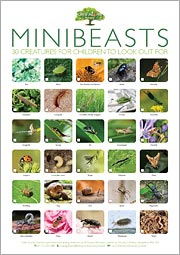 Children and parents, let’s go minibeast spotting! Whether you have a garden, neighbourhood park, or just a few potted plants, there are bound to be minibeasts visiting or living there. What’s more, summer is the perfect time to spot them. Spending time in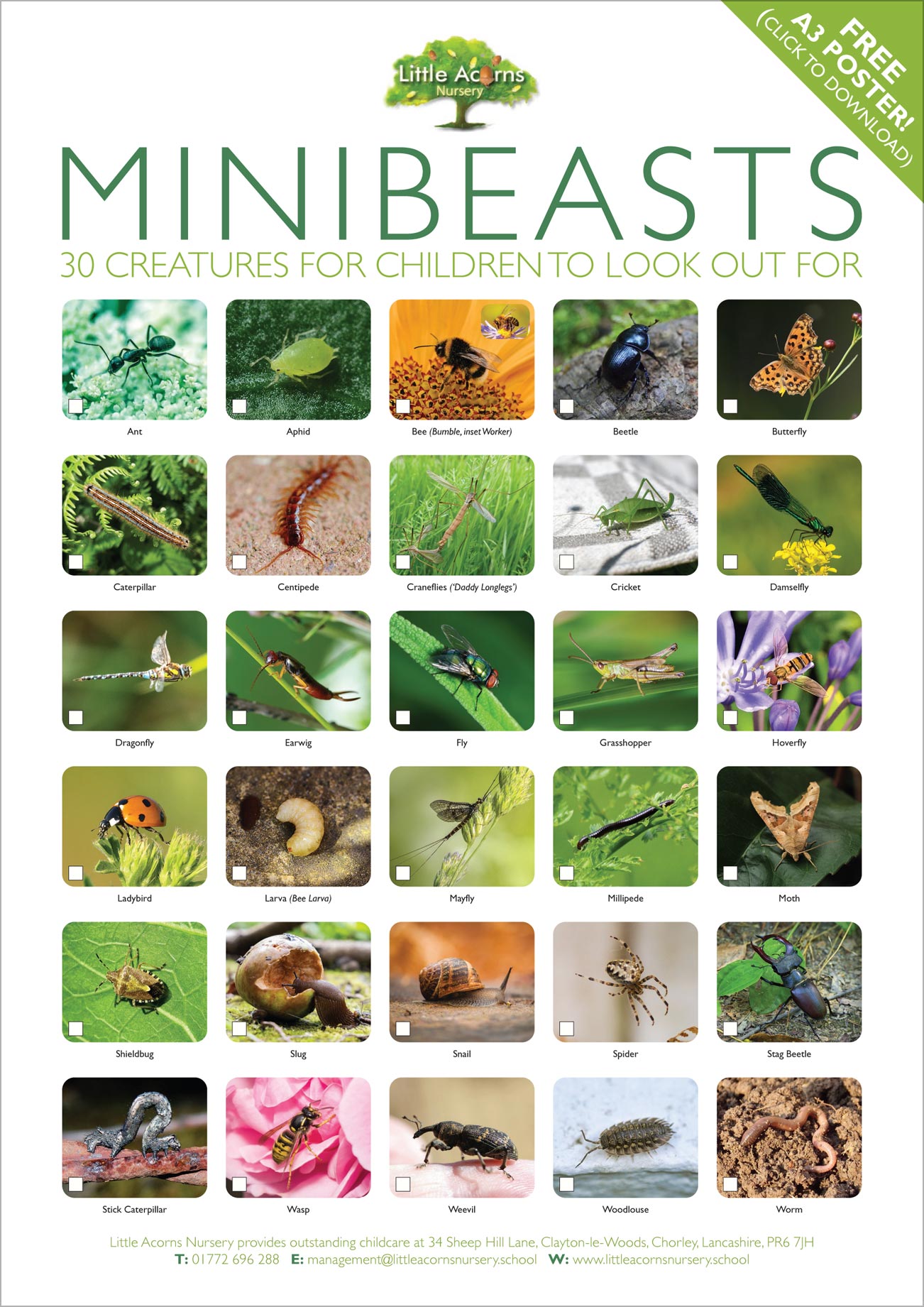


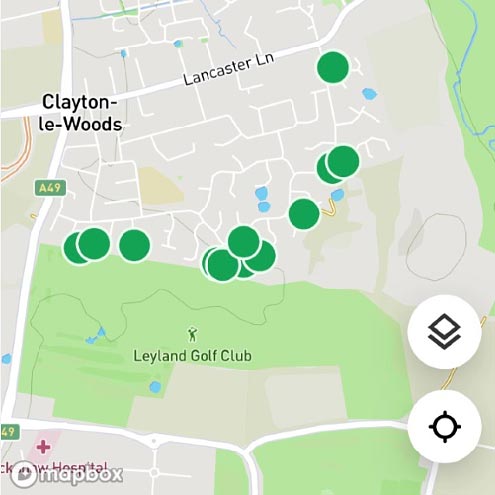
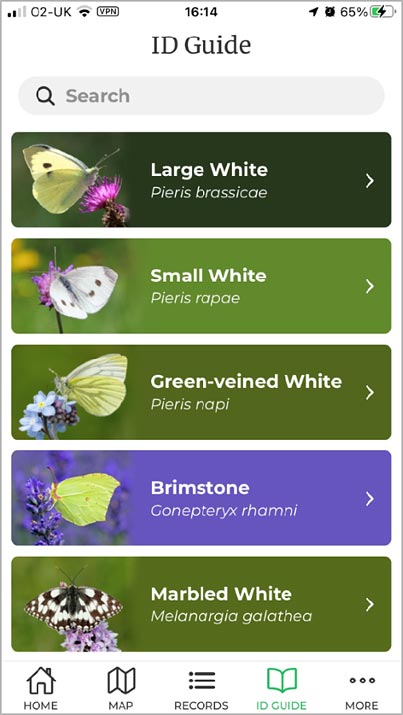
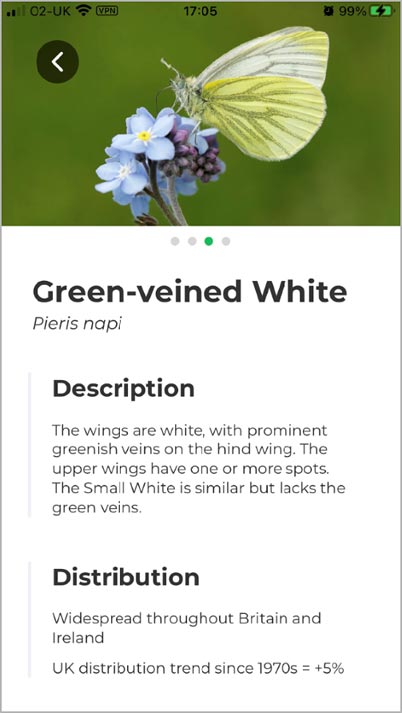
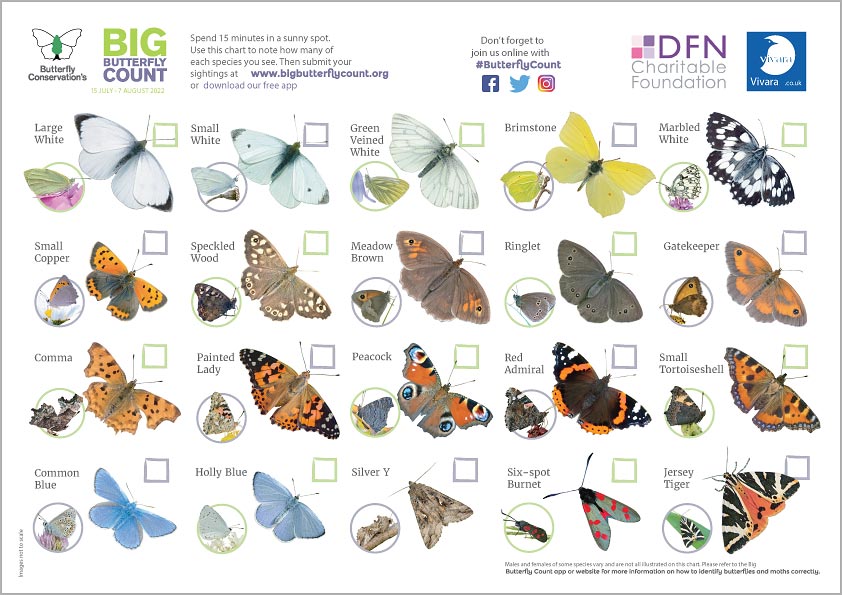
 Many will have heard of the Big Garden Birdwatch that takes place every year in January. However, fewer are aware of a similar activity called The Big Butterfly Count that takes place in July and early August. As well as being extremely worthwhile, it’s a wonderful activity for both children and adults to get involved in as citizen scientists. The activity helps with butterfly conservation, is educational for those taking part, and encourages families to get outdoors, closer to nature. And, as we know,


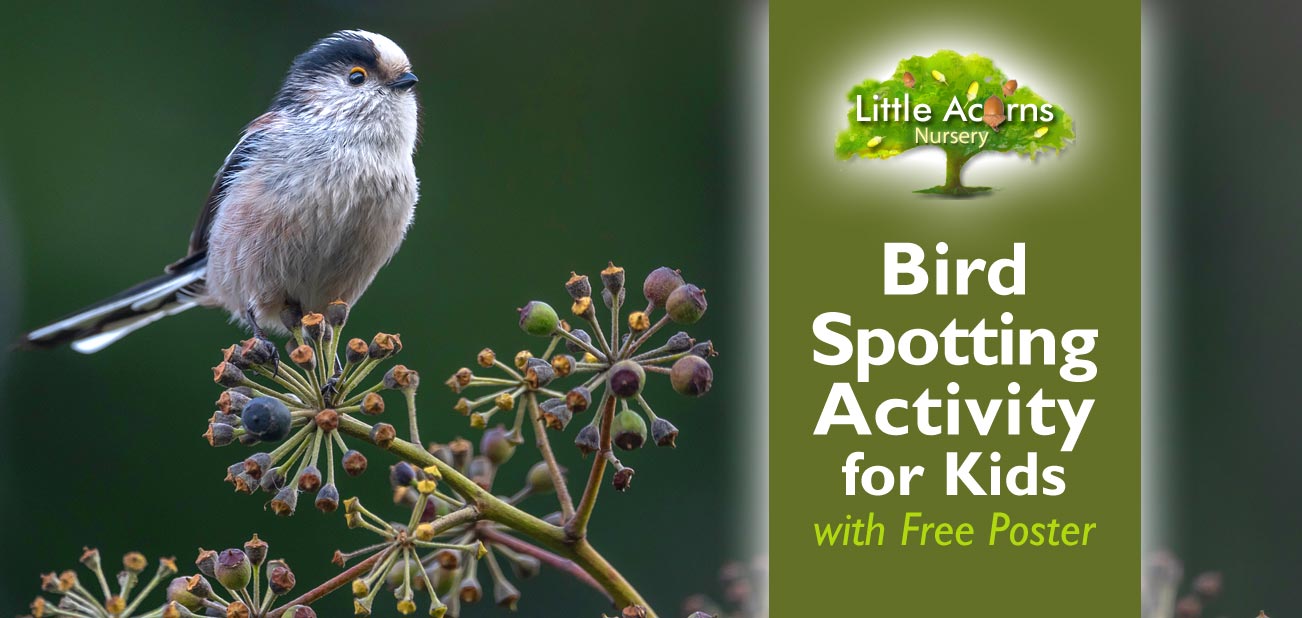
 Are you looking for a fun and educational activity for your children? Why not encourage them to do some bird spotting? Not only is it a great way to spend time outdoors, but it’s also a wonderful opportunity for them to learn about nature and develop observation skills. As we know,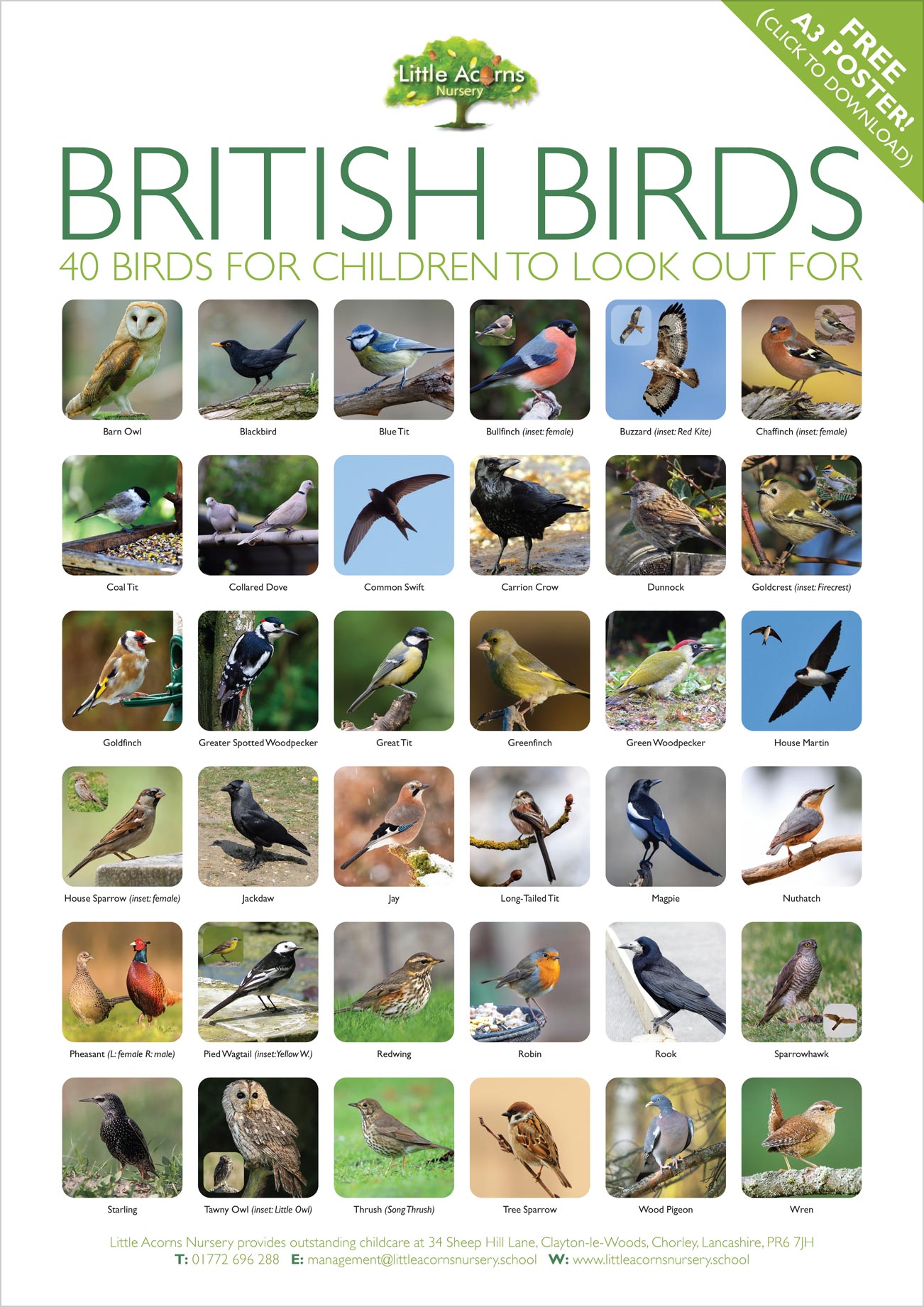
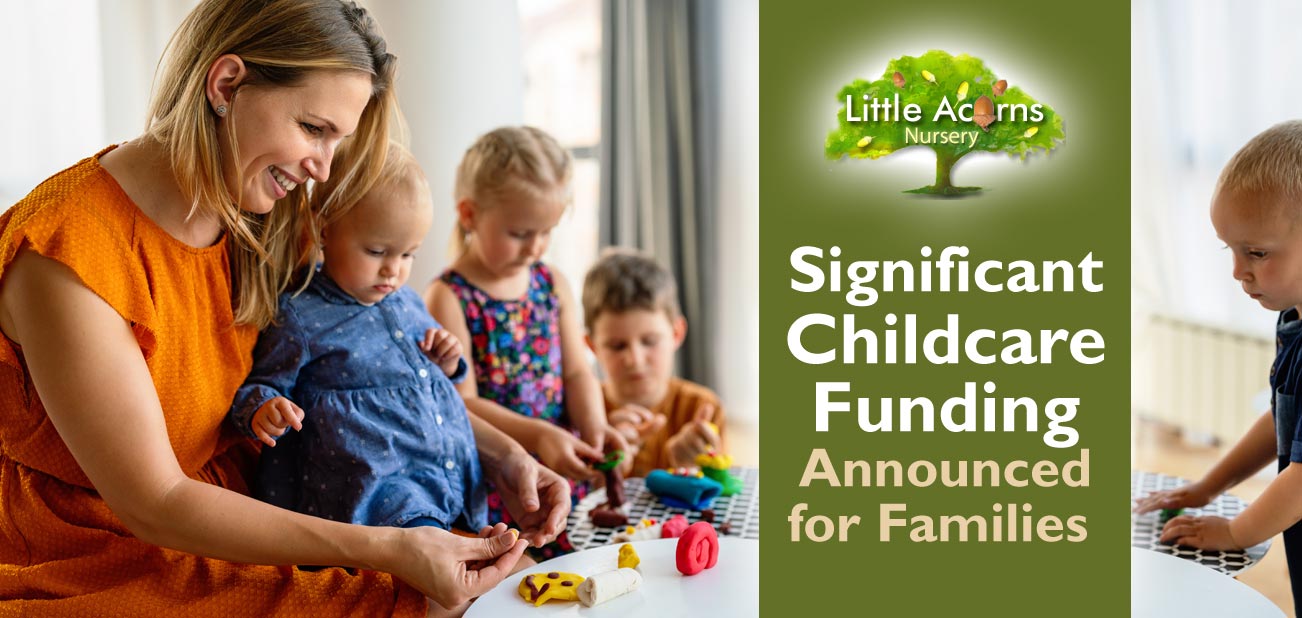
 parents to return to the workplace sooner after the birth of their child if they so choose;
 children aged 2 from eligible working families will be able to claim 570 hours of free childcare each year. This is typically taken as 15 hours of free childcare each week over 38 weeks, although exactly how it’s taken may be agreed otherwise between the family and the childcare provider.
 Until now, 87% of those eligible to claim childcare support through Universal Credit were not doing so. One of the main reasons for this was that it’s geared towards low-income families yet required them to pay childcare fees in advance — and later claim them back. Paying in advance is not so easy when household income is low, as is typically the case for households that would otherwise be eligible. For this reason, another of the Chancellor’s initiatives announced in the Spring Budget 2023 is to roll out the following improvements:
 The final childcare-related initiative in the Chancellor’s Spring Budget aims to fix another key problem for parents: how to juggle their own longer working hours with their child’s shorter school hours. When a child attends school, they often finish their school day several hours before their parent is finished at work, for example. There is therefore a childcare requirement to bridge the gap and this may be required both at the start and end of the child’s school day. In view of this, the Chancellor announced the piloting of a new Wraparound Pathfinder Scheme, which would fund childcare hours from 8 am until the start of the school morning and, later in the day, fund childcare for the mismatched afternoon hours up to 6 pm. The pilot will test the scheme to see how well it works. If successful, the Chancellor aims to roll it out to the whole of the UK from September 2024.

 Are you are a parent or carer of a child under five? If so, you could learn a lot about childcare, parenting and early years learning and development by following Little Acorns Nursery on social media. We’re active across multiple social channels including Twitter, Facebook, Pinterest and Instagram and share high quality content useful to parents of under-fives. That includes parents of children at Little Acorns although, actually, parents anywhere will find the content educational and useful. Our high quality content includes unusually informative ‘early years’ articles and information. For example, a whole range of guides, the findings from various studies, suggested activities for kids and overviews of things like childcare funding schemes with eligibility guidelines. Also, of course, the social media channels include posts relating to the exciting activities happening at the nursery in Clayton-le-Woods, Chorley.
 Follow Little Acorns Nursery on Twitter. There, you’ll see links to some great topics that relate to early years education. You’ll also see regular tweets and posts showing the exciting play and activities that children are taking part in at the nursery.
 On Facebook, we share our ‘bigger’ guides and articles from
  We love Pinterest! Its simple, pictorial approach makes it easy to just pick out something that interests you and save it to your own Pinterest pin board, so you can simply save it or share with others. We’ve got lots of pin ‘boards’ on our Pinterest profile, where we’ve pinned images and links to articles that interest us as early years practitioners. We think you’ll like them too. Board topics include nature activities, sensory activities for under-5s, early years parenting, Forest School, outdoor play, preschool, nursery school activities and, of course, Little Acorns Nursery itself.
 If you’re on Instagram, check out our photo gallery on our own Instagram profile. It shows images of the children playing and learning at the nursery as well as featured images that link to our highly interesting blog posts.
 Little Acorns Nursery is @LittleAcornsNurseryChorley on Google and;
 If you have used our childcare service and were pleased, please
  We’re active here on our Little Acorns blog too. Here, you’ll find larger articles that tend to cover the ‘bigger’ topics that parents and carers of children under five will find useful. These are well-researched, detailed and often very educational articles that will keep parents well-informed. For example, we cover topics like

 Today, we look at how early years childcare providers like Little Acorns Nursery can help children under five if they have special educational needs and disabilities. This is often referred to as ‘SEND’ or in longer forms like ‘SEN and disabilities’. Let’s explore the topic to get an overview of some of the help available.
 Actually identifying an area of special need or disability is, of course, the first, crucial step in being able to help a child. If an area of special need is suspected, early years providers can work with parents and sometimes other professionals, for example health visitors, speech and language therapists, paediatricians and so on. Involving such professionals will help with any diagnosis.
 This is important. Early years providers can create an inclusive environment that welcomes and supports children of all abilities. Encouraging the inclusion of children in social groups and in the making of friends, for example, is of huge benefit to children’s well-being. Childcare settings can also provide special equipment or adapt the environment to make it more accessible for children with specific physical needs.
 Early years providers like Little Acorns Nursery adapt the individual learning and development plans and activities to suit each child. In this way, they’re custom-designed to meet the needs of every child individually, including those with special needs. This is done as a matter of course as part of
  Later, each child will similarly have an ‘EYFS profile’ completed during the final term of reception year. However, as we’re focusing this article on children under five, we’ll not go into detail about that here.
 It may be useful for parents and carers to note that local authorities have a duty to publish what’s known as a ‘Local Offer’. This outlines the help available in the area for children with SEND, including how to access that support.
 One of the first challenges when considering childcare for your little one is how to fund it. If you’re an affluent family, then great. However, if childcare costs will be a more significant hurdle to overcome, the good news is that there are lots of options available. Either way, it will help to be well-informed about the various childcare funding schemes on offer from the Government. There are quite a few of them and some are extremely generous and surprisingly easy to obtain. Today’s Quick Guide to Childcare Funding Options in England will give you an at-a-glance overview of what’s available, the key eligibility criteria and how to apply. Note, though, that they generally fund in-person childcare only from approved providers (like Little Acorns). Take a look at the many options …
 You’ve no doubt heard of, or read about, childcare ‘vouchers’. They sound great, but what are they and how do you get them?
 Tax-Free Childcare is a great scheme which, in contrast to childcare vouchers, is widely available to working families — even for those with relatively high earnings.
 Certain 2-year-olds are eligible for 15 hours of free childcare each week, through another Government scheme. This one is to help primarily those families on benefits.
 3 and 4-year-olds in England are very well catered for when it comes to free childcare funding. This is aimed to help them receive that all-important early years education and to help those parents wishing to return to the workplace.
 Tax Credits specifically for childcare are only available to existing claimants under the scheme, through ‘Working Tax Credits’. New claimants should instead refer to the ‘Childcare Funding through Universal Credit’ section below.
 For those who are eligible, this is quite a generous scheme that allows them to reclaim* as much as 85% of their childcare costs. The maximum available, however, is £646.35* each month for one child, or it’s £1108.04* for more than one.
 This is a grant that does not need to be repaid and is in addition to any undergraduate Student Finance.
 Learner Support is a type of financial support designed for students who are suffering financial hardship. It can be used to fund childcare for eligible students who are also parents.
 Care to Learn may suit if you are a parent who is not yet 20 and are studying on a publicly-funded course, although see caveats below.