


Tag Archive for: Lancashire

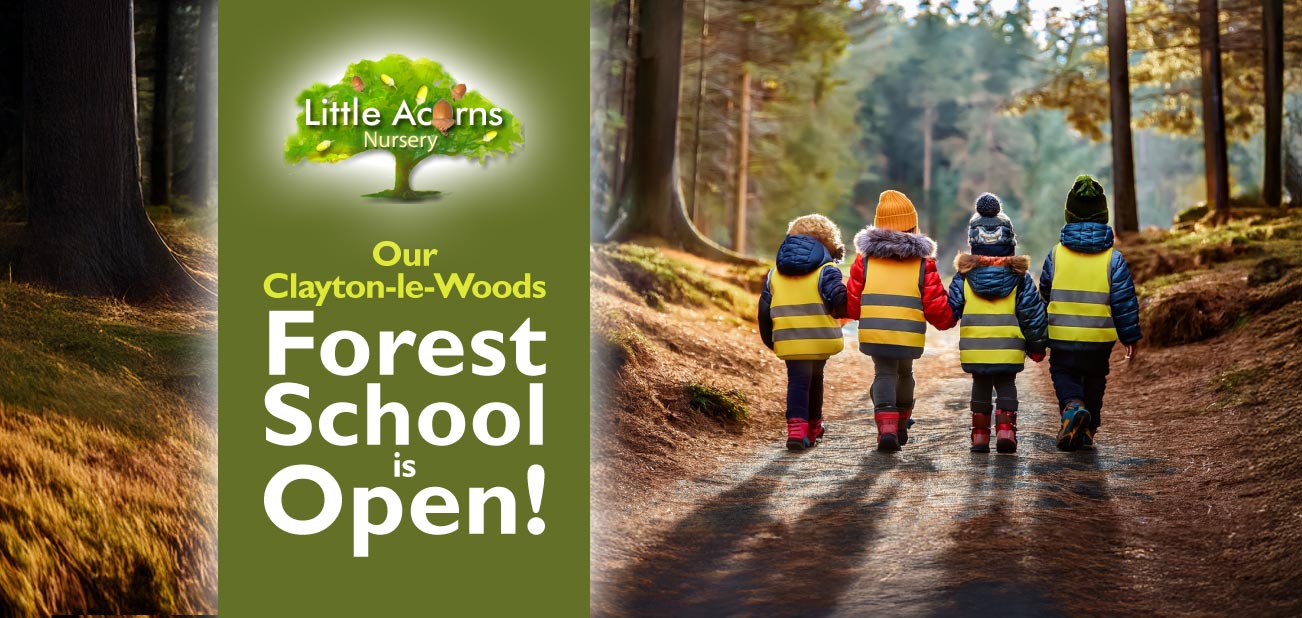
Our Clayton-le-Woods Forest School is Open!

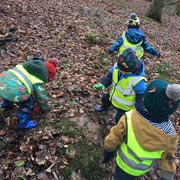
Our much-loved Forest School in Clayton-le-Woods re-opens from January 2026.We’re delighted to share some very exciting news: our much-loved Forest School in Clayton-le-Woods re-opens this January (2026). After dedicated staff training, careful preparation and thoughtful planning, we’re ready to welcome children back to outdoor learning — and we know it’s something they will be extremely excited about.
Forest School has always been an important part of who we are as a nursery. In fact, we are proud to have been the very first setting in the area to establish a Forest School, and it quickly became a highlight of the week for our children. Bringing it back now feels like a natural and meaningful step forward, rooted in the proven belief that young children thrive when they are given time, space and freedom to explore the natural world around them. Indeed, spending time in and around nature is profoundly beneficial to children.

A Natural Choice for Our Nursery & Children

Our childcare nursery is surrounded by local parks, green spaces and natural open areas, making Forest School a perfect fit.Our nursery is surrounded by local parks, green spaces and natural open areas, making Forest School a perfect fit. What’s more, nature is already part of daily life here, and Forest School will allow children to experience it more deeply and more intentionally. They are naturally curious and want to touch, observe, ask questions and make sense of what they see around them. Being outdoors opens up the enormity of the natural world to them. It gives them opportunities to notice changes in the seasons, discover plants and wildlife, better understand the circle of life, and their place in the world. It helps them develop a real sense of connection to their environment, and their power and responsibility over it. Those are all things that would be difficult to replicate indoors alone.

Safety First

This January’s re-opening follows comprehensive Forest School training for our team, alongside detailed preparation of activities, routines and risk assessments. Safety is, of course, always our top priority. Sessions are well supervised, thoughtfully structured, and designed to support exploration in a calm, nurturing, and safe way.

What Forest School Is All About

Forest School allows children to learn about nature, build new skills, learn to assess risks, and grow in confidence and independence.Forest School is a child-centred approach to learning that takes place outdoors and encourages children to explore, investigate, and learn about the natural world through hands-on experiences. Sessions are led by trained practitioners and are carefully planned to be age-appropriate for under-fives. They allow children to learn about nature, build new skills, learn to assess risks, and grow in confidence and independence.

Forest School isn’t about rushing or achieving a set outcome. It’s about giving children time — time to wonder, to try, to persevere and to feel proud of what they can do — all at their own pace.

Supporting Development, Confidence & the EYFS

Forest School teaches children so much about the world, and about themselves.Forest School offers rich opportunities for learning across all areas of the Early Years Foundation Stage. As children climb, balance, build, dig, collect and create, they naturally develop physical strength, coordination and problem-solving skills. They learn to communicate with one another, take turns, share ideas and work together, supporting social and emotional development in a meaningful context.
Being outdoors also supports children’s emotional wellbeing. Nature has a calming influence, helping children to regulate their emotions, build resilience and develop self-confidence. Whether a child is energetic and adventurous, or quieter and more reflective, Forest School offers something valuable for every personality and learning style.

Learning About Nature, Responsibility & Our Place in the World

Spending regular time in nature helps children build an understanding of living things — plants, animals and insects — and how they all play a role in the world around us. Through observation and gentle guidance, children begin to develop empathy and respect for flora and fauna, learning that all living things need care and consideration.

Forest School also supports early understanding of responsibility towards the environment and one another. Children learn that their actions matter, helping them develop a sense of stewardship for the planet and a growing awareness of their own place within it. Such early experiences lay important foundations for values such as kindness, responsibility and respect.

Forest School Beyond the Woodland

Little Acorns Nursery ensures that children have Forest School resources and activities both outside and indoors.Forest School is not limited to time spent outdoors for children at Little Acorns Nursery. The Forest School approach is also reflected throughout our nursery environment, both indoors and in our garden and grounds. Natural materials, open-ended resources and opportunities for exploration are woven into everyday play, allowing children to continue their connection with nature — whether indoors or outside.
This consistency helps children feel confident and supported, reinforcing learning and curiosity across multiple areas of the setting.

Discovering Nature in Every Season

Re-opening Forest School in January means children will initially experience the unique magic of nature in winter. Frosty mornings, muddy puddles, bare trees and changing weather all offer rich learning opportunities that will inspire meaningful — and often profound — conversations. Forest School is a year-round experience, though. So, as the seasons pass from winter, through spring and summer into autumn, each will bring new discoveries and moments of wonder to the children in our care.

A Special Part of Nursery Life

Offering Forest School reflects our commitment to high-quality, thoughtful early years practice.For families already with us, Forest School adds another enriching layer to the care and education your child receives. For those considering joining our nursery, it’s one of the many reasons we believe our setting offers something truly special. Being able to offer Forest School — especially as a nursery that pioneered it locally — reflects our commitment to high-quality, thoughtful early years practice.


After all, childhood is about curiosity, connection and discovery — and there is no better place to begin than in nature itself. Learn more about Forest School in our ultimate guide here.

Contact Little Acorns Nursery

Clayton-le-Woods, Chorley

Little Acorns Nursery, Clayton-le-Woods, ChorleyLittle Acorns Nursery is rated as a 'Good Provider' by Ofsted.The whole team at Little Acorns Nursery is incredibly excited to see Forest School come back to life this January. We can’t wait to watch our children grow, learn and flourish outdoors once again. If you’d like to find out more about Forest School or our weekday childcare services for under-fives, contact us, speak to our team, or come and see us; we’ll be delighted to tell you more.

Little Acorns is a childcare nursery in Clayton-le-Woods, Chorley, but may also suit families living close by, for example, in Clayton Brook, Clayton Green, Bamber Bridge, Lostock Hall, Penwortham, Buckshaw Village, Thorpe Green, Pippin Street, Whittle-le-Woods, Farington, Euxton, and Leyland.

15 Fascinating Facts About Babies

Human babies are incredible. Indeed, the more we learn about them, the more we realise just how incredible they are! Not only are they little bundles of joy that have evolved in less than a year, but they also conceal some amazing secrets. Did you know, for example, that babies have gills (kind of), fur and a tail during their development in the womb — and that they have three times more taste buds than adults when they’re first born? In today’s article, we explore some fascinating baby facts that surprised us — and may surprise you! Take a look.

We Remember Nothing Before the Age of 3

Scientists are not completely sure why, but none of us tend to have memories that go back beyond the age of three. Can you recall anything from when you were 2 or 3 years old? The vast majority of us can’t, and it is believed to be because of two possible reasons. One possibility is that we can’t remember our earliest years because the memory system in our brains was not developed enough at that time. The other possibility is that it’s because memory could be tied to language, and our language skills were not sufficient to store memories until the age of three. It could also be a mixture of the two, perhaps.

Newborn Babies have Heart Rates Twice as Fast as Adults

Newborn babies have a heart rate of somewhere between 120 and 160 beats per minute. That’s around double that of adults!

4.44 Babies Are Born Every Second!*

Every second, an average of 4.44 new babies are born around the world*. That’s about 266 babies per minute and almost 16,000 per hour. On a daily basis, it works out to over 383,600 new babies per day and about 140 million every year. The world population is currently growing at a rate of 0.9% annually.

The Birth Rate in England & Wales is Falling

In England and Wales, 591,072 babies were born in 2023 according to the latest Office for National Statistics (ONS) data(¹). That is the lowest birth rate for the region since 1977, as well as being the first time the rate was below 600,000 since 2002. Indeed, women in England and Wales give birth to an average of just 1.44 children over their lifetimes in the latest data, which is the lowest on record.

September is the Most Popular Month for Baby Births

September remains the most popular month for births in England and Wales, according to the same ONS data. The most popular day for births was 28 September, a date that has been in the top ten days for births since 2021.

Boxing Day Has the Lowest Birth Rate

Boxing Day, 26 December, has the lowest birth rate for the whole year, according to the ONS. What’s more, this has been the case for 11 years in a row!

Parents Are Getting Older When Babies Are Born

Data analysed by the ONS over the last 50 years shows that, for babies born in England and Wales, parents are gradually getting older. In the last count (for 2023), a new baby’s father was, on average, 33.8 years of age, while mothers were 30.9.

Over Half the World’s Babies are Born in Asia*

Almost 53% of births happen across the continent of Asia, 30.7% across the African continent, 10.7% in the Americas and just 0.7% in Oceania. That compares to 5% of births that occur in Europe.

Babies Have Gills in the Womb (Kind of)

There has been much debate about whether foetuses — developing babies — have gills when they’re in the womb. The answer is ‘kind of’ according to many experts, including the late Dr Michael Mosley/BBC(). While they do have tiny gill-like folds called pharyngeal arches, which may be evidence that humans evolved from fish, they are not gills in the true sense of the word. The so-called ‘gill slits’ can be found on the foetus’s neck in the very early stages of development, but are not for breathing. Instead, the structures migrate and evolve into the top lip, palate, and jaw of the baby.

Human Foetuses Have Tails

In the early stages of development in the womb, human foetuses have tails, which even have vertebrae. However, around the 7th and 8th week of gestation, those vertebrae fuse together, and the tail disappears, leaving only the ‘tailbone’ or coccyx that we’re all born with.

Babies Grow Fur in the Womb

Lanugo is a soft, fine, usually colourless body hair that’s grown by babies in the womb and that eventually covers the baby’s whole body. In tandem with the creamy covering of vernix caseosa that babies are born with, the Lanugo fur’s purpose is to help protect the developing child and help regulate its temperature. Developed from about the 14th week and visible on the foetus’s skin from the 21st week of pregnancy, it is usually shed by about week 35, before birth. It is replaced by vellus hair, which is commonly known as ‘peach fuzz’ on newborns. That said, up to 30% of babies are born with lanugo hair still evident somewhere on their bodies, and this is especially true for premature babies. (Source).

Babies Have 3 Times More Taste Buds Than Adults

Did you know that newborn babies have three times more taste buds than adults? It’s true! Newborn babies have around 30,000 taste buds, whereas adults have no more than 10,000. However, in a newborn, the taste buds are distributed not only over the tongue, but also the palate, throat lining, and tonsils. It is thought that this helps them better identify advantageous foods over potentially toxic ones. That said, the number of taste buds gradually reduces as the infant gets older, eventually being present only on the tongue, as with adults.

Babies Have Almost 50% More Bones Than Adults

Similarly, babies are born with many more bones than adults. It may surprise you to learn that a baby has 300 bones in their body when born, whereas an adult has only 206. As they mature and grow, however, some bones in children fuse together to form single bones. A great example of this can be found in the human skull, which, in babies, consists of several separate bones which, come adulthood, have fused together into a single bone. It is through this kind of process that humans reduce the number of bones in their bodies by almost one-third.

Babies Do Not Cry Tears When First Born

We all know that a baby’s first cry is an important milestone and one that signals that the child is breathing. However, not all of us may notice that most babies do not cry actual tears during the first part of their infancy. That’s because their tear ducts — or lacrimal glands — are not yet fully mature. As such, it may be several weeks or even as long as 2 or 3 months before normal tears are evident when a baby cries. Premature babies usually take the longest to exhibit full tears when crying.

Babies’ Brains Double in Size in the First Year

During the early years, a child’s brain grows rapidly. In the first year alone, babies’ brains double in size and, by the time they’re three, are already four-fifths the size of an adult’s. By the age of five, they’re usually nine-tenths the size of an adult’s brain. That said, traditional wisdom suggests that the human brain continues to develop right into a person’s mid-twenties. However, some experts now believe that some areas of the brain continue to mature right into the thirties.

We hope you found today’s list of fascinating baby facts interesting. We may follow up with another set of fascinating baby facts in a future post, so watch this space!

High-Quality Childcare in Clayton-le-Woods

Little Acorns Nursery: a first-class weekday childcare service for Under-5s near Chorley

Little Acorns Nursery, Clayton-le-Woods, ChorleyLittle Acorns Nursery is rated as a 'Good Provider' by Ofsted.Little Acorns Nursery provides families with a first-class childcare service in Clayton-le-Woods, Chorley. We have a Good Ofsted rating and support free childcare funding schemes for eligible working families with children as young as just 9 months of age. Little Acorns represents a fabulous choice for weekday childcare, which we provide for babies and children under five. Contact us today to apply for a nursery place or to learn more — we’d love to hear from you.

Located in Clayton-le-Woods, Little Acorns Nursery will also be conveniently close for families in Clayton Brook, Clayton Green, Thorpe Green, Pippin Street, Buckshaw Village, Whittle-le-Woods, Farington, Bamber Bridge, Lostock Hall, Euxton, Leyland, and Penwortham.

* (Correct at the time of writing — 12 December 2025 — according to the Live Birth Counter).

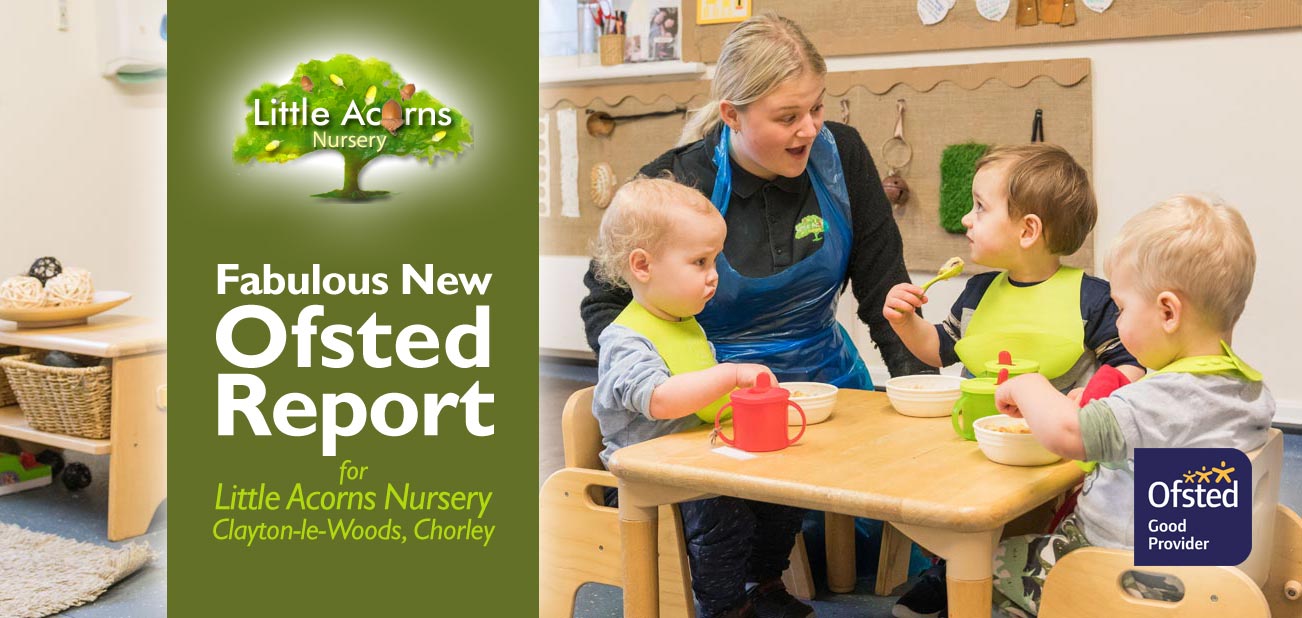
Fabulous New Ofsted Report for Little Acorns Nursery, Clayton-le-Woods, Chorley
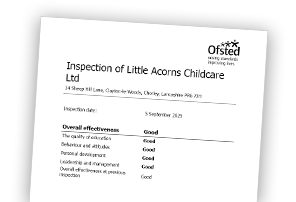
A fabulous new Ofsted report is out for Little Acorns Nursery, Clayton-le-Woods, Chorley. Published on 30 September 2025, it follows an inspection earlier that month. Parents and local families will be delighted to learn that, once again, Little Acorns Nursery was rated as ‘Good’ across all categories. That’s a high rating for overall effectiveness, the quality of education, the behaviour and attitudes of those attending, the personal development of staff, and the quality of leadership and management at the setting. A clean sweep! It’s news that will instil confidence in families that are considering enrolling a child at the nursery, and a clear demonstration that little ones who attend will benefit enormously — and be kept safe.

“What is it like to attend this early years setting?”

“The provision is good” — Ofsted.

  • Ofsted's latest report (Sept 2025) rates Little Acorns Nursery 'Good' in every category.Overall effectiveness: Good
  • The quality of education: Good
  • Behaviour and attitudes: Good
  • Personal development: Good
  • Leadership and management: Good

Let’s take a look at some of the positive findings and encouraging comments from the Ofsted Inspector who prepared this latest report.

  • Children Feel Happy, Settled,
    Safe & Secure at the Nursery

    The Ofsted Inspector could clearly see that children at Little Acorns are happy and feel at home at the nursery:

    “Children are happy and settled at the nursery… Staff help children to learn important language, such as to describe their feelings. This helps children to feel safe and secure at the nursery.” — Ofsted.

    She later also remarked that staff “are responsive to children’s needs, feelings and moods” and “encourage children to express and say what they feel,” later concluding in the report that “Children’s well-being is supported effectively.”

  • A Positive Attitude to Learning

    As the Ofsted Inspector said in her report, “Children make good progress in their learning of the nursery’s curriculum”, and she recognised the positive approach to children’s learning at the setting:

    “Leaders are ambitious for children’s learning and development. They are clear about the knowledge that they want children to learn and why.” — Ofsted.

    And, with that in mind, it was clear to the Inspector that children’s learning and development are nurtured well by thoughtful and attentive staff:

    “Staff know the children well. They provide meaningful learning opportunities that build on children’s interests effectively… Children demonstrate a positive attitude to their learning.” — Ofsted.

  • Children’s Personal Development is Promoted Well

    Ofsted’s report also points out that children’s personal development is nurtured very effectively, resulting in them becoming independent and “confident in their own abilities.”

    “Leaders make certain that staff promote children’s personal development well. Children benefit from the many opportunities that staff provide to help them to become independent.” — Ofsted.

  • Help Making Friends

    The Ofsted Inspector also recognised the nursery’s positive role in helping babies and children socialise and make friends:

    “They develop important knowledge about how to make friends because of staff’s skilful help. Babies show curiosity and are inquisitive about others. Older children are confident when meeting new people.” — Ofsted.

  • Help Developing Physical Skills

    The way the nursery and its practitioners help children develop physical skills was also picked up in the latest Ofsted report. The Inspector sang the praises of the ‘thoughtful’ early years practitioners and the appropriateness of equipment:

    “The nursery provides plenty of opportunities for children to develop essential physical skills. For example, staff working with babies provide climbing equipment, such as low-level steps, for babies to explore how they can move their bodies. Staff working with older children provide them with access to large equipment, such as the outdoor slide and wheeled ride-on toys. Children delight in testing out how strong they have become because of the thoughtful help of the nursery.” — Ofsted.

  • Strong Safeguarding at the Nursery

    Ofsted’s inspector applauded the nursery’s “effective” safeguarding arrangements:

    “There is an open and positive culture around safeguarding that puts children’s interests first.” — Ofsted.

    She also recognised recent safeguarding enhancements. With regard to possible allergens, for example, she remarked:

    “The provider ensures that known allergies for children are identified, understood and managed well… It is now a nut-free nursery. Staff have attended relevant training and leaders have strengthened risk assessments.” — Ofsted.

    And, with regard to security, she noted the excellent measures in place:

    “The provider ensures that the premises are safe and secure […] additional locks and entrance bells have been added to the nursery’s external gate. Staff understand their responsibility to ensure that external doors are locked and that they adhere to the nursery’s risk assessments. Leaders ensure that children are adequately supervised. This ensures the safety of children.” — Ofsted.

  • Staff Recognised

    Another key area that Ofsted inspectors look at is staffing. For example, are staff happy, are they adequately supervised and managed by leaders, and are they given the opportunity to grow? Well, as the ‘Good’ ratings for ‘Personal Development’ and ‘Leadership & Management’ in this latest report testify, it was a resounding ‘yes’ on all counts. The Inspector recognised that the leaders ‘ensure the smooth running of the nursery’ and support the work of staff. She went on to report:

    “leaders ensure that supervisions for staff are effective and include opportunities to discuss individual staff’s training and development needs. Staff receive effective coaching from leaders that improves the quality of education that children receive.” — Ofsted.

Click here to view/download the September 2025 Ofsted Report for Little Acorns Nursery, Clayton-le-Woods, Chorley.

Little Acorns Nursery: a High-Quality Childcare Service in Clayton-le-Woods, Chorley

Little Acorns Nursery, Clayton-le-Woods, ChorleyLittle Acorns Nursery is rated as a 'Good Provider' by Ofsted.As the latest Ofsted report testifies, Little Acorns Nursery is a great choice if you’re looking for a high-quality childcare service in Clayton-le-Woods, near Chorley. We’re open virtually all year round, support funded childcare places for children aged 9 months to 4 years (inclusive), and give under-fives the best start in life. Contact us today to arrange a guided visit to the nursery, ask any questions, or enrol your child for a nursery place. We can’t wait to meet you!

Little Acorns is an award-winning nursery in Clayton-le-Woods, near Chorley, Central Lancashire, and may also represent a convenient choice for families living nearby in Clayton Brook, Clayton Green, Thorpe Green, Pippin Street, Buckshaw Village, Whittle-le-Woods, Farington, Bamber Bridge, Lostock Hall, Euxton, Leyland, and Penwortham.

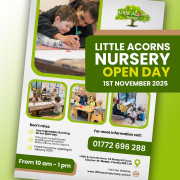
Little Acorns Nursery Open Day: Saturday 1st November 2025

Little Acorns Nursery is rated as a 'Good Provider' by Ofsted.Little Acorns Nursery is holding an Open Day on Saturday, 1 November 2025. We’ll be opening our doors to Lancashire families, so they can see this wonderful childcare setting in person. There’s no need to book — you are welcome to come along at any time between 10 a.m. and 1 p.m. What’s more, being on a Saturday, it should prove more convenient for working families. On the day, our team will be available for guided tours. We can show families the rooms, excellent facilities, and well-equipped outdoor areas, and answer any questions that you might have. Saturday is a non-working day at the nursery, so you’ll have our undivided attention. Why not bring your own child with you, so they can see the setting too — and get a feel for how well they would fit in? Come along — we’d love to meet you!

“A fabulous enabling environment, indoors and outdoors.”

Alert Alert

Come Along — And Save!

If you sign up for a nursery place on the day, we’ll waive the registration fee!

Nursery Open Day: Saturday 1 November 2025, 10 am – 1 pm

Little Acorns Nursery Open Day: Saturday 1st November 2025, 10 a.m. to 1 p.m.

Little Acorns Nursery, Clayton-le-Woods, ChorleyLittle Acorns is a wonderful childcare nursery at 34 Sheep Hill Lane, Clayton-le-Woods, Chorley, Lancashire, PR6 7JH. We are a convenient choice for families seeking high-quality childcare near Clayton Brook, Clayton Green, Chorley, Thorpe Green, Pippin Street, Buckshaw Village, Whittle-le-Woods, Farington, Bamber Bridge, Lostock Hall, Euxton, Leyland, and Penwortham. We operate virtually all year round, closing only for Bank Holidays and over Christmas/New Year. We support free/funded childcare places for eligible children aged from just 9 months— great for working families. Little Acorns Nursery is recognised by Ofsted as a Good Provider.

“Children are happy and settled at the nursery.” — Ofsted, September 2025.

‘Good Provider’ status from Ofsted (September 2025 report).
Government-funded childcare places are supported for eligible families.
A nurturing & enabling environment, inside and out.
Forest School re-opening in 2026.
Baby Massage and Baby Yoga sessions planned for 2026 — training already in progress!
5-Star Food Hygiene Rating from the Food Standards Agency (June 2025).
A purpose behind everything we do at the nursery.

“Children demonstrate a positive attitude to their learning.” — Ofsted, September 2025.

We’d love to show you our fabulous nursery and preschool on the 1st of November, so please come along anytime from 10 a.m. to 1 p.m. — we can’t wait to meet you!

Need More Information? Call 01772 696 288

Little Acorns Nursery, Clayton-le-Woods, Chorley - photographs showing activities with children and staff.

Composting for Kids — Educational Fun That's Perfect for Autumn

For children and under-fives, autumn is one of the most exciting times of the year.As the bright days of summer give way to crisp autumn air, parks, gardens, and pavements begin to fill with a carpet of crunchy leaves. For children and under-fives, autumn is one of the most exciting times of the year. With the landscape so full of textures, sounds, and colours, it’s the perfect time to get outdoors, explore, and learn about the natural world. It’s also the ideal time for them to begin a simple but deeply rewarding project: composting. In today’s post, we outline how children can approach this wonderful activity and explain its significant benefits.

Composting for Kids

Composting is a wonderful, hands-on activity that gives children an opportunity to enjoy the outdoors and connect with nature.Composting is a wonderfully simple, hands-on activity that provides children of all ages with an opportunity to enjoy the outdoors and connect with nature. It will introduce big ideas about recycling and responsibility in a child-friendly way, teach patience, and make good use of all those autumn leaves. Best of all, it’s fun, messy in all the right ways, and will lead to fascinating discoveries — from the changing smells of the compost heap to the tiny minibeasts that wriggle in to help the process along. Composting is also an activity that can be done with just a little guidance from grown-ups.

Why Composting is a Brilliant Activity for Little Learners

Spending time outdoors gathering materials will help children understand where natural resources come from and get them out in the fresh air, moving, playing, and making discoveries.Spending time outdoors gathering materials will not only help children understand where natural resources come from, but it will also give them valuable time in the fresh air, where they can move, play, and make discoveries. At this age, such experiences are vital for confidence and development. And because composting is a gentle, ongoing project, children can revisit it over weeks and months, and watch as nature slowly transforms what they collected into something new and incredibly useful.

Composting may at first look like a simple pile of garden scraps, but for young children it’s a treasure chest of learning opportunities. Through the activity, they’ll begin to see the cycle of life in action — how fallen leaves, apple cores, and even cardboard tubes can change and return to the soil. This sparks curiosity about science and the environment in a way that feels playful and natural.

Beyond the fun of collecting leaves and layering waste materials into the compost heap, composting offers a wealth of developmental benefits:

  • Beyond the fun of collecting leaves and layering waste materials into the compost heap, composting offers a wealth of developmental benefits.It encourages children to care for the environment and understand recycling in its most natural form.
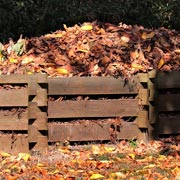
  • It helps them practise patience too, as they wait for their compost heap to transform. They learn to return regularly, check progress, and wait for the outcome — a valuable lesson for young minds.
  • It provides endless sensory play — the changing colours, the rustle of leaves, the smell of damp earth, and perhaps the feel of wriggling worms!
  • It gives them a sense of responsibility as they check on their compost and add new materials.
  • Spending time outdoors, especially in contact with nature, offers a myriad of benefits to children, including reducing stress, regulating mood, giving little ones a sense of achievement, and a confidence boost. Close proximity to nature has also been shown to improve academic grades! Follow the bold green link to learn more.
  • Composting can be scaled to whatever space you have available.Composting shows children how cycles work in nature — how things grow, fall, break down, and then help new life grow again. This is an early introduction to science and sustainability in action.

  • It builds vocabulary and boosts communication as children discuss what they’re adding, like “crunchy leaves,” and “soft apple peelings,” and describe smells, textures, and colours as the compost heap changes.
  • Collecting leaves, scooping soil, and turning the compost all involve gross and fine motor skills. For under-fives, these small but regular actions strengthen coordination, mobility skills, and confidence.
  • It’s also a surprisingly fun and satisfying activity for children — get your little one(s) to give it a try this autumn.

How to Get Composting

The good news is you don’t need a large garden or fancy equipment to begin. Composting can be scaled to whatever space you have available. A simple corner of the garden, a small patio or balcony, or even a large tub or bin can be turned into a child-friendly compost space.

List List

Step-by-step Composting with Little Ones

Composting could be introduced as a fun “nature experiment.” Here’s how you could explain and explore the process with a young child:

Step 1: Collecting Treasures

Step 1 is to gather leaves, twigs, and other natural treasures that will be suitable for composting.Head outdoors with a small bucket or bag and invite your child to gather leaves, twigs, and other natural “treasures.” Encourage them to notice the crunch, colour, and shapes of the leaves. Kitchen scraps can also be sourced from indoors, for example, apple cores, banana skins, and vegetable peelings from mealtimes.
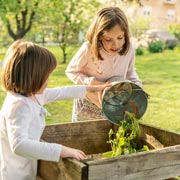
Avoid cooked food, meat, dairy, and oily scraps. These don’t break down well and could potentially attract pests.

Step 2: Layering

Step 2 is to tip the leaves and suitable kitchen scraps into your compost heap, bin or tub. Children will enjoy sprinkling, layering, and patting it all down.Show them how to tip the scraps into your compost heap, bin, or tub. Explain that the pile needs a mix of “green” (like fruit and vegetable peelings and grass cuttings) and “brown” (like dry leaves and cardboard) to work properly. Young children will enjoy the action of sprinkling, layering, and patting it all down. It’s a great moment to remind them that all living things eventually return to the earth — and through composting, they can see that process step by step.
Step 3: Adding Water & Air

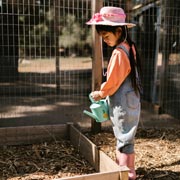
If the compost starts to dry out, let your child sprinkle a little water with a small watering can.Sometimes compost can dry out. You might therefore encourage your child to sprinkle a little water with a small watering can. Every few weeks, show them how to “stir” the compost gently, for example, with a small trowel or child’s spade — this lets in air and helps it break down.

Step 4: Observing Over Time

Composting is a brilliant opportunity to link to a Minibeast Nature Hunt activity. Grab your free minibeast poster, so your child can learn more about the helpful creatures they find.Encourage your child to check the compost regularly. Ask what they can see, smell, and feel. Over time, the compost heap will shrink and darken in colour. Your child may begin to spot minibeasts like worms, beetles, woodlice, and centipedes — all busy at work breaking down the compost pile. This is a brilliant moment to draw your child’s attention to our free Minibeast Nature Hunt activity and poster, so they can learn more about the helpful creatures they’ve found.
The Finished Product

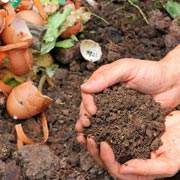
After a few months, the compost turns into a dark, crumbly, earthy material that's great for flowerbeds and potted plants.After a few months, the compost turns into a dark, crumbly, earthy material. This is the finished product, which is perfect for feeding plants. Involving your child in scooping and spreading it onto flowerbeds or into plant pots helps them see the complete cycle: from scraps to soil, and then back into growing things again. This is a lovely moment of achievement — through their endeavours, they have produced something valuable that will feed plants in the year ahead. It’s the perfect way to show children the cycle of seasons and how nature gives back when we take care of it.
The Long-term Value of Composting

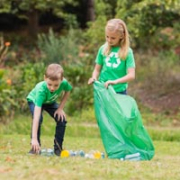
Activities like these can encourage children to live healthier lifestyles and care more about the world around them.By introducing composting at a young age, you’ll plant more than just seeds in the soil — you’ll plant ideas in your child’s mind. They’ll learn that waste can have value, that patience is rewarded, and that nature is full of tiny helpers working behind the scenes.


Such early experiences often form the foundation of a lifelong respect for the environment. More importantly, they’re fun, shared moments that children will remember — running through leaf piles, spotting their first worm, or proudly spreading their very own compost in the garden.

A Hugely Worthwhile Activity for Under-Fives

Autumn composting is a simple yet powerful activity for children under five. It combines outdoor play, sensory exploration, and gentle science, while teaching responsibility and care for the world around them. With a little guidance from parents and carers, children can enjoy months of discovery and end up with something genuinely useful for the garden.

So, as the leaves begin to fall this year, gather up a bucket, step outside, and let your little one’s hands (and imagination) get busy. Composting is nature’s recycling — and for young children, it’s nothing short of magical.

Your Childcare Nursery in Clayton-le-Woods, Chorley

Little Acorns Nursery, Clayton-le-Woods, Chorley

Little Acorns Nursery is rated as a 'Good Provider' by Ofsted.Today’s activity suggestion comes courtesy of Little Acorns Nursery in Clayton-le-Woods, Chorley. The award-winning Lancashire setting provides a high-quality weekday childcare service for children under five. It supports childcare funding schemes for eligible families, operates virtually all year round from 7:30 a.m. to 6:00 p.m., and has Good Provider status from Ofsted.

Get in touch today to explore the possibility of sending your baby, toddler, or preschooler to Little Acorns Nursery — we’d love to show you around, answer any questions, and enrol your child for a nursery place:

Little Acorns Nursery offers a convenient choice for families in and around Clayton-le-Woods, Clayton Brook, Clayton Green, Chorley, Thorpe Green, Pippin Street, Buckshaw Village, Whittle-le-Woods, Farington, Bamber Bridge, Lostock Hall, Euxton, Leyland, and Penwortham.

Attention Attention

Safety Notes for Parents & Carers

While composting is safe and fun, there are a few simple guidelines to make sure it stays child-friendly:

Always supervise under-fives and young children when foraging outdoors and adding or exploring the compost.

Provide child-sized gloves if they’re handling the compost heap directly.

Avoid letting children handle compost with sharp sticks or heavy tools. A small trowel or spoon is ideal.

Teach children to wash their hands thoroughly afterwards.

Make sure any container used has drainage holes to avoid soggy, smelly compost.

Gentle Ways to Handle a Toddler Meltdown

Tips for Tackling Toddler Tantrums — Gentle Ways to Handle a Toddler Meltdown

We’ve all witnessed a toddler tantrum and, sadly, they’re not pretty. Perhaps you’ve carefully prepared your child’s favourite lunch and set their plate in front of them. They take one look, fling the food away from them, and collapse with a wail that could rival a tone-deaf opera singer. Welcome to toddlerhood! It’s a time of wonder, growth … and occasional emotional meltdowns!

The good news? Tantrums are perfectly normal. The bad news? They can happen anywhere — at home, in the supermarket, on the bus, or in that quiet café you thought was your “safe place”. However, understanding why tantrums happen, and having a few tried-and-tested strategies to hand, can make all the difference.

Info-circled Info-circled

Why Do Toddlers Have Tantrums?

The part of the brain responsible for emotional control is still under construction when children are young, so they can easily become overwhelmed.In their earliest years, children’s brains are doing a phenomenal amount of developing. At this stage, little ones understand far more than they can express, and they’re learning to handle powerful emotions without the calm reasoning skills adults (mostly) have. The part of the brain responsible for emotional control is still under construction, so when they’re hungry, tired, frustrated, or simply want something right now, they can easily become overwhelmed. In short, they’re not trying to give you a hard time. They’re having a hard time.

“They’re not trying to give you a hard time. They’re having a hard time.”

Head Off a Tantrum Before It Starts

While not every outburst can be prevented, a little foresight can go a long way. Predictability is a toddler’s best friend, so sticking to a consistent routine can reduce meltdowns. Transitions, such as leaving the park or getting ready for bed, may also benefit from a bit of warning rather than surprising a toddler with a sudden change.

Choice can also be a powerful tool too. Simple, limited options (“Shall we wear the red jumper or the blue one?”) often help children feel some control over their day.

And, of course, let’s not forget the basics; a well-fed, well-rested toddler is usually a calmer one. So, keep an eye out for the early signs of tiredness or hunger, and act to rectify matters before things have time to escalate.

Stay Calm When the Storm Hits

Composure and empathy will help to calm a toddler tantrum.It’s not always easy as a parent, but your own composure is key. A calm, even tone and steady body language tell your child that you’re in control, even if you feel anything but. Also, try avoiding lengthy explanations in the heat of the moment — too many words can overwhelm an emotional toddler.

Safety comes first, though. So, if you’re out and about, make sure your child is in a safe space before you do anything else. Some toddlers respond best to a gentle, reassuring presence; others need a little space to work through their feelings. Either is fine, as long as they know you’re there when they’re ready.

Basket Basket

Example:

A Tantrum at Tesco

A toddler having a tantrum in a supermarket aisle.The nightmare scenario: You’re halfway down the biscuit aisle when your toddler takes an unhealthy shine to a chocolate-covered, sugar-filled snack that’s really not going to be good for them. So, you say no. They flop to the floor, wail at a volume that seems to fill the entire supermarket, and protest in a dramatic fashion that catches the attention of every shopper in the vicinity. Not only is your child in full, public, tantrum mode, but you’re also going to feel judged!

How to handle it with flair:

Keep your voice calm and your response consistent. Offer your little one a brief explanation without entering into a long debate (“We’re not buying that today, but you can choose between bananas or apples”). Show empathy and acknowledge the disappointment (“I know you really wanted that snack”), then gently redirect their focus. That could be achieved by inviting them to choose something else or by giving them a small “shopping job” like holding a loaf of bread. If needed, find a quieter spot to let them work through the big feelings before continuing your shop.

Help Them Learn From Big Feelings

When the volume drops and the tears start to slow, that’s your golden moment. Offer comfort — a cuddle, a hand on the shoulder, or just sitting quietly together. This is also a good time to put words to their emotions: “You were feeling really cross because we had to leave the playground.”

Labelling feelings not only shows empathy, but also helps your child start to recognise and manage those emotions in the future. Once calm is restored, praising their return to positive behaviour reinforces what you’d like to see next time.

Android Android

Example:

A Toy Tantrum

A young boy having a tantrum over a toy.Scenario: At home, your child sees their sibling or a friend playing with the toy they absolutely must have right now. They shout, try to grab the toy, and then the sobbing begins.

How to handle it:

Step in to keep everyone safe and calm. Use clear, simple language: “It’s not your turn yet. You can play with it when they’ve finished.” Offer a distraction by suggesting another toy or activity they enjoy. Once they’re calmer, talk about taking turns and how everyone gets a chance. Praise them when they do wait patiently, even if it’s just for a short time — that positive reinforcement will help for next time.

Look After You, Too

Repeated tantrums can be exhausting. If you need to and it’s safe for your little one to do so, step into another room for a few deep breaths, or take a short moment for yourself when help is available. Chatting to other parents can be surprisingly reassuring — nothing bonds people quite like swapping “you’ll never believe what happened in Tesco” anecdotes!

Thumbs-down Thumbs-down

Example:

A Tea-time Tantrum

A toddler having a tantrum about his dinner.Scenario: Dinner is served, and your child takes one look at the plate and decides it’s the worst thing that’s ever happened to them. Cue gesticulating arms, shouting and, in all probability, some dramatic sliding under the table.

How to handle it:

First, try to stay matter-of-fact — it will demonstrate that this is not a huge deal in the big scheme of things. Also, resist the urge to whip up a separate “peace-keeping” meal. Acknowledge your child’s feelings (“It’s okay not to be keen on everything”), and encourage them to try at least a small bite. It’s important to keep the mealtime atmosphere calm — power struggles over food often make the problem worse. If they refuse to eat, calmly remove the plate when the mealtime ends and offer a healthy snack later if needed. Ensure you’re consistent with this approach in the future.

A Final Word

Tantrums are not forever. They’re simply a stage in your child’s journey towards understanding themselves and the world around them. With patience, empathy, and a few practical strategies, you’ll navigate these storms together — and one day, you may even laugh about them!

Little Acorns Nursery, Clayton-le-Woods

A High-Quality Weekday Childcare Service Near Chorley, Central Lancashire

Little Acorns Nursery, Clayton-le-Woods, Chorley

Little Acorns Nursery is rated as a 'Good Provider' by Ofsted.We hope that today’s tips for taming toddler tantrums will be useful to parents and carers of under-fives. They’re all part of a normal childhood and, in any case, such meltdowns are usually just a short-lived phase. At Little Acorns Nursery in Clayton-le-Woods, Chorley, we’re familiar with such challenges and are always here for parents and families if any further tips and insights are ever required. So, ask away if you ever need a second opinion on ways to counter any challenging situations involving little ones.

If you’d like to explore a possible nursery place for your child at Little Acorns Nursery, please choose an option below:

Little Acorns Nursery is located in Clayton-le-Woods, Central Lancashire, so offers a convenient childcare choice for families near Clayton Brook, Clayton Green, Chorley, Thorpe Green, Pippin Street, Buckshaw Village, Whittle-le-Woods, Farington, Bamber Bridge, Lostock Hall, Euxton, Leyland, and Penwortham.

Summer Nature Hunt — a Fun & Educational Activity for Children (with Free Reference Poster!)

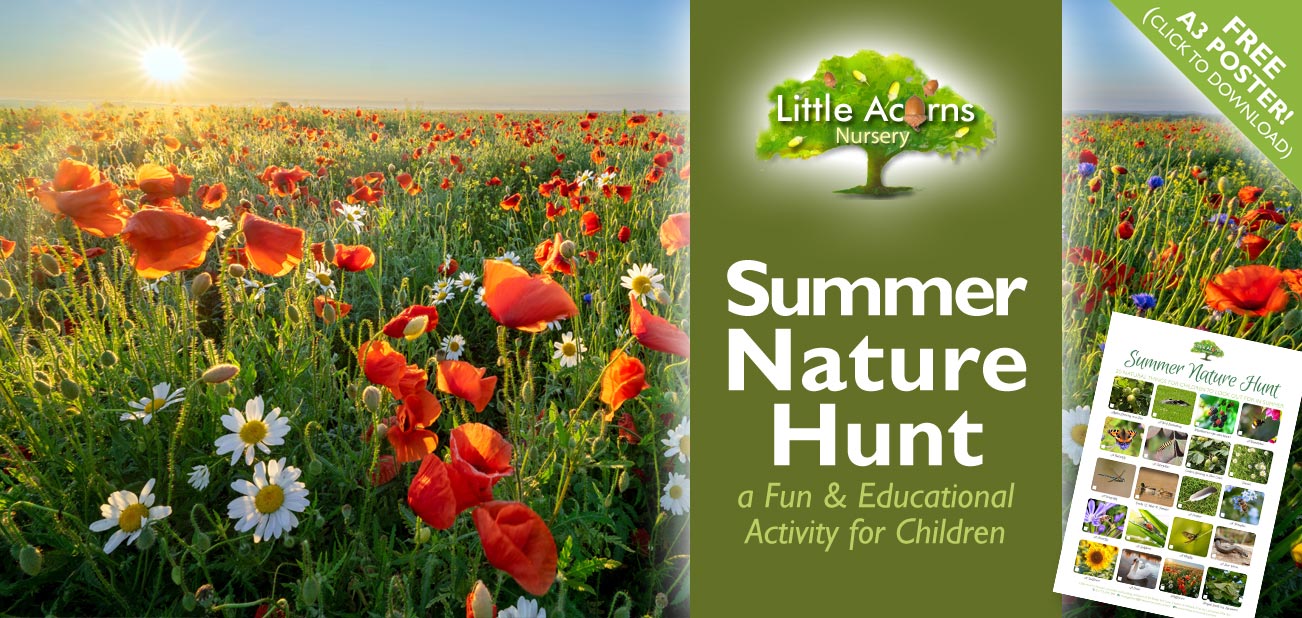
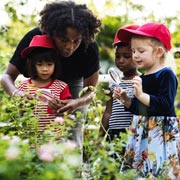
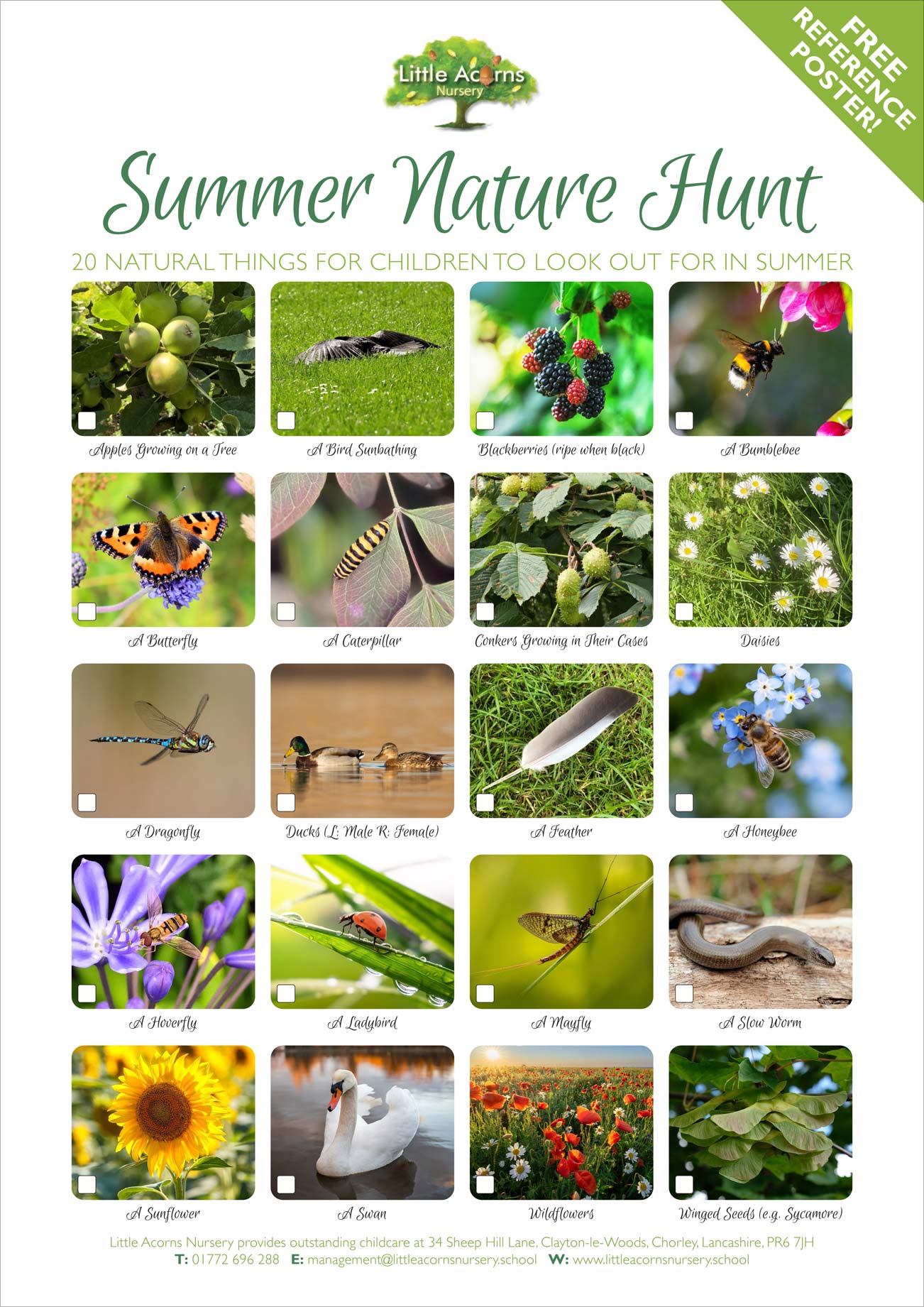
Summer is a wonderful time for children to get outdoors and our summer nature hunt is a perfect opportunity to do so.Summer is a wonderful time for children to get outdoors. There, they can breathe the fresh air, benefit from being closer to the natural world, and escape from electronic screens. Nature is incredibly good for children as well as adults (more about that later). A simple way to encourage little ones outdoors is to take them on an exciting and educational nature hunt! There are many fascinating things to look out for during the summer months including butterflies, caterpillars, bees, beautiful wildflowers and much more. A summer nature hunt will open their eyes and minds to the wonders of nature’s flora and fauna, lead to educational conversations with accompanying adults, and be an enjoyable and educational activity. Within all that in mind, we’ve put together a free Summer Nature Hunt poster that will give children and families an idea of what to look out for during the warmer months of summer — and serve as useful visual reference. The poster is free to download right here in this blog post (see below). Once printed out, it can be displayed large on children’s bedroom walls or taken along during the activity — perhaps reduced to a convenient size like A5. Children can use the little tick boxes to tick off each item that’s been spotted. So, venture out little ones — see how many wonderful things you can spot in the natural world this summer!

Venture out little ones — see how many wonderful things you can spot in the natural world this summer!

Eye Eye

What Children Should Look Out For

There are many wonderful things for children to look for in the natural world.Many of the adorable creatures featured in the poster will be easy to spot at this time of year. Bees, hoverflies, and other pollinators are common to see where flowers are blooming. Butterflies are both stunningly beautiful and at their most abundant during July and August each year, so are sure to delight children with their fabulous colours and patterns. Delightful ladybirds are also rather abundant right now (time of writing: mid-July). Wildflowers like poppies and daisies always make the world a more beautiful place, so they’re a wonderful thing for children to discover too.

There are a few other things featured on our free poster that children may find a little more challenging to spot. However, once finally seen, they will be the cause of much excitement and interest! For example, has your child ever seen a bird sunbathing? It’s quite a sight to see them lying still in a sunny patch, with wings outstretched, feathers ruffled and often with beaks open to keep cool — they can look quite comical!

Finding a meadow filled with wildflowers can be magical for children and adults alike.Has your little one ever seen apples growing on a tree? All that blossom from earlier in the year has now given way to little green apples that will grow and ripen as we head further into the year — eventually becoming ready to fall or be eaten come autumn. It’s a great example to show under-fives where some food comes from and explain why pollinators are so important.
Dragonflies are also quite a sight to behold closer to water sources like ponds. There, of course, supervising adults will need to stay closer and keep an even more watchful eye on children in order to keep them safe.

Has your child ever noticed that some kinds of seeds have wings? We’ve featured some winged seeds as the last item on our poster. Try finding a sycamore tree, a maple, or even a mature acer to find examples of winged seeds. If picked and launched into the air, children will be able to witness how a winged seed spins like a helicopter and floats gently away on the breeze. It’s a great lesson to demonstrate one of the ways in which nature spreads seeds far and wide, ready to grow into new plants and trees. Winged seeds are a great example of the wonder and inventiveness of nature.

An adult should, of course, always accompany and supervise children outdoors, particularly the youngest.We must also mention slow worms. Now we will be honest here: they’re quite a challenge to spot as they’re very shy and incredibly silent. They may hide in long grass, under grass cuttings, in the undergrowth, and in compost heaps. They are likely to come out only to warm themselves in the sunshine. That’s because they are essentially cold-blooded and legless lizards rather than any kind of snake. Children will have to be very lucky, patient, stealthy, or have deliberately made a wildlife-friendly garden if they’re going to spot a slow worm. However, their relative rarity is one of the many things that will make finally spotting one all the more exciting for children! One last note about slow worms: children must not try to pick them up by their tails (they are more delicate than they look and tails can therefore easily break, which would be very painful for the slow worm). It’s really best not to try to pick them up at all, but if children do, slow worms should be completely supported underneath, for example in cupped hands, rather than being suspended in any way. Release them back into the undergrowth so they’re not exposed to predators like rodents and birds. And, of course, children should wash their hands thoroughly with soap and water afterwards.
Download Your Child’s Free Summer Nature Hunt Poster

Click the preview image below to save or view the reference poster in Acrobat PDF format. It’s less than just 2MB in size. For best printing results, choose your printer’s highest-quality settings and paper.

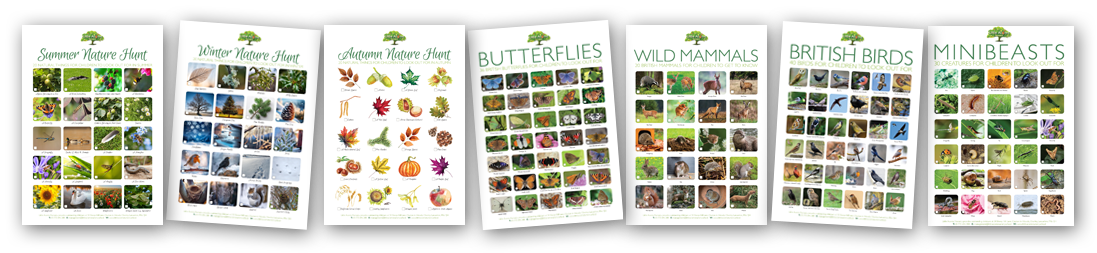
Here's what the Summer Nature Hunt poster looks like - click to view or download it in high resolution.

Spending Time Around Nature is Hugely Beneficial to Children

Studies have proven a myriad of benefits from nature including the development of lifelong greener values.As we said in the introduction, spending time in and around nature is incredibly beneficial to children of all ages. Studies have proven a myriad of benefits, in fact. Just a few examples include a lowering of stress and anxiety, improved motor skills, greater knowledge of the world (and children’s place within it), improved empathy for other living things, a feeling of greater responsibility for nature’s flora and fauna, a development of often lifelong greener values and choices, and even improved academic grades! These are just a few examples — the benefits of spending time closer to nature are incredible. Learn more about nature’s importance to children here.
Little Acorns Nursery: Quality Childcare in Clayton-le-Woods, Chorley

The best start in life for babies & children under five in Central Lancashire

Little Acorns Nursery, Clayton-le-Woods, Chorley

Little Acorns Nursery is rated as a 'Good Provider' by Ofsted.If you’d like your baby or child under five to have the very best start in life, consider Little Acorns Nursery in Clayton-le-Woods for your weekday childcare. We’re recognised by Ofsted as a good provider and also support free childcare funding for eligible children as young as just 9 months. With a warm and welcoming home-from-home environment, great facilities, and exciting outdoor gardens where children can get closer to nature, Little Acorns will bring out the best in every child and allow them to absolutely thrive in readiness for when they begin school.

Contact Little Acorns Nursery today to begin your child’s exciting nursery adventure:

Located in Clayton-le-Woods, Chorley, the nursery and preschool may also be a convenient choice for those living nearby in Clayton Brook, Clayton Green, Thorpe Green, Pippin Street, Buckshaw Village, Whittle-le-Woods, Farington, Bamber Bridge, Lostock Hall, Euxton, Leyland and Penwortham.

Safety Notice

It’s essential to accompany and supervise young children whenever they play or explore outdoors. Stranger danger, water sources like ponds and lakes, getting lost, traffic, poisonous plants, and toxic berries and fungi are all examples of high-risk hazards that adults will need to assess and mitigate if they’re to keep little ones safe from possible harm. Children need to be dressed appropriately too and use sunscreen to protect themselves from harmful sun rays when it’s sunny. These safety points are also great teaching opportunities, of course, because children will need to learn to recognise such dangers more and more as they get older and become more independent.

(Free ‘30 Hours’ Childcare Scheme for Eligible Working Families)

Don’t Miss Out on Free Childcare This September: Apply NOW!

Don't miss out on the free ‘30 Hours’ childcare funding scheme for eligible working families.In September this year (2025), free childcare for eligible working families expands to 30 hours per week for children as young as just 9 months. Little Acorns Nursery in Clayton-le-Woods is supporting the funding scheme too. Taken usually over 38 weeks* of the year, it means a generous 1140 hours of funded childcare will be available to eligible children in Central Lancashire over the course of a year. For the first time, the funding will cover eligible babies aged from only 9 months and children up to 2, the scheme having previously rolled out to eligible 3-and-4-year-olds last year. An urgent factor to be aware of, however, is that the funding application deadline is only weeks away for those wanting to start in the September 2025 term. So, whether you’re thinking of applying at Little Acorns Nursery or elsewhere, don’t delay your application any longer if you want to access the free funding from September. If your child is eligible and you do not apply by the deadline, your child will not be able to access the free funding for the entire September term. Read on to learn more about the new funding for eligible working families, the deadlines for applications, and the rules that apply.

Calendar Calendar

When is the Application Deadline for the September Term?

— & What if you Miss it?

The application deadline for September 2025 childcare funding is the 31st of August 2025. At the time of writing (late June 2025), that’s just a few weeks away. If you miss the August deadline, your child will not be able to access funding for that term even if, in theory, they had been eligible. You will then either need to pay for childcare during the September term or defer your funding application to the following one. That begins in January 2026 with an application deadline of 31 December 2025. Similarly, if you miss that deadline, you’ll need to cover childcare costs yourself or defer to the subsequent term, which will start in April 2026. The funding application deadline for the April term will be 31 March 2026.

Is Little Acorns Nursery, Chorley, Accepting ‘30 Hours’ Funded Applications?

Yes, Little Acorns Nursery in Clayton-le-Woods will be supporting the newly expanded free childcare scheme. That means we’ll be able to look after eligible Lancashire children, including babies aged from just 9 months, free of childcare costs for 30 hours* per week subject to available places.

† While the free childcare hours are funded by the government scheme for eligible working families, extras like the cost of trips, nappies, food/drink, and any additional hours are not usually covered. Ask your specific childcare provider for clarification.

Why is the Free Childcare Available?

The newly expanded childcare funding scheme for working families has several aims and stems from plans made originally during the Spring Budget of 2023. Although the governing party changed in the intervening time, the new Government has continued to support and implement the funding scheme. The main aims of the childcare funding expansion include:

  • The '30 Hours' childcare funding scheme helps eligible working families, their children, and the economy.Helping to make childcare more affordable for working families;

  • Helping children to begin their early years education earlier (this has been shown to significantly increase outcomes in studies);
  • Helping parents, particularly mothers, return to the workplace, or extend existing working hours, after having time off to look after a young child;
  • Helping the economy as a whole by filling job vacancies.

The scheme will save eligible families significant sums. With eligible children aged 3 to 4 having been able to access the ’30 hours’ funding since September 2024, this September’s further expansion will mean that eligible children will be able to access free childcare hours from 9 months right up until school age. Fabulous!

“Eligible children will be able to access free childcare hours from 9 months right up until school age.”

Is Your Child Eligible for the ‘30 Hours’ Funded Childcare for Working Families?

The main eligibility requirements are that the child’s parent, and their spouse/partner, if applicable, are each earning:

  1. the equivalent of the National Minimum Wage (or Living Wage) for at least 16 hours per week over the next 3 months and;
  2. no more than £100,000 per annum (current tax year).

Other rules and caveats apply but the above represent the two key rules for eligibility. Learn more here.

Pencil Pencil

How to Apply for Childcare Funding for Eligible Working Families

When to Apply

The application deadline for September 2025 childcare funding is the 31st of August 2025.You can apply for funded childcare for eligible working families as soon as your child reaches the age of 23 weeks (that’s just over 5¼ months). If successful, they’ll be able to start using their free childcare hours the term after they reach the age of 9 months. Depending on when that occurs, they’ll be able to start accessing the funded childcare from either the 1st of September, the 1st of January, or the 1st of April, with application deadlines for each being the day before.
Please note that there are other rules concerning when you can apply if, for example, you’re returning to work following maternity/paternity leave and similar, or you are starting a new job. Learn more here.

Where to Apply

To access childcare funding for working families, you’ll need to apply for it via your Childcare Account on the Gov.uk website. You can use that same link to create a Childcare Account if you don’t already have one. Have your National Insurance (‘N.I.’) number, your Unique Taxpayer Reference (‘UTR’) if self-employed/applicable, and your child’s UK birth certificate reference number at the ready when you apply. Confirmation of your application’s success — or otherwise — is usually immediate but may take up to a week in some circumstances.

Rocket Rocket

How to Access Your Free Childcare Hours

If your application for the ’30 Hours’ childcare funding is successful, you’ll receive a code to your Childcare Account. You’ll need to give the code to your chosen childcare provider along with your child’s date of birth and your own N.I. number. You will need to do so before the deadlines, which are explained in the information box near the beginning of this guide. So, as we said before, if you are applying for the September term, don’t delay — you must apply by the 31st of August or you will miss out on that entire term’s funding.

Is That Everything?

Not quite; you’ll need to reconfirm your details and eligibility every three months. You should do so via your Childcare Account. On success, a new code will then be provided via the account for you to pass on to your childcare provider.

Apply for a Childcare Place at Little Acorns Nursery

High-Quality Weekday Childcare in Clayton-le-Woods, Chorley, Central Lancashire

Little Acorns Nursery, Clayton-le-Woods, ChorleyLittle Acorns Nursery is rated as a 'Good Provider' by Ofsted.Little Acorns Nursery welcomes new applications for childcare places in Clayton-le-Woods, Chorley. We’re a highly-regarded nursery with a Good Ofsted rating and support many different childcare funding schemes for eligible families. As well as serving local families from Clayton-le-Woods and Chorley, we also represent a convenient choice for those in nearby locations like Clayton Brook, Clayton Green, Thorpe Green, Pippin Street, Buckshaw Village, Whittle-le-Woods, Farington, Bamber Bridge, Lostock Hall, Euxton, Leyland and Penwortham.

Get in touch today to explore a possible nursery place for your baby, toddler, or preschooler at Little Acorns Nursery. We’ll be happy to hear from you, show you around, and answer any questions. Get started via one of the following:

* The ’30 hours’ free childcare scheme usually covers 38 weeks of the year and a maximum of 1140 hours per year. Whether the free hours can be spread out a different way, for example using less than 30 hours per week but over more weeks of the year, will depend upon availability from your chosen childcare provider. Ask your provider about availability.

How to Create a Fairy Garden for National Children’s Gardening Week

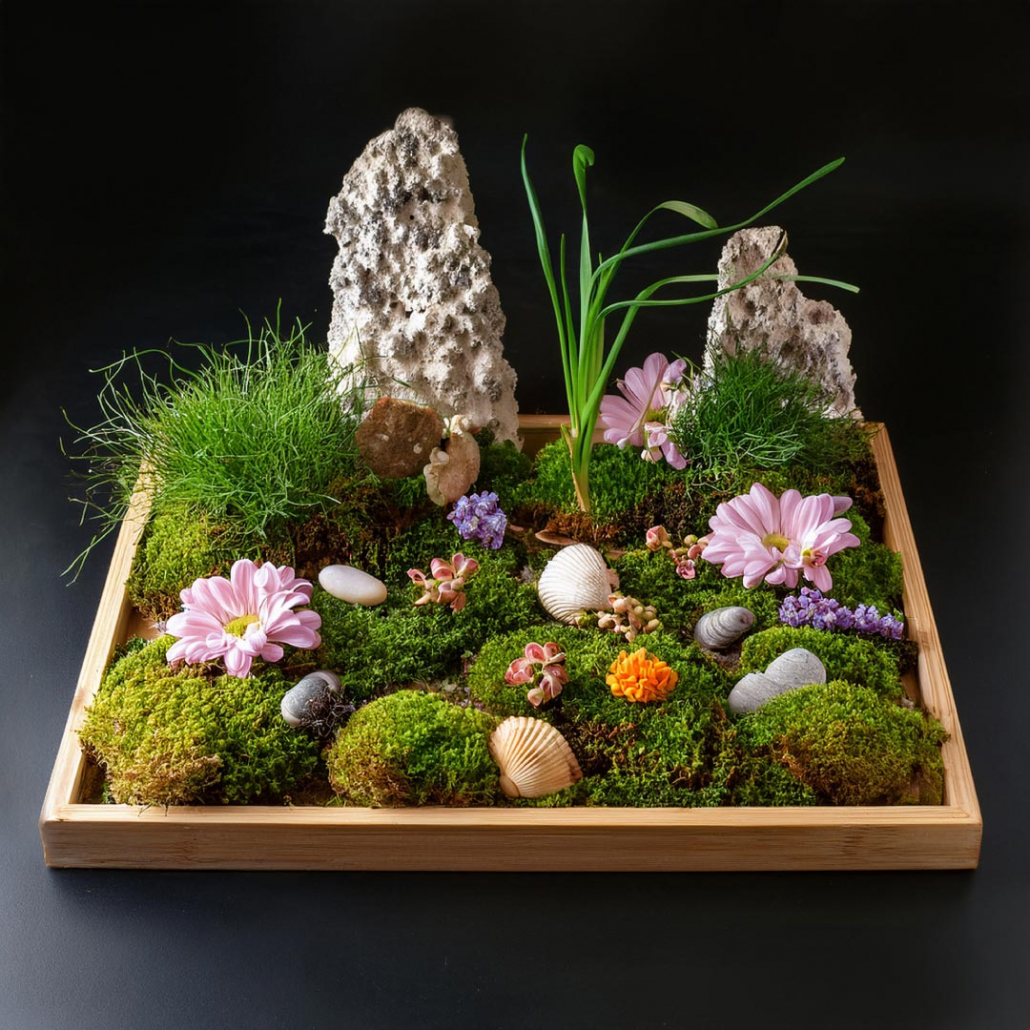
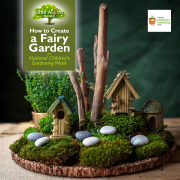
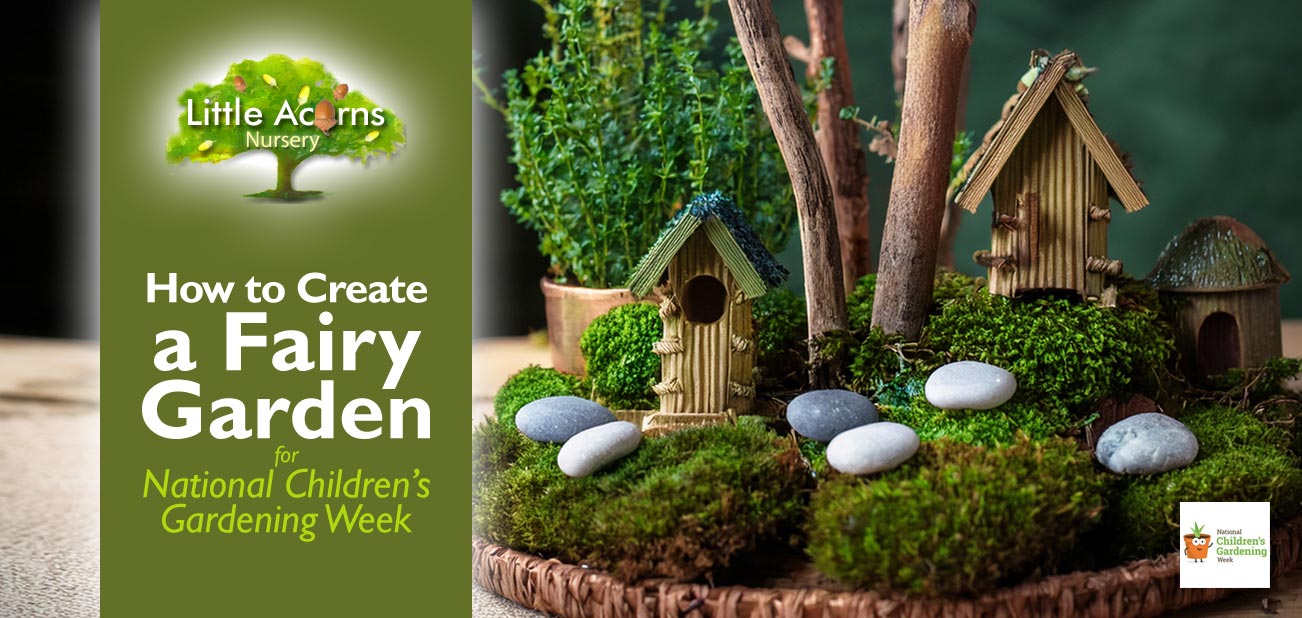
Today, we suggest a wonderful gardening-related activity that's perfect for young children.National Children’s Gardening Week arrives in late May and is the perfect time for young children to get involved in gardening activities. In celebration of the event, we describe a wonderful gardening-related activity that’s small-scale, easy, fun, and educational — perfect for little ones! The finished result is also rather magical and, once complete, lends itself to imaginative play. Today, we outline how children can make their own miniature fairy gardens. These are a great way to introduce little ones to creative gardening at a child-friendly scale. Under parent supervision* and largely using scavenged materials from outdoors, under-fives can let their imaginations run free and get creative! What’s more, the results are simply enchanting and will bring magic and a whole lot of delight to young children!
Take a look at some of the examples we show below and you’ll quickly see how enchanting the results can be. Shown are just a few of the many magical mini gardens that are possible using simple, natural, materials and a sprinkling of creativity. They are sure to inspire children to attempt their own fairy garden creations. Whether children call them fairy gardens, magical gardens, or mini gardens is up to them. Indeed, they may even think of them as mini kingdoms where imagined adventures are ready to unfold! This is a wonderful open-ended activity for kids that’s perfect for National Children’s Gardening Week. Enjoy!

When is National Children’s Gardening Week?

National Children's Gardening Week runs from the 24th of May to the 1st of June 2025.National Children’s Gardening Week begins on the 24th of May this year (2025) and runs until the 1st of June. The timing is no coincidence as it’s generally a warm week and therefore perfect for gardening and growing plants and flowers. What’s more, it also spans the half-term school holiday that most schools recognise in the last week of May.

The Aims of National Children’s Gardening Week

National Children’s Gardening Week is designed to inspire youngsters to get involved in gardening-related activities. It’s timed to arrive during a traditionally warm time of year when seeds, plants, and flowers grow fast. With such timing, they’ll see the fruits of their labour in a short space of time — sometimes literally! That’s great for little ones who may not have mastered the art of patience!

Gardening teaches children so much. Through gardening-related activities, they can spend time outdoors* in the fresh air and enjoy the many different benefits of spending time closer to nature. They’ll discover new skills and learn about living things, the world around them, and their place within it. Through such endeavours, they’ll better understand the circle of life and the need to care for living things. They’ll learn about taking responsibility, the importance of empathy, cause and effect, and so much more. It’ll also be fulfilling, enjoyable, and fabulous for their physical and mental well-being. Learn more about the benefits of spending time around nature for children here.

* (Appropriate adult supervision is essential for children, especially the youngest, when playing, exploring, and foraging outdoors. This includes the assessment and oversight of fairy garden assembly including age-appropriate component choices).

Fairy Garden Inspiration for Your Child

With that explained, let’s begin by showing 24 wonderful fairy garden examples to inspire you and your child. Click an image for a larger view and caption:

As you can see, each fairy garden is made almost entirely of natural materials that have been scavenged from the outdoors. Parents can help children find such things and, of course, supervision outdoors is paramount for young children. The types of materials that are perfect for making fairy gardens include:

  • Loose compost or sieved earth, which can be shaped to form the foundation of the fairy garden structure;
  • Different types of moss, some of which can be carefully laid onto the shaped earth or compost and used to represent grassy lawns and hills, while other types can represent bushes;
  • Small pebbles, which can represent footpaths, stepping stones, or even standing stones;
  • Medium-sized rustic rocks, which can be used to represent rocky outcrops, small cliffs, and focal points;
  • Small sticks and twigs, which can represent trees or be used for picket fencing boundaries or paths;
  • See shells, which are perfect for introducing a magical feel and can be used as attractive decorations;
  • Small pieces of driftwood from the beach, which can represent tree trunks and suchlike;
  • Tin foil to mould into miniature ponds, lakes or streams or to cover rocks that are used as magical features;
  • Small seedlings or picked flowers, which (under supervision) can be pushed into mossy mounds to add a bit of colour and beauty;
  • Small fir tree sprigs which, when placed vertically into mounded moss, will look like trees;
  • Plus other small props to add details that will appeal to a child, for example, a little wooden house that a child may already have in their toy collection. Other options are (when age-appropriate) miniature figures, small animal models, and so on. These are a great way to add characters to fairy gardens in readiness for the creation of stories and interesting adventure scenarios in the child’s play. They are the finishing touch that can bring the fairy garden to life!

How to Assemble a Child’s Fairy Garden

First, your child will need a small space in or on which to build the fairy garden. Although this could be a small, unused area in the garden, something more portable would be better so the fairy garden can be created somewhere convenient like on a garden table, on a raised flowerbed, in a potting shed, etc. A medium-sized flower pot filled three-quarters with soil, a shallow tin, a flat section of log, or a flat rock — as shown in many of the examples — would make perfect portable bases for mini gardens to sit on. A kitchen tray or seed tray could also be suitable as a base, particularly if the final creation will be housed indoors and children intend to water them to keep the moss and any plants alive.

TIP: Sometimes, it’s useful to get a head-start with the main base by choosing a log, flowerpot, or rock that already has some moss established. This saves time and also means the moss will hold more firmly from the outset. Be mindful not to harm any minibeasts living there though – teach kindness to little ones.

If starting from scratch, a little soil or compost needs to go on first to form the structural ‘landscape’ of the scene, shaped creatively to the child’s preference. Although a flat mini landscape will work, an undulating format will add extra interest to the final scene. For instance, children could shape this ‘foundational’ base to form a hillside, valley, or simple slope. Such things will eventually allow for intriguing details and picturesque focal points, particularly once covered in a thin layer of short moss to represent grass. Longer or more bulbous types of moss can be great for representing bushes, while fir tree sprigs make wonderful trees if stood on end and secured upright by pushing into the moss and underlying soil. A hillside with trees or bushes surrounding a miniature house will look fabulous as in some of the photo examples provided today. Lower levels may be perfect places to make ponds or streams. Once such foundations are in place, paths can be represented using carefully placed pebbles. For larger fairy gardens, children can consider introducing bigger components like standing stones, or rocks used to represent cliffs and rocky outcrops. Small seashells and even small flowers with stems pushed into the moss can be nice decorative touches to take creations to the next, beautiful level. Children can occasionally water the final creation to keep the moss moist, green, and alive.

The beauty of this activity is that children (and parents) can let their imaginations run riot! And, who knows; the activity could even lead to a life-long interest in model making and the creative arts! Children will love the finished result and can interact to create stories, different scenarios, and adventures using their wonderfully organic and magical scenes.

Support for the EYFS

Speaking of creative arts and crafts, this activity is also a great way to support the specific ‘Expressive Arts and Design’ area of focus within the Early Years Foundation Stage (EYFS) curriculum. It’s indeed the perfect opportunity to spark children’s imaginations and creativity and perhaps even result in some role-playing.

Another area of the EYFS that’s supported by this activity is ‘Physical Development’ as children will need to be dextrous in order to carefully place items like moss and other components within their fairy gardens. It will require fine motor skills and good hand-eye coordination.

‘Understanding the World’ is another area of the EYFS that’ll be well-supported by this activity. Children will learn more about nature, the world around them and some of its flora and fauna. And, if they decide to try to keep their fairy gardens alive through watering and perhaps even selective plant-growing, it’ll teach them important lessons about responsibility and the care of living things.

Have a wonderful time with your fairy gardens! They’re great fun, rather magical for little ones, and superb settings to use as focal points for imaginative play!

Nursery Places Available in Clayton-le-Woods, Chorley

Little Acorns Nursery, Clayton-le-Woods, Chorley

Little Acorns Nursery is rated as a 'Good Provider' by Ofsted.If you’d like your under-five child to get the best start in life in a first-class childcare setting near Chorley, consider a nursery place at Little Acorns Nursery, Clayton-le-Woods. Here, we understand just how important nature is to children and that’s one of the many reasons why Forest School was introduced to the setting. That’s along with a high-quality curriculum that brings out the best in every child, fabulous facilities indoors and out, and an enviable reputation for excellence. Ours is a home-from-home environment too, where children are part of the Little Acorns ‘family’ and first-class early years practitioners ensure they’re as school-ready as possible by the time they leave us. Free childcare hours are also available here for eligible babies and children aged from 9 months.

Contact Us Today

As a nursery based in Clayton-le-Woods, Chorley, we are also a suitable choice for families in Clayton Brook, Clayton Green, Thorpe Green, Pippin Street, Buckshaw Village, Whittle-le-Woods, Farington, Bamber Bridge, Lostock Hall, Euxton, Leyland and Penwortham.

Little Learners: Get Ready for World Bee Day!

World Bee Day is a wonderful opportunity for families and supervised children to get involved in something meaningful, fun, and full of learning opportunities.Little learners, get ready – it’s almost time to buzz into action for World Bee Day! The annual event arrives in May and it’s a brilliant opportunity for children and families to get involved in something meaningful, fun, and full of learning opportunities.

Bees are amazing little helpers, whether in gardens, parks or the countryside — but they need our help too! World Bee Day is a chance for children to discover the magic of these fascinating creatures, learn more about the natural world, and start to build early environmental awareness. They can get proactive too. Whether by planting wildflowers, spotting bees in the garden, or creating bee-inspired arts and crafts, even our tiniest learners can join in the buzz. Read on to learn more about this fun, educational, and hugely worthwhile event, which takes place each May.

World Bee Day

World Bee Day arrives on the 20th May every year.World Bee Day is celebrated every year on 20th May to raise awareness of the vital role that bees and other pollinators play in our world. From helping plants grow and supporting the food we eat every day, bees are some of nature’s hardest workers – and they need our help to survive and thrive.

People around the world mark the day by learning more about bees, planting flowers, protecting wild habitats, and sharing ways to care for the environment. Under appropriate supervision, there are lots of ways even the youngest children can join in too!

2025’s World Bee Day Theme:

2025’s World Bee Day theme is “Bee inspired by nature to nourish us all.”“Bee inspired by nature to nourish us all”

2025’s theme is all about how bees help feed the world, and how we can look after them by taking inspiration from nature. Without bees and pollinators, there would be no fruit, vegetables, crops, and nuts to keep us healthy. The message is simple: if we care for bees and their habitats, they’ll continue to care for us too by helping our plants grow and keeping the planet blooming.

Learn more about World Bee Day, its background and its aims here.

How World Bee Day Supports Early Years Learning

Getting involved in World Bee Day supports many areas of the Early Years Foundation Stage (EYFS) and helps children learn and grow in meaningful, hands-on ways.Getting involved in World Bee Day isn’t just fun — it also supports many areas of the Early Years Foundation Stage (EYFS), helping children learn and grow in meaningful, hands-on ways. Here are just a few ways bee-related activities can support early development:

  • Understanding the World: Through bee-related activities, children will learn about living things, the environment, and how everything in nature is connected. Exploring bees and their role in pollination helps little learners begin to understand the world around them — and how they can help look after it.
  • Communication and Language: Talking about bees, asking questions, listening to stories and learning new words (like ‘pollination’, nectar’ and hive’) builds vocabulary and encourages curiosity.
  • Young girl making bee crafts.Expressive Arts and Design: Making bee crafts, drawing flowers, role-playing as working bees, or moving like insects in a dance — all help develop creativity and imagination.
  • Personal, Social and Emotional Development: Caring for nature supports empathy and kindness. Group activities like planting or creating a bee garden also build teamwork and a sense of shared responsibility.
  • Physical Development: Activities like planting seeds, cutting out bee shapes, or painting flower petals develop fine and gross motor skills through playful, purposeful movement.

In short, World Bee Day is a brilliant opportunity for young children to explore the wonders of the natural world in a way that supports their learning across multiple areas, is fun, and makes a difference!

Bee-Themed Activities for Under-Fives

There are so many fun and simple ways for little learners to join in with World Bee Day!There are so many fun and simple ways for little learners to join in with World Bee Day! Here are a few activities that are perfect for children under five — each one encourages creativity, curiosity, and care for nature while also supporting the EYFS.

Plant a Pollinator Patch

Children can help plant bee-friendly flowers such as lavender, sunflowers, or wildflowers in a pot, bed or border. This not only encourages responsibility and care as they water and watch the plants grow but also supports the EYFS’s Understanding the World, Personal, Social & Emotional Development, and Physical Development goals.

Make Buzzy Bee Crafts

Children can use materials like paper plates, cardboard tubes, egg cartons and recycled materials to create their own bees!Using paper plates, cardboard tubes, egg cartons or recycled materials, children can create their own bees! Add wings, stripes, googly eyes and antennae for a hands-on creative session. These are wonderfully creative activities that will boost several areas of the EYFS including Expressive Arts & Design and Physical Development.

Bee-Themed Storytime

Snuggle up with stories that introduce bees in a child-friendly way. Great choices include The Very Greedy Bee by Steve Smallman and Jack Tickle, Bee: Nature’s Tiny Miracle by Patricia Hegarty, and What if There Were No Bees? by Suzanne Slade. Even better, encourage children to create their own stories involving bees! After storytime, don’t forget to talk about what bees do with your child and ensure they understand why they’re important. These are great activities to boost the EYFS’s Communication & Language, Literacy and Understanding the World focus areas.

Sing and Dance Like a Bee

The Bee Waggle Dance (video).Do you or your child know about the bee Waggle Dance? It’s a real dance that honey bees do to communicate the direction, distance, and quality of a food source to the rest of the bee colony. Click the video thumbnail to learn more — it’s absolutely fascinating! It’s also a great piece of knowledge to inspire children to buzz around the room with bee-themed songs, dances, and movement games. What’s more, it will help children in their EYFS goals including Physical Development and Expressive Arts & Design.

Go Bee-Spotting

A bee-spotting activity is a great opportunity to explore areas of the EYFS that include Understanding the World and Communication & Language.Explore the garden or outdoor space and, without disturbing them, see what pollinators your child can spot. Can they see any bees? What colours and flowers do they seem to like best? Are they collecting nectar? What type of bees are they? Bumblebees are super cute. Honey bees are super-hard workers and do so much for the world. A bee-spotting activity is a great opportunity to explore areas of the EYFS that include Understanding the World and Communication & Language.

Honey Tasting and Talk

If age-appropriate (never feed to babies under 12 months) and there is no allergy to it, let children try a small taste of honey. Then talk about how bees make it, and discuss where it comes from. You could even take this a step further by helping your child make a simple honey-based snack. For example, honey drizzled over pancakes or porridge oats — delicious! Such activities can help children focus on EYFS areas including Understanding the World, Communication & Language, and Physical Development.

These activities are designed to feel like play but, underneath, they’re packed with learning opportunities. What’s more, they help children build positive associations with the natural world and start to understand that even small actions can make a big difference.

Let’s Celebrate Bees on World Bee Day

World Bee Day is a chance to slow down and take a closer look at the tiny creatures that do such big jobs for our planet. It’s also a fantastic opportunity to help young children connect with nature, ask questions, and start to develop a sense of care for the world around them. Through simple, enjoyable activities, families can help raise awareness of the challenges bees and other pollinators face — from habitat loss to climate change. It’ll show children that even small actions, like planting flowers or spotting bees in the garden, can make a difference. So, get them buzzing while they explore nature, grow in confidence and curiosity, and learn that they too can help protect bees along with the wonderful world they’re a part of.

Nursery Places in Clayton-le-Woods, Chorley

Little Acorns Nursery, Clayton-le-Woods, Chorley

Little Acorns Nursery is rated as a 'Good Provider' by Ofsted.With our own gardens and outdoor spaces close by, children have lots of opportunities to explore and learn from nature at Little Acorns Nursery in Clayton-le-Woods. We know just how important nature is to children and it’s one of the many reasons we love introducing them to nature-based events, themes, and activities like those suggested in today’s post.

At Little Acorns Nursery, children have a wonderful start in life in a warm, caring, home-from-home environment where they feel safe, nurtured, and valued. Free childcare is available for eligible children from just 9 months of age. If you’d like to explore the possibility of sending your baby, toddler, or preschool child under five to this wonderful nursery and preschool in Clayton-le-Woods, Chorley, get in touch today. We’d love to answer any questions, tell you more, and show you and your child around the setting.

Contact Little Acorns Nursery

Families living nearby in Clayton Brook, Clayton Green, Thorpe Green, Pippin Street, Buckshaw Village, Whittle-le-Woods, Farington, Bamber Bridge, Lostock Hall, Euxton, Leyland and Penwortham may also find our nursery conveniently close.