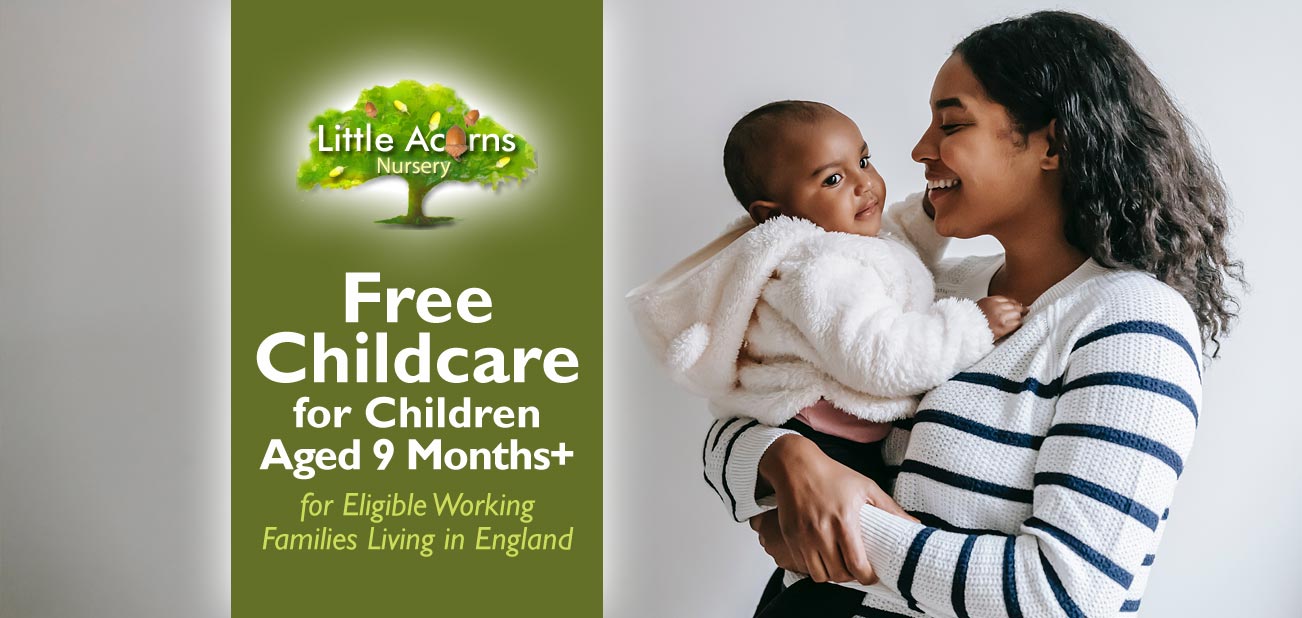
 With September 2024 arriving, eligible children aged as young as 9 months can now access free childcare in England. The new childcare ‘hours’ are available where working families are eligible for the support and, in tandem, where local childcare providers are set up with appropriate staffing ratios and capacity. The good news, however, is that Little Acorns Nursery, in Clayton-le-Woods, supports the new scheme. It’s therefore with great pleasure that we’re now beginning to welcome children as young as just 9 months of age for free childcare hours at the Chorley setting.
In today’s guide, we’ll explain who is eligible and how much free childcare they can access right now — and in a year’s time when the scheme expands further.
When Does the New Childcare Support Start?
The new childcare support began at the start of September 2024, so it is already available for eligible children. It will expand yet further in September 2025 and we clarify what that means below.
What Free Childcare Can Babies (9m +) & Children of Eligible Working Families Access?
 From September 2024 (so already active), eligible children aged from 9 months to 3 years of age can access 570 hours and eligible children aged 3 and 4 can access 1140 hours of free childcare support per year. The free hours are usually taken over the course of 38 weeks (equating to 15 and 30 hours per week respectively). However, some childcare providers may allow the hours to be spread over more weeks of the year by reducing the number of hours per week. Speak directly to your specific childcare provider about the availability of this more flexible option.
- From September 2025, eligible children aged from 9 months to 3 years will also be able to take 1140 hours of free childcare per year, again usually taken as 30 hours per week. As before, it may be possible to spread the hours out over a greater number of weeks of the year by reducing the number of hours taken per week. Again, speak with your specific childcare provider to see if that option is available if it’s of interest.
 From September 2024 (so already active), eligible children aged from 9 months to 3 years of age can access 570 hours and eligible children aged 3 and 4 can access 1140 hours of free childcare support per year. The free hours are usually taken over the course of 38 weeks (equating to 15 and 30 hours per week respectively). However, some childcare providers may allow the hours to be spread over more weeks of the year by reducing the number of hours per week. Speak directly to your specific childcare provider about the availability of this more flexible option.
Summary:
| Available Now | Available From Sept ’25 | |
|---|---|---|
| Eligible* children 9 months – 3 years | 570 hours (usually 15 per week) | 1140 hours (usually 30 per week) |
| All children 3-4 living in England (‘Universal Entitlement’) | 570 hours (usually 15 per week) | 570 hours (usually 15 per week) |
| Eligible* children 3 to 4 years | 1140 hours (usually 30 per week) | 1140 hours (usually 30 per week) |
* Subject to eligibility criteria outlined below. Additional charges may apply (e.g. for food/nappies – ask your provider if these cost extra).
Note that some 2 and 3-year-olds are also eligible for 570 hours of childcare funding under a different scheme where they fall into certain ‘additional needs’ categories or their parents receive qualifying government benefits. Today’s guide, however, focuses primarily on the more widely available scheme for eligible working families.
*Eligibility Criteria for Working Families
The free childcare scheme for children aged from 9 months to 4 years (inclusive) applies to children of eligible working families. But what constitutes an eligible working family? The following rough guide explains:
As a rough guide, to be eligible, both you and your partner (if you have one):
 Must not have an adjusted net income above £100k in the current tax year;
- Must each expect to earn at least the equivalent of the National Minimum Wage or Living Wage for 16 or more hours on average per week, over the next 3 months;
– for those aged 21 or over, this currently equates to £183 per week and £2,380 over 3 months;
– for those aged 18-20, it currently equates to £137 per week and £1,788 over 3 months;
– for those either under 18 or in an apprenticeship, it currently equates to £102 per week and £1,331 over 3 months;
Figures are before tax and are correct at the time of writing (September 2024) - Must have a National Insurance number;
- Must be applying, of course, for a child of the appropriate age for the scheme.
 Must not have an
 There are additional rules around specific scenarios, for example, for foster carers, those starting a new job, those whose earnings do not form a regular pattern, the self-employed, and those receiving one or more government benefits. Immigration status is also a factor. Learn more about the eligibility rules here.
“Some children from working families can now receive free childcare from just 9 months old until they begin school.”
Get Started!
Learn more about when and how to apply and when you can start using the free childcare hours here. Staff at Little Acorns Nursery in Clayton-le-Woods, Chorley, are also happy to discuss the childcare needs of local parents, including the various funding options available to those who are eligible.
High-Quality Childcare Services in Clayton-le-Woods, Chorley
Little Acorns Nursery, Clayton-le-Woods, Chorley, Central Lancashire
 Little Acorns is a wonderful childcare nursery in Clayton-le-Woods, Chorley, Lancashire. We provide a high-quality childcare and ‘early years’ education service for babies and children aged up to five, giving them the very best start in a home-from-home environment. As well as being perfectly located for local families in Clayton-le-Woods, we may also suit families living nearby in Clayton Brook, Clayton Green, Thorpe Green, Pippin Street, Buckshaw Village, Whittle-le-Woods, Farington, Bamber Bridge, Lostock Hall, Euxton, Leyland and Penwortham.
Register your child for a nursery place today, arrange a guided tour, or ask us any questions — we’ll be happy to help:

 January’s Big Garden Birdwatch is a perfect home learning opportunity where children can find out about wild birds and get a better understanding of nature itself. What’s more, it’s a hugely worthwhile event that will benefit birds, conservation efforts, and children themselves. The activity also demonstrates how easy it is for little ones to become citizen scientists. With that in mind, let’s explore today the Big Garden Birdwatch, explain what it is, how to take part, and why it’s important for families to get involved.
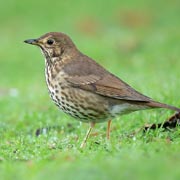 The idea of the Big Garden Birdwatch is to understand how garden birds are faring in the UK. Sadly, many bird populations are in decline, with some species facing huge declines over recent decades. Some 38 million fewer birds are now seen compared to 60 years ago. Song Thrush populations, for example, are down by 80% since the survey started in 1979. Even House Sparrow numbers have more than halved during that time. By studying the bird populations each year, trends can be identified including whether any bird species are in danger. Then the RSPB and other conservation organisations can work out what the problems are and how we might go about rescuing the situation as a nation. It also follows that, if there is a problem with bird populations, then there is likely to be a wider problem in nature too. This could be, for example, due to disease, over-intensive farming methods, habitat loss, invasive species, climate change, use of chemicals in gardens and farmland, and so on. Gathering data across the UK each January will help guide the nation to improve things — and children can help by getting involved in the Big Garden Birdwatch each January.
 — it’s quick, easy and free to do so. Once registered you’ll receive detailed instructions in your free guide to the event, which includes your free bird identification reference sheet. This will be useful to you and your children so each bird species can be recognised more easily.
 This wonderful activity is a great way to encourage families outdoors, where children benefit from nature in a myriad of ways. From lower stress and increased well-being to improved academic performance, stimulated imaginations, and better sleep,
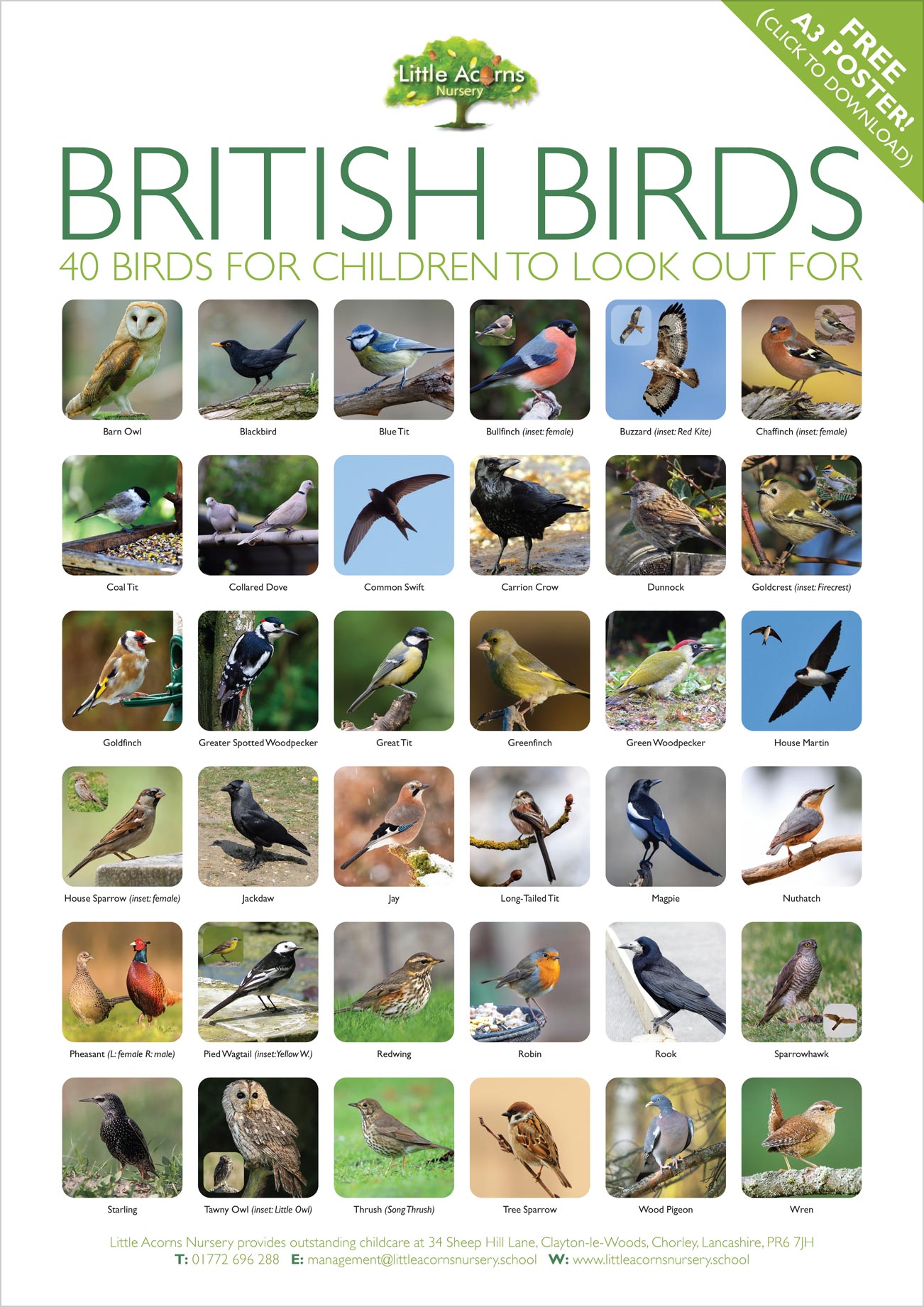
 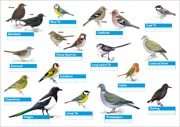 Together with the RSPB, we also have bird identification covered for children. The first option is the RSPB’s free bird reference sheet, which families will receive when they register for the event. Their digital version is best because it’s more environmentally friendly, is quicker to access, and usually shows a larger list than is shown on their printed version.
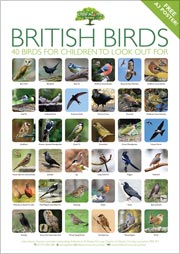 However, don’t forget that Little Acorns Nursery also published
 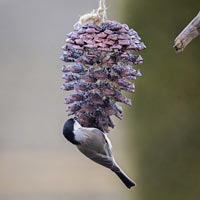 How to Encourage Birds to Visit Your Garden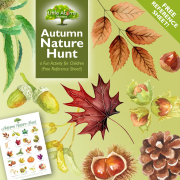
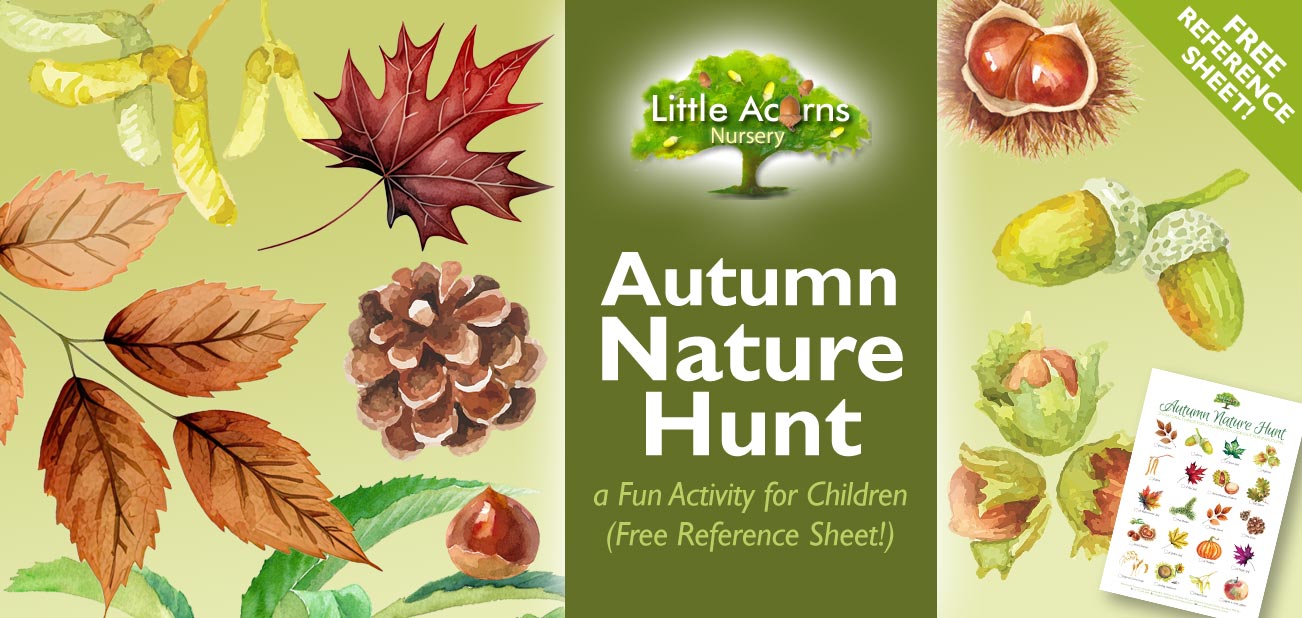
 By mid-November, autumn is in full swing and leaves are turning a myriad of different colours. Scenes of green, yellow, red and golden trees can be breathtakingly beautiful and the air is often crystal clear at this time of year — that’s great for photos! The autumn season also brings with it a treasure trove of fascinating natural things that children can discover if they take the time to look. Indeed, an autumn nature hunt is the perfect excuse for little ones to spend some time outdoors, where they will also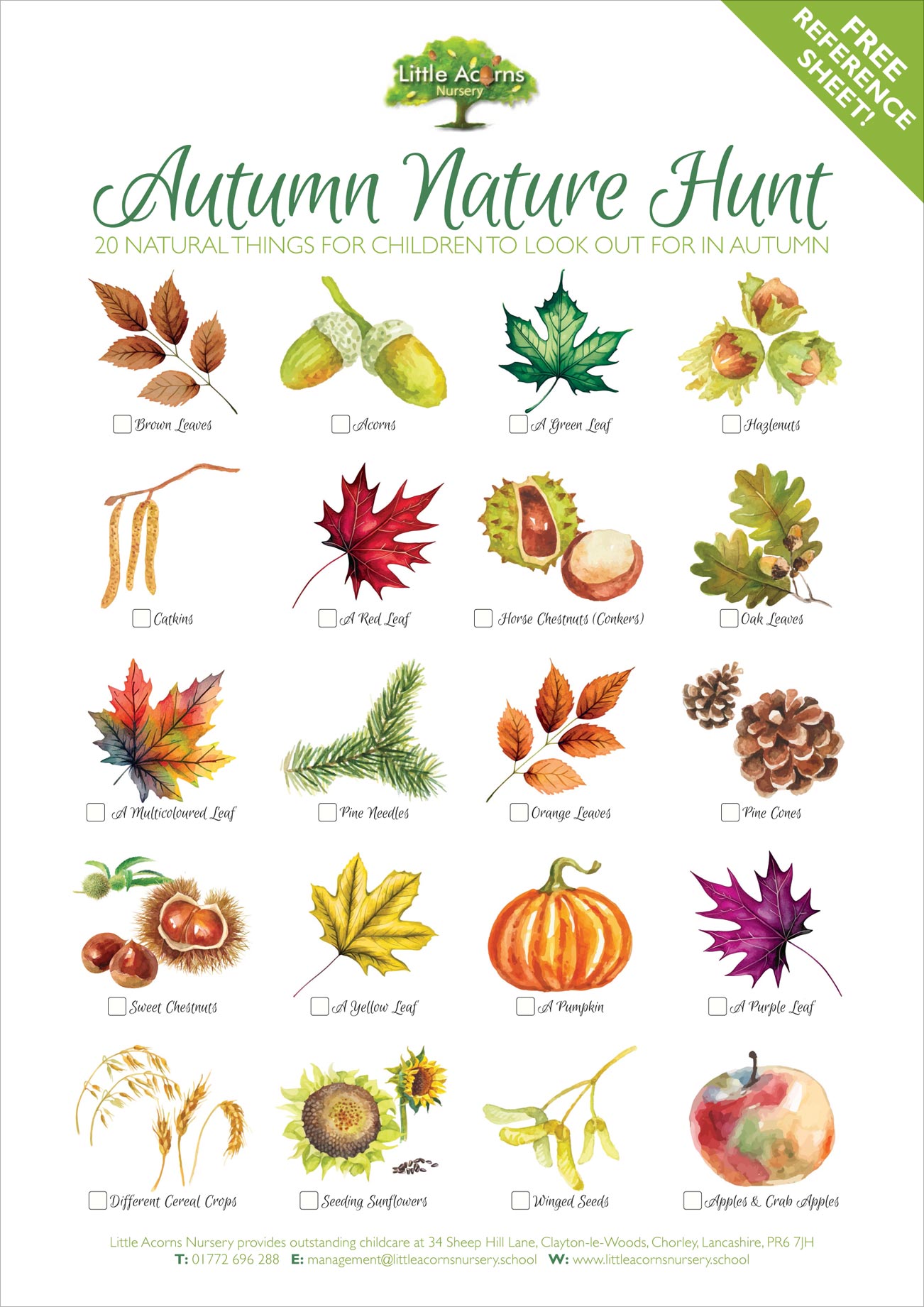
 Ensure children, particularly the very young, receive appropriate adult supervision at all times. Although fascinating and fun, the outdoors holds many hazards for the unwary. Therefore, children will need to be closely monitored by a responsible adult in order to safeguard their well-being.
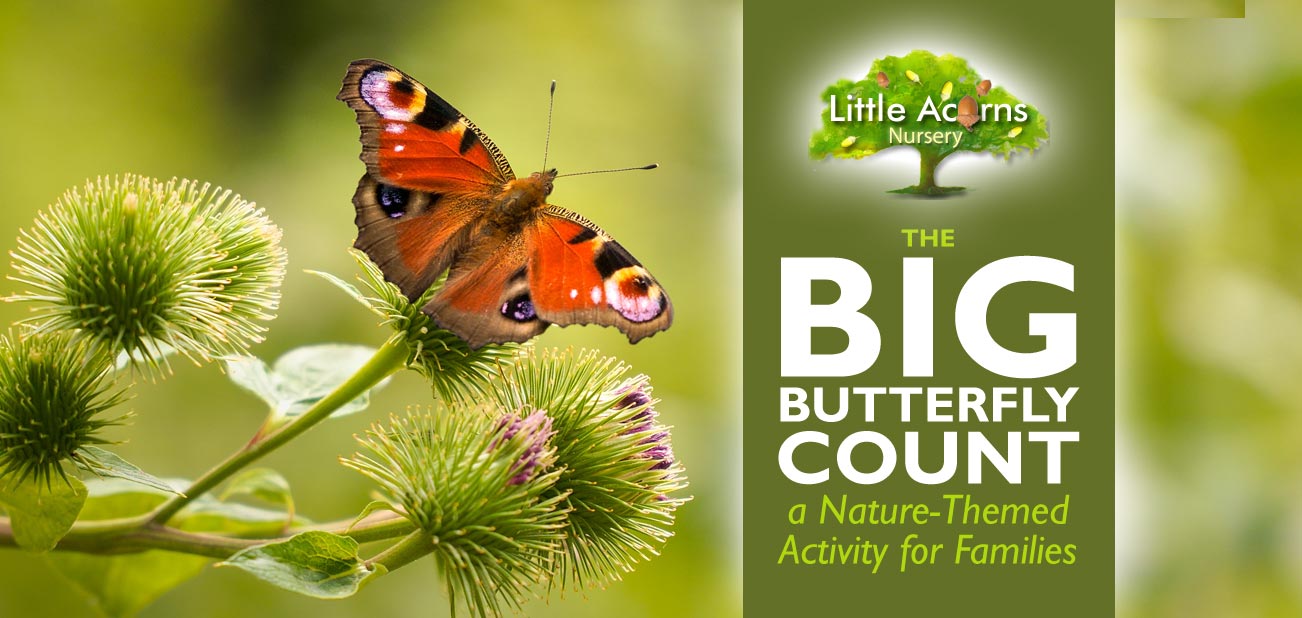
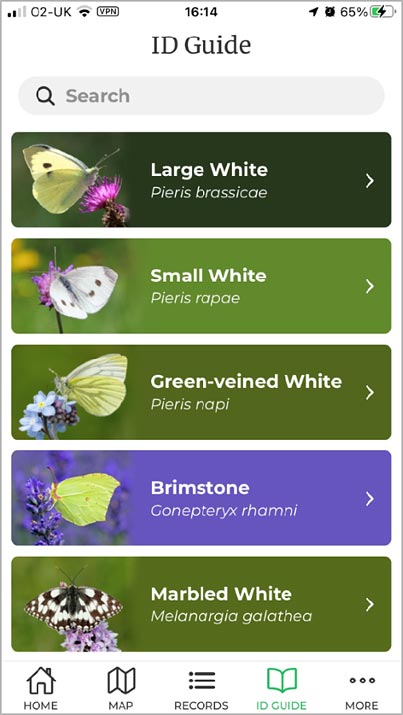
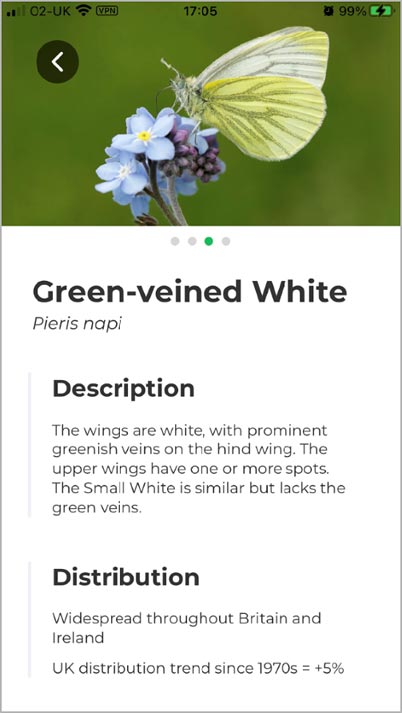
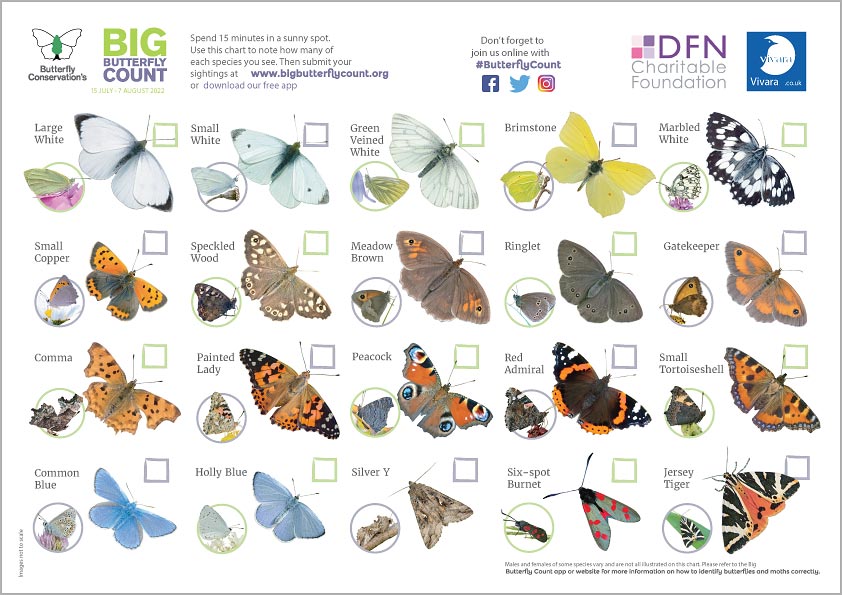
 Many will have heard of the Big Garden Birdwatch that takes place every year in January. However, fewer are aware of a similar activity called The Big Butterfly Count that takes place in July and early August. As well as being extremely worthwhile, it’s a wonderful activity for both children and adults to get involved in as citizen scientists. The activity helps with butterfly conservation, is educational for those taking part, and encourages families to get outdoors, closer to nature. And, as we know,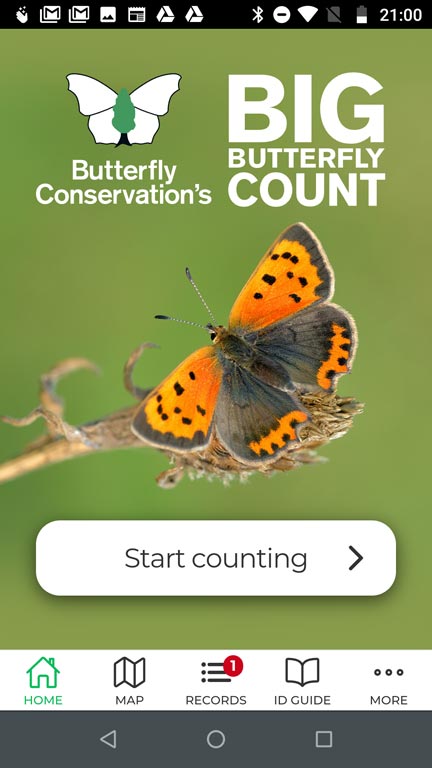



 October sees one of the year’s biggest traditions in the form of Halloween, which arrives on the 31st. Halloween, which is short, in effect, for “All Hallows’ Eve”, has it’s historical roots in Christian and, many believe, Celtic, Gaelic and Pagan festivals. Broadly speaking, these festivals were events to remember the dead, including saints (a.k.a. “hallows”). However, for virtually all children these days, it’s simply a traditional time for some themed fun. And what fun it can be! Today we’ll therefore take a look at the activities and opportunities that Halloween has for little ones at this time of year.
 Halloween Costumes — Dressing Up Fun!
 Edward Scissor Hands is another favourite. Try taping teaspoons or kitchen foil to your little one’s fingers to simulate Edward’s hands — but only if they’re old enough to be able to control movements so they don’t hurt themselves or others.
 Halloween Parties
 Parents and children can prepare for such parties, or when staying at home for the evening, with a range of Halloween-themed party food. This is also great fun and may even encourage little ones to eat foods they may not normally try (as appropriate for their age, of course). Try baking plain biscuits in Halloween themed shapes. Some can be made to look like pumpkins, bats and ghosts, for example, with suitable icing. Use whichever recipe is your favourite for the actual biscuits. Children will love the theming, which will make the food fun!
 Carved pumpkins are, of course, a great tradition for Halloween and one that children will love. For the safety of little ones, though, parents/adults will need to do the carving. Children can get involved in emptying out the pumpkin flesh and perhaps saving seeds, which they can later grow into new pumpkin plants for next year. They can also get involved in decorating outside of the carved pumpkins with paint or Sharpie pens. Red or green food dye can also be used to paint the inside. A good hand wash will be needed after all of this.
 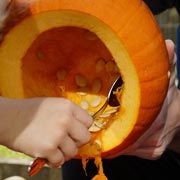 A lit candle (or an LED equivalent) can be placed inside by the adult and this will shine through and illuminate the design or face. Then the finished pumpkin can be placed somewhere safe — where little ones cannot endanger themselves if a real flame is used — for example out in the garden or on the front drive.
 Pumpkin Picking Locally
 Another pumpkin farm that’s open to families is also in Leyland, again less than 4 miles away from Clayton, at Moss Lane, Farington Moss, Leyland PR26 6QD. To pick your own pumpkin there (weekends only in October), call 07701 082 482 or get
  Trick or treating is the Halloween tradition of knocking on neighbours’ doors, shouting “trick or treat?” and hoping that some sweets or similar will be handed over to children by kindly neighbours. That would be the ‘treat’ element. The ‘trick’ element is more rarely used today, especially with the younger children. However, it still occasionally involves funny tricks being played on those neighbours who didn’t offer sweets. This ‘trick’ element is to be used only with particularly friendly households, though, and perhaps only with those that have been forewarned by the parents involved. If not handled with care, it can backfire and cause terribly bad feeling or even be thought of as antisocial behaviour. For that reason, forewarning neighbourhoods about any group trick or treat sessions is wise, including agreeing a way for them to opt out if they prefer.
 Each year, around 1 million families miss out on thousands of pounds in free childcare funding — despite being eligible through the Government’s Tax-Free Childcare scheme. Are you one of them?
 Families, including single parent families, are usually eligible for tax-free childcare scheme if they meet the following criteria:
 The Tax-Free Childcare contribution from the Government can only be used to pay for childcare provided by approved childcare providers that have signed up to the scheme. Such providers must be registered with either the Early Years Register, the Childcare Register or Ofsted in order to be approved. However, they can be nurseries, childminders, nannies, play schemes or even after school clubs. Little Acorns Nursery is, of course, such an approved childcare provider and would be happy to assist families to make the most of this very useful, free childcare funding opportunity.

 Last year, we wrote a detailed post outlining
  Interestingly, under-five children who came from disadvantaged backgrounds were shown to benefit even more than those who didn’t. For this reason, reading with parents/carers has been proposed as a possible way to close the performance deficit often seen with children from such backgrounds. It may well represent a perfect solution to even up the playing field.
 Deeper bonds with parents/carers (after all, this is quality time spent together, one-to-one);

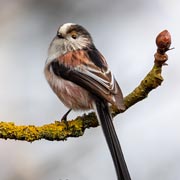 1. Bird spotting
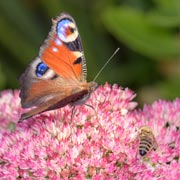 ee & Butterfly Spotting
 3. Search for Animal Tracks
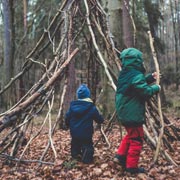 4. Make a Den
 5. Float a Boat
 6. Go on a Ramble
 7. Get into Photography
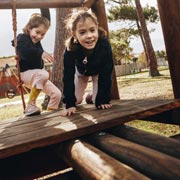 8. Obstacle Course
 9. Have a Picnic
 11. Hunt for Mini Beasts
 12. Get Creative with Rocks & Stones
 Whether on the beach or in the garden, it’s surprising how creative children can be with stones and rocks! Stones can be painted with lovely patterns or images, perhaps combined with simple words or as part of a ‘stone story’. Bigger rocks can be piled one on top of the other to form sculptures — these look magical. Children will love these and other creative activities that they can take part in outdoors, with simple stones and rocks.