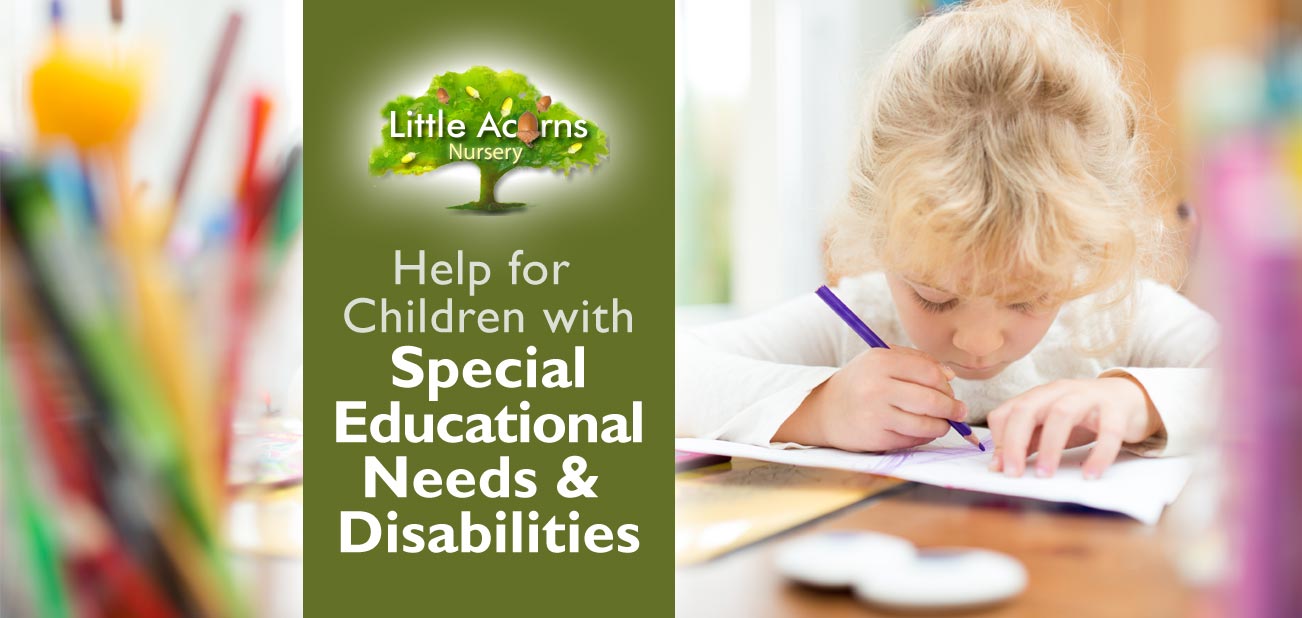
 Today, we look at how early years childcare providers like Little Acorns Nursery can help children under five if they have special educational needs and disabilities. This is often referred to as ‘SEND’ or in longer forms like ‘SEN and disabilities’. Let’s explore the topic to get an overview of some of the help available.
Childcare Help for Children with Special Educational Needs & Disabilities
Early years and childcare providers can support children under five in a variety of ways if they have special educational or developmental needs, and/or a disability. Indeed, helping affected children as early as possible in their lives is of paramount importance:
“Early identification of needs and the timely provision of appropriate support, together with high aspirations, can help ensure that the vast majority of children who have SEN or disabilities can achieve well and make a successful transition into adulthood.” (DfE)*
The specific strategies used will depend on the child’s individual needs and the resources available to any particular provider. That said, typical examples of ways that early years childcare providers — and others — can support children with special needs include the following:
Identifying Children with Special Needs
 Actually identifying an area of special need or disability is, of course, the first, crucial step in being able to help a child. If an area of special need is suspected, early years providers can work with parents and sometimes other professionals, for example health visitors, speech and language therapists, paediatricians and so on. Involving such professionals will help with any diagnosis.
It’s worth bearing in mind that the presence of a special need may not be crystal clear in many cases, especially when children are very young. As an example, it would not be possible to diagnose dyslexia until a point when a child’s understanding of language is sufficiently developed to actually begin the process of reading text. However, the involvement of such external expertise may make the initial identification of a child’s special need or disability more feasible.
Following such a diagnosis, the various parties surrounding the child can then, together, develop a plan of how best to support that child during their early years and potentially beyond. For our part as a nursery and childcare provider, we will also ensure that we regularly review the support that an affected child receives, making adjustments and taking further actions etc. when appropriate.
Creating an Inclusive and Supportive Environment
 This is important. Early years providers can create an inclusive environment that welcomes and supports children of all abilities. Encouraging the inclusion of children in social groups and in the making of friends, for example, is of huge benefit to children’s well-being. Childcare settings can also provide special equipment or adapt the environment to make it more accessible for children with specific physical needs.
Creating a positive and responsive culture is also crucial, so that children feel comfortable to express themselves, irrespective of any differences or abilities/disabilities that they may have.
Additional Support and Resources Through Funding
In some circumstances, childcare providers can access special funding in order to provide additional support and resources to children with special educational needs or disabilities. Examples include the hiring of additional staff to provide one-to-one support, providing extra resources to support learning, or offering additional activities to extend children’s experiences. Access to the specific funding will, though, require eligibility criteria to be met. Often, such funding applications may require a team effort between parents/carers, childcare settings and potentially other types of early years professional mentioned above.
Tailoring Learning & Development Plans & Activities to Meet Individual Needs
 Early years providers like Little Acorns Nursery adapt the individual learning and development plans and activities to suit each child. In this way, they’re custom-designed to meet the needs of every child individually, including those with special needs. This is done as a matter of course as part of the Early Years Foundation Stage (EYFS) approach to early years education and development. The tailored approach helps to level-up the playing field and, in effect, encourage equal opportunities for each child. It also helps them to reach their own personal bests in every area of their learning and development.
Progress Checks
The EYFS approach means that our early years practitioners use a continuous assessment approach in regard to every child’s progress, whether or not they have special needs or any disabilities. However, for those affected by SEN or disabilities, such an approach is even more crucial.
Special education provision for children, including those with SEN or disabilities, follows four stages of action: “Assess, Plan, Do and Review.”
In tandem with this, all children receive a Progress Check at 2 and this will highlight whether progress is on track, additional support is appropriate and indeed whether there is a SEND-related issue. Either way, tailored activities and strategies will be planned and put in place to address any issues and help optimise every child’s progress.
 Later, each child will similarly have an ‘EYFS profile’ completed during the final term of reception year. However, as we’re focusing this article on children under five, we’ll not go into detail about that here.
The SENCo
As well as having a ‘Key Person’ allocated to each child, early years providers like Little Acorns have a Special Educational Needs Coordinator (SENCo). The SENCo oversees the setting’s tailored support for children, under their care, who have special educational needs or disabilities. Similarly, the local authority will have an Area SENCO. They will advise and help coordinate support for children with special needs between the local authority itself, the child’s parents, early years and education settings, health and social care services and so on. The Area SENCO will also help when the time comes to transition the under-five child to school.
Communicating with Parents and Other Professionals
Communication is key. Childcare providers like Little Acorns Nursery will communicate regularly with parents/carers and, when appropriate, local authorities, health visitors, paediatricians and other healthcare professionals. This is to ensure that everyone is aware of the child’s progress and any additional support that may be needed. Ensuring that all parties are pulling in the same direction is crucial to outcomes for each child, particularly if they have special needs and/or disabilities.
“When a child is very young, or SEN is first identified, families need to know that the great majority of children and young people with SEN or disabilities, with the right support, can find work, be supported to live independently, and participate in their community.” (DfE)*
EHC Assessments and Plans
In the event that a child does not make the expected progress despite everyone’s best efforts and high quality support, there is recourse to request an Education, Health and Care (EHC) needs assessment via the local authority. If such a request is made by a childcare setting, it would only be done with the knowledge of the child’s parent(s) and after discussion with them. Basically, such an assessment may result in a brand new plan to support the child, if that’s deemed appropriate. It’s a big topic in its own right, so we may follow up separately to explain more about EHCs in due course.
The ‘Local Offer’ from the Local Authority
 It may be useful for parents and carers to note that local authorities have a duty to publish what’s known as a ‘Local Offer’. This outlines the help available in the area for children with SEND, including how to access that support.
A good example is the Local Offer published by our own local authority (Lancashire County Council), which can be found here. (Note that the early years childcare section of that particular Local Offer can be found here). A quick search there for SEND services will indeed reveal Little Acorns Nursery as an outstanding provider of childcare services, including for children with special educational needs and disabilities.
Free Funded Childcare Places for Children with SEND
While all 3- and 4-year-olds in England have access to free childcare provision each week, 2-year-olds with SEND may also be eligible for a significant number of free childcare hours if they get a Disability Living Allowance (‘DLA’), have a valid Education, Health and Care (‘EHC’) plan or have been referred through the local authority’s Portage service. Follow the bold links or speak to us at Little Acorns Nursery if you are local to Clayton-le-Woods, Chorley, and would like to learn more more about the options.
Outstanding Childcare in Clayton-le-Woods, Chorley

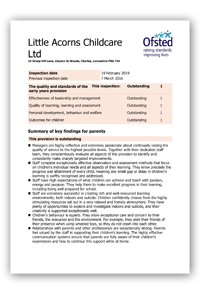
 Children get the very best start at Little Acorns Nursery. Little Acorns is an outstanding nursery and pre-school in Clayton-le-Woods, Chorley, Central Lancashire (PR6). We are also close to Clayton Brook, Clayton Green, Thorpe Green, Pippin Street, Buckshaw Village and Whittle-le-Woods. Farington, Bamber Bridge, Lostock Hall, Euxton, Leyland and Penwortham, so may suit those living/working in any of those nearby locations. Trust your child’s early years education and childcare to an award-winning nursery/pre-school and a nursery recognised by Ofsted as an Outstanding Provider —
To register your child for a place at Little Acorns Nursery, to ask a question or to see the nursery in action, please contact us:
* Quotation references: DfE, ‘Early Years: Guide to the 0 to 25 SEND Code of Practice’
 and that’s just one of many reasons why little ones should be encouraged to learn about sowing seeds and growing their own plants. Today, we’re taking that a step further by explaining how children can grow plants that will give them real, edible food! With a little planning, care and effort, children can grow herbs, vegetables and even fruit if they put their minds to it. What’s more, it’s possible without a garden and needn’t cost a penny!
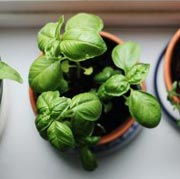 That will never be more evident than when a seed has grown into a plant that bears fruit, which contains more seeds, through which the whole process can start again.
 Seeds for herbs, vegetables and microgreens are all widely retailed in places like garden centres and even some supermarkets. Each seed packet will usually explain when and how seeds can be planted. This is perhaps the most obvious way for children to grow plants that, if all goes well, result in a healthy crop of food. However, we can be far more adventurous than that! Where is the fun in buying seeds in packets when children can get them for free? Let’s take a look at some cheaper and far more creative ways that children can start things off.
 “Free” you say? Well, pretty much! Next time you have some shop-bought tomatoes and/or peppers as part of your ordinary shopping, get your little one to take a few moments to save some of the seeds. These are found within things like tomatoes, before they’re eaten, and are usually discarded in the case of peppers. Such seeds can simply be spaced out on some compost or earth, watered in and a thin layer of soil or compost added on top. If these are left on the windowsill and the earth kept moist by the child over the coming days, little seedlings will soon start to appear.
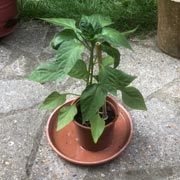 The image of the green plant shows our pepper seedling grown in this exact way — and it was incredibly easy to achieve. Ours is about 3 or 4 weeks old and it’s just about ready to be “planted out” outdoors, to mature. Once mature, they should flower then sprout some new peppers! It’s identical for tomatoes. If children have no garden for larger plants to be transferred to, ‘grow bags’ or any kind of suitable container can be used on a patio or balcony. Children will need to keep watering them every day, to keep the soil moist. Flowers will eventually appear and, with a little help from bees and insects, will be pollinated so that they eventually ‘fruit’. If appropriate care and attention continues, your child will eventually end up with vegetables that can eventually ripen and be eaten. That’s free tomatoes and peppers for the family, in our examples. Don’t forget to remind your child to save a few more seeds, though, so they can repeat the whole process again … and again!
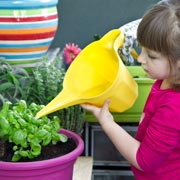 Does your little one know that he/she can grow new herb plants totally free of charge? This is done simply by clipping cuttings from your usual shop-bought herbs and leaving them in water to root. It’s incredibly easy so long as the child has some patience (that’s another useful lesson for them). All the child needs to do is to save some small (3 or 4 inch long) cuttings from the tips of herbs like basil or coriander. For safety, parents/carers may need to help with the cutting part if the children are very young.
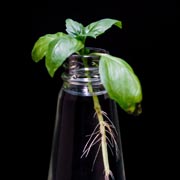 The bottom sections of the clipped cuttings should be dangled into a glass, small bottle or other suitable vessel of water and left over a period of days until they sprout roots. See the photo for an example. A clear water vessel, e.g. drinking glass, will allow your child to clearly see the roots. Once suitably long, these new little plants can be transplanted individually into compost/soil in something like flower pots — or indeed a free, recycled alternative like a yoghurt pot. The little ones will need to continue attending to the plants with regular watering so that the herbs grow and mature. This activity can all be done indoors on a windowsill too, so requires minimal space. Growing their own herbs may even make children more inclined to eat them!
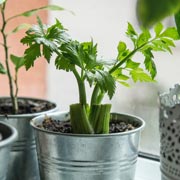 Another ridiculously easy way to grow food is to “re-grow” it. A classic example of this is to save the root section from a salad vegetable like iceberg lettuce or celery. This is the part of a shop-bought vegetable that would normally be cut off and discarded. However, in what has to be the easiest food growing activity of all, the child simply needs to keep that root section and leave it root down in water for 1 to 3 weeks. It will eventually grow some roots but, before that, the upper tip will start to sprout new leaves. In our own test using an iceberg lettuce we ended up with loads! That is new, free salad that can be later harvested and eaten. Simple!
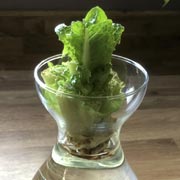 (Speaking of iceberg lettuces): Excuse the pun, but the ideas above are just the tip of the iceberg! There are so many other types of vegetable and fruit that children can grow (or re-grow) for next to nothing. For example, they can grow new apple trees from apple pips and new strawberry plants from the outside skin of strawberries. And the whole topic of


 Each year, around 1 million families miss out on thousands of pounds in free childcare funding — despite being eligible through the Government’s Tax-Free Childcare scheme. Are you one of them?
 Families, including single parent families, are usually eligible for tax-free childcare scheme if they meet the following criteria:
 The Tax-Free Childcare contribution from the Government can only be used to pay for childcare provided by approved childcare providers that have signed up to the scheme. Such providers must be registered with either the Early Years Register, the Childcare Register or Ofsted in order to be approved. However, they can be nurseries, childminders, nannies, play schemes or even after school clubs. Little Acorns Nursery is, of course, such an approved childcare provider and would be happy to assist families to make the most of this very useful, free childcare funding opportunity.

 “Exceptionally Effective Observation & Assessment” of Children
 Outstanding Personal Development, Behaviour & Welfare
 Are you looking for the best nurseries or pre-schools for your baby or child? Then consider