Tag Archive for: early learning

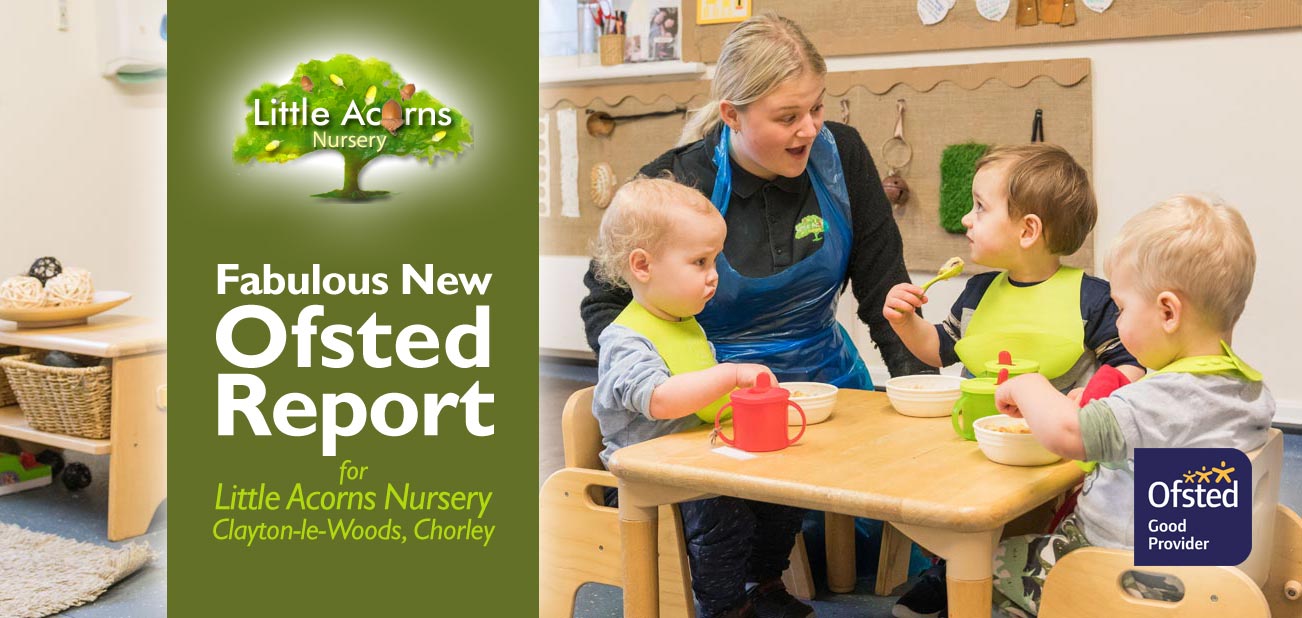
Fabulous New Ofsted Report for Little Acorns Nursery, Clayton-le-Woods, Chorley
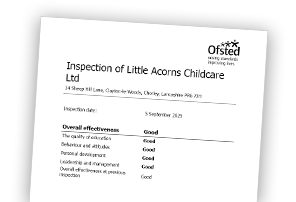
A fabulous new Ofsted report is out for Little Acorns Nursery, Clayton-le-Woods, Chorley. Published on 30 September 2025, it follows an inspection earlier that month. Parents and local families will be delighted to learn that, once again, Little Acorns Nursery was rated as ‘Good’ across all categories. That’s a high rating for overall effectiveness, the quality of education, the behaviour and attitudes of those attending, the personal development of staff, and the quality of leadership and management at the setting. A clean sweep! It’s news that will instil confidence in families that are considering enrolling a child at the nursery, and a clear demonstration that little ones who attend will benefit enormously — and be kept safe.

“What is it like to attend this early years setting?”

“The provision is good” — Ofsted.

  • Ofsted's latest report (Sept 2025) rates Little Acorns Nursery 'Good' in every category.Overall effectiveness: Good
  • The quality of education: Good
  • Behaviour and attitudes: Good
  • Personal development: Good
  • Leadership and management: Good

Let’s take a look at some of the positive findings and encouraging comments from the Ofsted Inspector who prepared this latest report.

  • Children Feel Happy, Settled,
    Safe & Secure at the Nursery

    The Ofsted Inspector could clearly see that children at Little Acorns are happy and feel at home at the nursery:

    “Children are happy and settled at the nursery… Staff help children to learn important language, such as to describe their feelings. This helps children to feel safe and secure at the nursery.” — Ofsted.

    She later also remarked that staff “are responsive to children’s needs, feelings and moods” and “encourage children to express and say what they feel,” later concluding in the report that “Children’s well-being is supported effectively.”

  • A Positive Attitude to Learning

    As the Ofsted Inspector said in her report, “Children make good progress in their learning of the nursery’s curriculum”, and she recognised the positive approach to children’s learning at the setting:

    “Leaders are ambitious for children’s learning and development. They are clear about the knowledge that they want children to learn and why.” — Ofsted.

    And, with that in mind, it was clear to the Inspector that children’s learning and development are nurtured well by thoughtful and attentive staff:

    “Staff know the children well. They provide meaningful learning opportunities that build on children’s interests effectively… Children demonstrate a positive attitude to their learning.” — Ofsted.

  • Children’s Personal Development is Promoted Well

    Ofsted’s report also points out that children’s personal development is nurtured very effectively, resulting in them becoming independent and “confident in their own abilities.”

    “Leaders make certain that staff promote children’s personal development well. Children benefit from the many opportunities that staff provide to help them to become independent.” — Ofsted.

  • Help Making Friends

    The Ofsted Inspector also recognised the nursery’s positive role in helping babies and children socialise and make friends:

    “They develop important knowledge about how to make friends because of staff’s skilful help. Babies show curiosity and are inquisitive about others. Older children are confident when meeting new people.” — Ofsted.

  • Help Developing Physical Skills

    The way the nursery and its practitioners help children develop physical skills was also picked up in the latest Ofsted report. The Inspector sang the praises of the ‘thoughtful’ early years practitioners and the appropriateness of equipment:

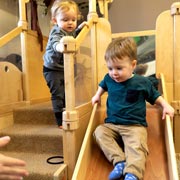
    “The nursery provides plenty of opportunities for children to develop essential physical skills. For example, staff working with babies provide climbing equipment, such as low-level steps, for babies to explore how they can move their bodies. Staff working with older children provide them with access to large equipment, such as the outdoor slide and wheeled ride-on toys. Children delight in testing out how strong they have become because of the thoughtful help of the nursery.” — Ofsted.

  • Strong Safeguarding at the Nursery

    Ofsted’s inspector applauded the nursery’s “effective” safeguarding arrangements:

    “There is an open and positive culture around safeguarding that puts children’s interests first.” — Ofsted.

    She also recognised recent safeguarding enhancements. With regard to possible allergens, for example, she remarked:

    “The provider ensures that known allergies for children are identified, understood and managed well… It is now a nut-free nursery. Staff have attended relevant training and leaders have strengthened risk assessments.” — Ofsted.

    And, with regard to security, she noted the excellent measures in place:

    “The provider ensures that the premises are safe and secure […] additional locks and entrance bells have been added to the nursery’s external gate. Staff understand their responsibility to ensure that external doors are locked and that they adhere to the nursery’s risk assessments. Leaders ensure that children are adequately supervised. This ensures the safety of children.” — Ofsted.

  • Staff Recognised

    Another key area that Ofsted inspectors look at is staffing. For example, are staff happy, are they adequately supervised and managed by leaders, and are they given the opportunity to grow? Well, as the ‘Good’ ratings for ‘Personal Development’ and ‘Leadership & Management’ in this latest report testify, it was a resounding ‘yes’ on all counts. The Inspector recognised that the leaders ‘ensure the smooth running of the nursery’ and support the work of staff. She went on to report:

    “leaders ensure that supervisions for staff are effective and include opportunities to discuss individual staff’s training and development needs. Staff receive effective coaching from leaders that improves the quality of education that children receive.” — Ofsted.

Click here to view/download the September 2025 Ofsted Report for Little Acorns Nursery, Clayton-le-Woods, Chorley.

Little Acorns Nursery: a High-Quality Childcare Service in Clayton-le-Woods, Chorley
Little Acorns Nursery, Clayton-le-Woods, ChorleyLittle Acorns Nursery is rated as a 'Good Provider' by Ofsted.As the latest Ofsted report testifies, Little Acorns Nursery is a great choice if you’re looking for a high-quality childcare service in Clayton-le-Woods, near Chorley. We’re open virtually all year round, support funded childcare places for children aged 9 months to 4 years (inclusive), and give under-fives the best start in life. Contact us today to arrange a guided visit to the nursery, ask any questions, or enrol your child for a nursery place. We can’t wait to meet you!

Little Acorns is an award-winning nursery in Clayton-le-Woods, near Chorley, Central Lancashire, and may also represent a convenient choice for families living nearby in Clayton Brook, Clayton Green, Thorpe Green, Pippin Street, Buckshaw Village, Whittle-le-Woods, Farington, Bamber Bridge, Lostock Hall, Euxton, Leyland, and Penwortham.
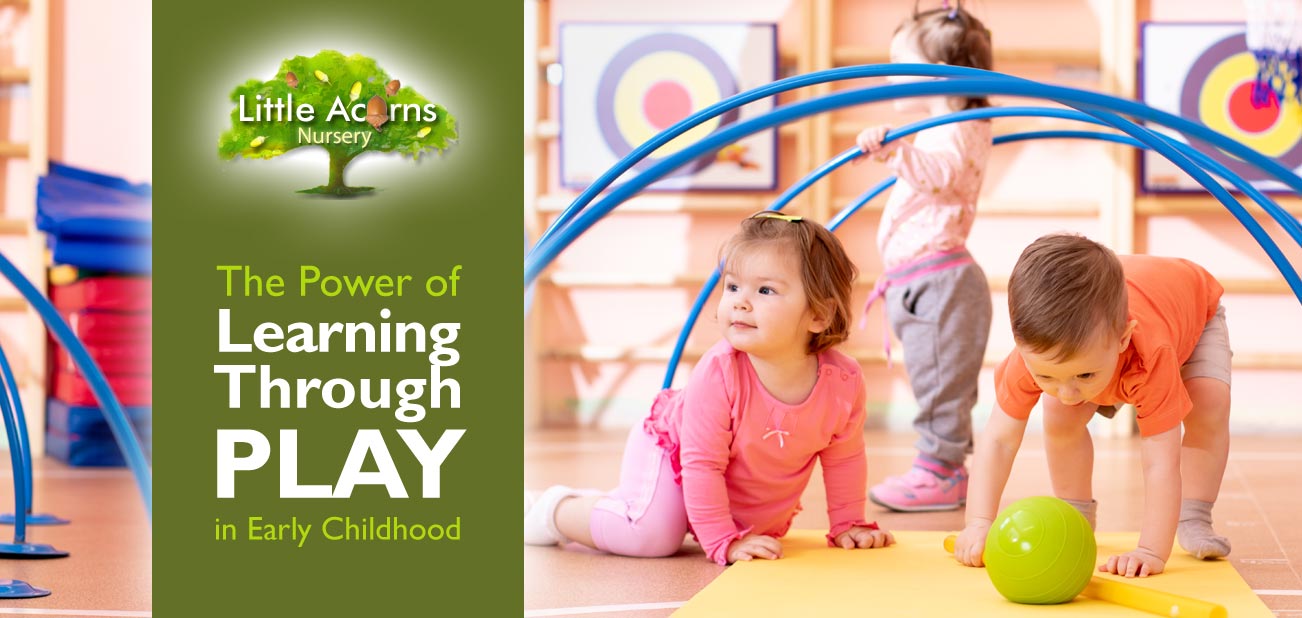
The Power of Learning Through Play in Early Childhood

Children learn best when they are learning through play — it is the gateway through which they explore, discover, learn, and grow.In the world of child development and early education, there is a simple yet profound truth: children learn best when they are learning through play. Play is the universal language of childhood and, indeed, it transcends both borders and cultures. Whether it’s building sand castles on a sunny beach or arranging blocks on the floor at home, play is the gateway through which children explore, discover, and grow.

But how and why is play so important? And can it benefit even babies, the tiniest members of society? In today’s article, we’ll unravel the secrets of learning through play. We’ll refer to some findings of scientific studies that attest to its incredible impact, explore play’s significance in the early years and infancy, and explain how childcare nurseries like ours harness its potential to nurture young minds.

So, join us today as we explore the power of play and why it should be at the heart of every child’s learning experience. Let’s open the door to a world where fun, laughter, imagination, and natural discovery pave the way to a brighter future for our children.

Why Is Learning Through Play So Important?

Learning through play lays the groundwork for cognitive development, social and emotional growth, imaginative thinking, and a lifelong passion for learning.As adults, we often associate learning with classrooms, textbooks, and structured lessons. However, for children, the process of learning is a dynamic and ever-evolving adventure, with play being their very best companion during the journey.

  • It develops cognitive skills. Play serves as a powerful vehicle for the development of cognitive skills. When children engage in activities like building with blocks, solving puzzles, or pretending to be characters in their favourite stories, they are actively honing their problem-solving abilities, critical thinking, and creativity. Importantly, these skills are also the building blocks of a lifelong love of learning, which we’ll come to later.
  • It sparks social & emotional growth. Play isn’t just about individual growth; it’s a social endeavour. Through play, children learn to navigate the complex world of relationships. They practise communication, cooperation, and negotiation as they interact with peers, siblings, and caregivers. Sharing toys, taking turns, and resolving conflicts during playtime are valuable life skills that lay the foundation for healthy social development.
  • Exploration feeds the imagination. One of the most beautiful aspects of play is its ability to fuel the imagination. When children engage in imaginative play, whether it’s hosting a tea party for stuffed animals or embarking on a make-believe adventure, they are cultivating their creativity and expanding their understanding of the world. Imagination is the driving force behind innovation and problem-solving in adulthood, making it a vital skill to nurture from a young age.
  • It fosters a love for learning. Perhaps the most compelling reason to prioritise learning through play is that it fosters a genuine love for learning. When children associate learning with fun, joy and discovery, they will naturally develop a thirst for knowledge that stays with them throughout their lives. Such an intrinsic motivation is priceless and will serve them well in all their pursuits, whether academic, work-related or personal.

So, as we can see, learning through play is a fundamental part of a child’s educational journey. It lays the groundwork for cognitive development, social and emotional growth, imaginative thinking, and a lifelong passion for learning.

Babies & Under-5s

Play-based learning is not just for older children. In reality, its influence begins right from infancy and continues to shape young minds throughout their early years. Let’s explore that a little further.

Play for Babies – Building Foundations

Tummy time for babies allows them to play, discover, explore, learn about the world around them, and build strength.Do babies benefit from play? Absolutely. Play is the first way through which infants start understanding their world. They use their senses to explore toys, grasp objects, and make sense of the environment around them. Sensory play, such as touching different textures or listening to soothing sounds, stimulates their developing senses and lays the groundwork for future learning.

Infant play also plays a crucial role in the development of fine and gross motor skills. As babies reach for toys, practise tummy time, and eventually start crawling and walking, they are strengthening their muscles and improving coordination.

Early Years Play – Growing Skills

Play allows children to experiment, make connections, and refine a multitude of skills.During the run-up to the age of 5, play is integral to children’s development. During this phase, children are like little sponges, soaking up information from their surroundings. Play allows them to experiment, make connections, and refine their cognitive and many other skills. Skills enhanced through play include:
  • Language development. Through imaginative play, storytelling, and conversations with peers and caregivers, children will naturally expand their vocabulary and improve their communication skills.
  • Maths and science concepts. Counting blocks, sorting shapes, and exploring basic scientific principles through hands-on experiments are all part of early years play. Such activities build a firm foundation for mathematical and scientific understanding.
  • Problem-solving and critical thinking. Whether it’s solving puzzles, figuring out how to build a tower without it toppling, or strategising during a game, play encourages children to think critically, make decisions, assess risk, and find solutions to challenges.
  • Emotional intelligence. Role-playing and interactive games help children navigate complex emotions. Through these, they will naturally enhance emotional intelligence, develop empathy, and learn about relationships. Such skills are vital for their social and emotional growth going forward.

Play is a powerful and natural tool that’s critical to the development of babies and young children. From sensory exploration in infancy to the cognitive challenges of early years, play enriches their lives and gives them foundational skills and knowledge that will serve them throughout their educational journey.

The value of play is backed up by extensive research

Children who engage in open-ended play activities are better at problem-solving and divergent thinking, a skill that is essential for creativity. (Early Childhood Research Quarterly).

Children who engage in imaginative play demonstrate greater cognitive flexibility and creativity. (Developmental Psychology Journal).

Children who engage in pretend play with caregivers have more advanced language skills, including a richer vocabulary and more complex sentence structures. (Journal of Child Language).

Children who engage in cooperative play exhibit higher levels of empathy and better conflict resolution skills. (American Journal of Play).

Physical play, such as climbing, running, and manipulating objects, contributes significantly to the development of fine and gross motor skills. (Journal of Motor Learning and Development).

Play can lower cortisol levels, a hormone associated with stress, and promote a sense of well-being in children. (Psychological Science).

The scientific evidence is clear: play is not just a pastime; it’s a fundamental component of child development 1. Indeed, learning through play is a major part of a good, holistic, approach to child development. It teaches children almost infinite amounts about the world around them while fostering cognitive skills, emotional intelligence, creativity, and a love for learning that will benefit them throughout their lives. Play is the primary vehicle through which children explore, discover, and grow, and it should be at the heart of every child’s educational journey.

The Role of Childcare Providers Like Little Acorns Nursery

Childcare settings like Little Acorns Nursery are often a child’s first introduction to structured learning outside the home. We play a pivotal role in nurturing young minds through a play-based approach to education. This is designed to encourage children to explore, experiment, and naturally discover through play.

  • At Little Acorns Nursery, we provide carefully-designed play spaces that are rich in stimulating materials, equipment and resources. These allow children to engage in various types of play, from imaginative to sensory.Creating playful environments — we understand the importance of a conducive environment for learning through play. With that in mind, we provide carefully designed play spaces that are rich in stimulating materials and resources. These spaces allow children to engage in various types of play, from imaginative to sensory, in a safe and supportive setting.

  • Trained educators — our nursery staff are trained to facilitate play-based learning effectively. They observe and engage with children during their play, providing guidance when necessary while allowing children the autonomy to explore and experiment. Our skilled educators recognise the many learning opportunities that arise naturally during such play.
  • A balance of structured and unstructured play — we strike a careful balance between structured and unstructured play. Structured activities may include group games, circle time, and planned art projects, while unstructured playtime allows children to choose their activities, fostering independence and decision-making skills.
  • Incorporating learning goals — while play is central to the nursery experience, it doesn’t mean a lack of educational goals. Childcare providers like Little Acorns Nursery align play activities with specific learning objectives. For example, a play dough activity can promote fine motor skills and creativity, while a group storytelling session enhances language development.
  • Assessing progress — continuous assessments help our childcare practitioners and each child’s Key Person to gauge children’s development. Such assessments consider, for example, children’s engagement, problem-solving abilities, social interactions, and other skills that emerge during play. This holistic approach helps our educators to tailor their support to each child’s individual needs.

By recognising the immense value of play in child development and providing a nurturing environment where children can learn, grow, and thrive through play-based activities, we not only prepare children for the transition to school but also facilitate the development of essential life skills.

Nursery Places at an Outstanding Nursery in Clayton-le-Woods, Chorley

An outstanding childcare provider

Little Acorns Nursery, Clayton-le-Woods, Chorley

Are you looking for an outstanding nursery for your child in Clayton-le-Woods or near Chorley? If so, you should consider Little Acorns Nursery. Not only does Ofsted rate us as an ‘Outstanding Provider’ but we also have a highly prestigious national nursery award under our belt. All Government-funded childcare schemes are supported at the nursery too, making childcare provision more affordable for eligible families. To register your little one for a place, arrange a tour with your child, or ask a question, please contact us:

Little Acorns is a nursery in Clayton-le-Woods, near Chorley, Central Lancashire. Families living or working nearby in Clayton Brook, Clayton Green, Thorpe Green, Pippin Street, Buckshaw Village, Whittle-le-Woods, Farington, Bamber Bridge, Lostock Hall, Euxton, Leyland or Penwortham may also find it convenient.

Coming Soon:

How to Encourage Learning Through Play at Home

Parents and caregivers also play a crucial role in fostering an environment that supports exploration, curiosity, and growth through play. Your home can be a vibrant hub for play-based learning. Moreover, by creating a nurturing environment, providing the right resources, and actively engaging with your child during play, you empower them to explore, learn, and really grow as individuals. We explore the topic of Encouraging Learning Through Play at Home here.

Spanish lessons have been going amazingly well at Little Acorns Nursery in Clayton-le-Woods, Chorley, Lancashire. The children are really loving their early learning!