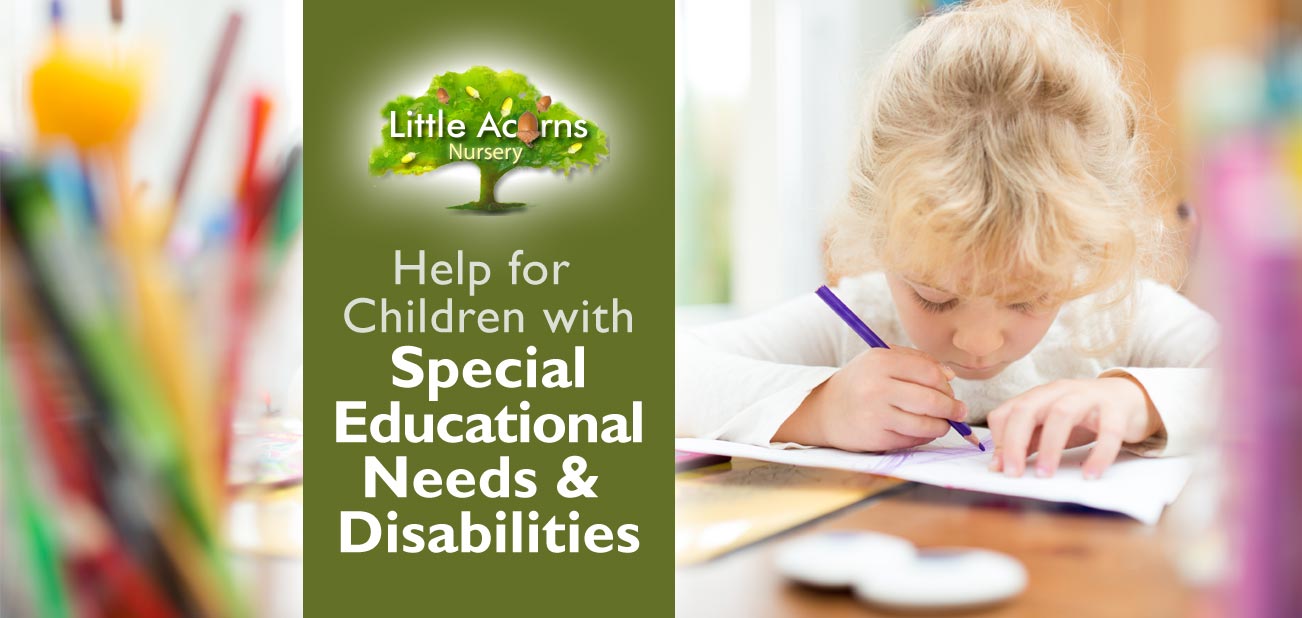
Today, we look at how early years childcare providers like Little Acorns Nursery can help children under five if they have special educational needs and disabilities. This is often referred to as ‘SEND’ or in longer forms like ‘SEN and disabilities’. Let’s explore the topic to get an overview of some of the help available.
Childcare Help for Children with Special Educational Needs & Disabilities
Early years and childcare providers can support children under five in a variety of ways if they have special educational or developmental needs, and/or a disability. Indeed, helping affected children as early as possible in their lives is of paramount importance:
“Early identification of needs and the timely provision of appropriate support, together with high aspirations, can help ensure that the vast majority of children who have SEN or disabilities can achieve well and make a successful transition into adulthood.” (DfE)*
The specific strategies used will depend on the child’s individual needs and the resources available to any particular provider. That said, typical examples of ways that early years childcare providers — and others — can support children with special needs include the following:
Identifying Children with Special Needs
Actually identifying an area of special need or disability is, of course, the first, crucial step in being able to help a child. If an area of special need is suspected, early years providers can work with parents and sometimes other professionals, for example health visitors, speech and language therapists, paediatricians and so on. Involving such professionals will help with any diagnosis.
It’s worth bearing in mind that the presence of a special need may not be crystal clear in many cases, especially when children are very young. As an example, it would not be possible to diagnose dyslexia until a point when a child’s understanding of language is sufficiently developed to actually begin the process of reading text. However, the involvement of such external expertise may make the initial identification of a child’s special need or disability more feasible.
Following such a diagnosis, the various parties surrounding the child can then, together, develop a plan of how best to support that child during their early years and potentially beyond. For our part as a nursery and childcare provider, we will also ensure that we regularly review the support that an affected child receives, making adjustments and taking further actions etc. when appropriate.
Creating an Inclusive and Supportive Environment
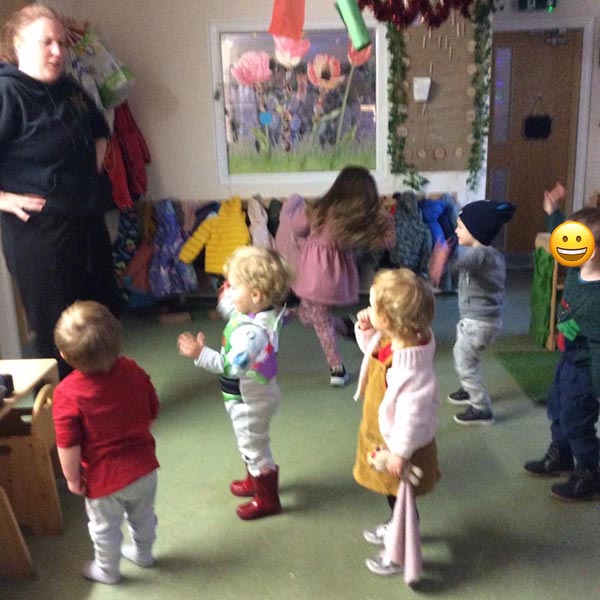
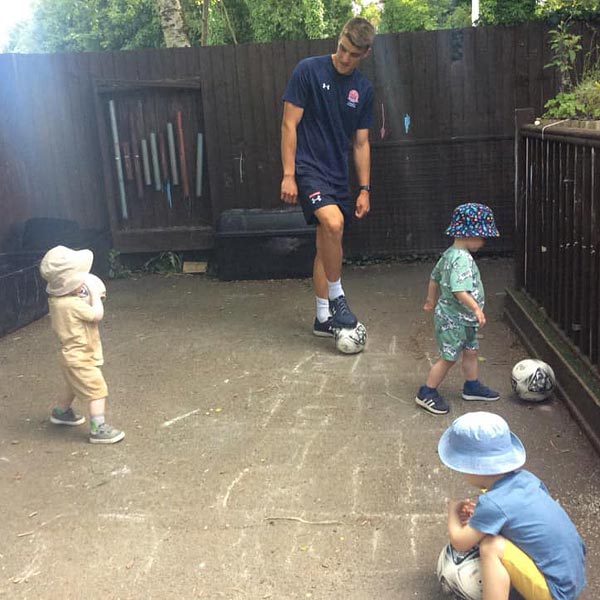
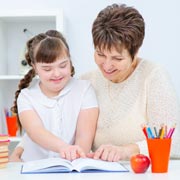
This is important. Early years providers can create an inclusive environment that welcomes and supports children of all abilities. Encouraging the inclusion of children in social groups and in the making of friends, for example, is of huge benefit to children’s well-being. Childcare settings can also provide special equipment or adapt the environment to make it more accessible for children with specific physical needs.
Creating a positive and responsive culture is also crucial, so that children feel comfortable to express themselves, irrespective of any differences or abilities/disabilities that they may have.
Additional Support and Resources Through Funding
In some circumstances, childcare providers can access special funding in order to provide additional support and resources to children with special educational needs or disabilities. Examples include the hiring of additional staff to provide one-to-one support, providing extra resources to support learning, or offering additional activities to extend children’s experiences. Access to the specific funding will, though, require eligibility criteria to be met. Often, such funding applications may require a team effort between parents/carers, childcare settings and potentially other types of early years professional mentioned above.
Tailoring Learning & Development Plans & Activities to Meet Individual Needs
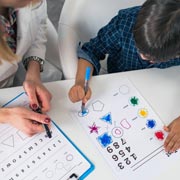
Early years providers like Little Acorns Nursery adapt the individual learning and development plans and activities to suit each child. In this way, they’re custom-designed to meet the needs of every child individually, including those with special needs. This is done as a matter of course as part of the Early Years Foundation Stage (EYFS) approach to early years education and development. The tailored approach helps to level-up the playing field and, in effect, encourage equal opportunities for each child. It also helps them to reach their own personal bests in every area of their learning and development.
Progress Checks
The EYFS approach means that our early years practitioners use a continuous assessment approach in regard to every child’s progress, whether or not they have special needs or any disabilities. However, for those affected by SEN or disabilities, such an approach is even more crucial.
Special education provision for children, including those with SEN or disabilities, follows four stages of action: “Assess, Plan, Do and Review.”
In tandem with this, all children receive a Progress Check at 2 and this will highlight whether progress is on track, additional support is appropriate and indeed whether there is a SEND-related issue. Either way, tailored activities and strategies will be planned and put in place to address any issues and help optimise every child’s progress.
Later, each child will similarly have an ‘EYFS profile’ completed during the final term of reception year. However, as we’re focusing this article on children under five, we’ll not go into detail about that here.
The SENCo
As well as having a ‘Key Person’ allocated to each child, early years providers like Little Acorns have a Special Educational Needs Coordinator (SENCo). The SENCo oversees the setting’s tailored support for children, under their care, who have special educational needs or disabilities. Similarly, the local authority will have an Area SENCO. They will advise and help coordinate support for children with special needs between the local authority itself, the child’s parents, early years and education settings, health and social care services and so on. The Area SENCO will also help when the time comes to transition the under-five child to school.
Communicating with Parents and Other Professionals
Communication is key. Childcare providers like Little Acorns Nursery will communicate regularly with parents/carers and, when appropriate, local authorities, health visitors, paediatricians and other healthcare professionals. This is to ensure that everyone is aware of the child’s progress and any additional support that may be needed. Ensuring that all parties are pulling in the same direction is crucial to outcomes for each child, particularly if they have special needs and/or disabilities.
“When a child is very young, or SEN is first identified, families need to know that the great majority of children and young people with SEN or disabilities, with the right support, can find work, be supported to live independently, and participate in their community.” (DfE)*
EHC Assessments and Plans
In the event that a child does not make the expected progress despite everyone’s best efforts and high quality support, there is recourse to request an Education, Health and Care (EHC) needs assessment via the local authority. If such a request is made by a childcare setting, it would only be done with the knowledge of the child’s parent(s) and after discussion with them. Basically, such an assessment may result in a brand new plan to support the child, if that’s deemed appropriate. It’s a big topic in its own right, so we may follow up separately to explain more about EHCs in due course.
The ‘Local Offer’ from the Local Authority
It may be useful for parents and carers to note that local authorities have a duty to publish what’s known as a ‘Local Offer’. This outlines the help available in the area for children with SEND, including how to access that support.
A good example is the Local Offer published by our own local authority (Lancashire County Council), which can be found here. (Note that the early years childcare section of that particular Local Offer can be found here). A quick search there for SEND services will indeed reveal Little Acorns Nursery as an outstanding provider of childcare services, including for children with special educational needs and disabilities.
Free Funded Childcare Places for Children with SEND
While all 3- and 4-year-olds in England have access to free childcare provision each week, 2-year-olds with SEND may also be eligible for a significant number of free childcare hours if they get a Disability Living Allowance (‘DLA’), have a valid Education, Health and Care (‘EHC’) plan or have been referred through the local authority’s Portage service. Follow the bold links or speak to us at Little Acorns Nursery if you are local to Clayton-le-Woods, Chorley, and would like to learn more more about the options.
Outstanding Childcare in Clayton-le-Woods, Chorley

 Children get the very best start at Little Acorns Nursery. Little Acorns is an outstanding nursery and pre-school in Clayton-le-Woods, Chorley, Central Lancashire (PR6). We are also close to Clayton Brook, Clayton Green, Thorpe Green, Pippin Street, Buckshaw Village and Whittle-le-Woods. Farington, Bamber Bridge, Lostock Hall, Euxton, Leyland and Penwortham, so may suit those living/working in any of those nearby locations. Trust your child’s early years education and childcare to an award-winning nursery/pre-school and a nursery recognised by Ofsted as an Outstanding Provider —
To register your child for a place at Little Acorns Nursery, to ask a question or to see the nursery in action, please contact us:
* Quotation references: DfE, ‘Early Years: Guide to the 0 to 25 SEND Code of Practice’
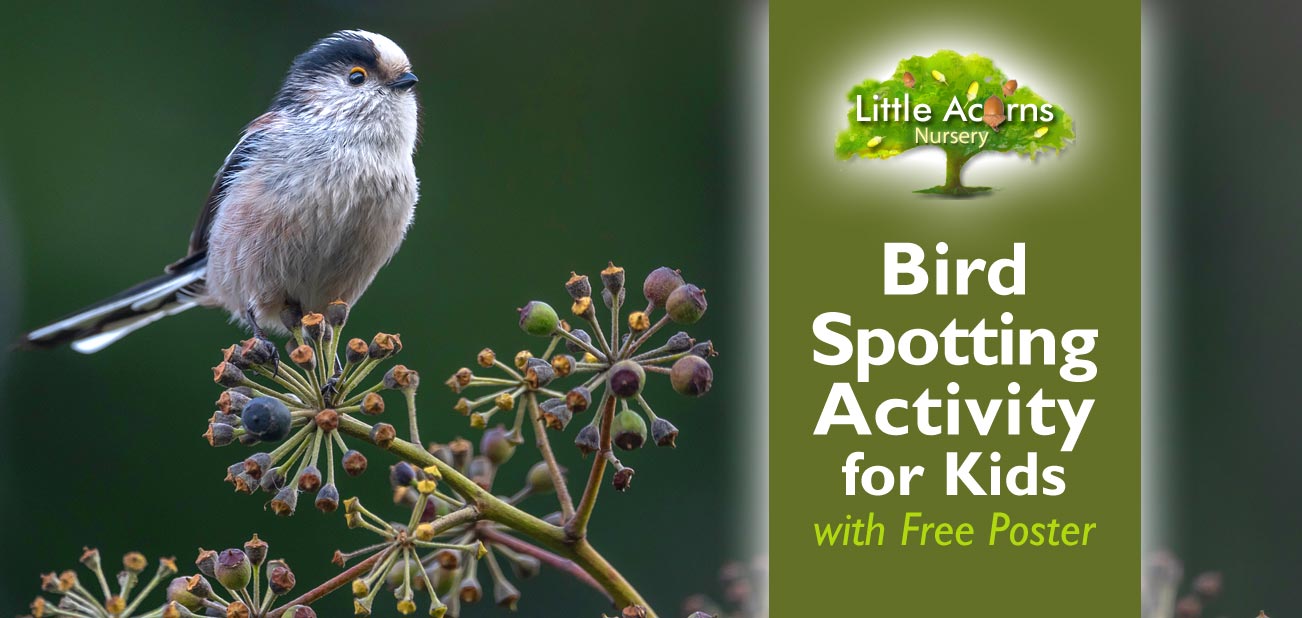
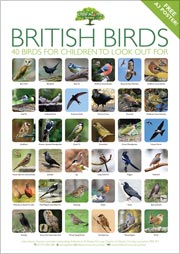 Are you looking for a fun and educational activity for your children? Why not encourage them to do some bird spotting? Not only is it a great way to spend time outdoors, but it’s also a wonderful opportunity for them to learn about nature and develop observation skills. As we know, being around nature is hugely beneficial to children and outdoor play is important.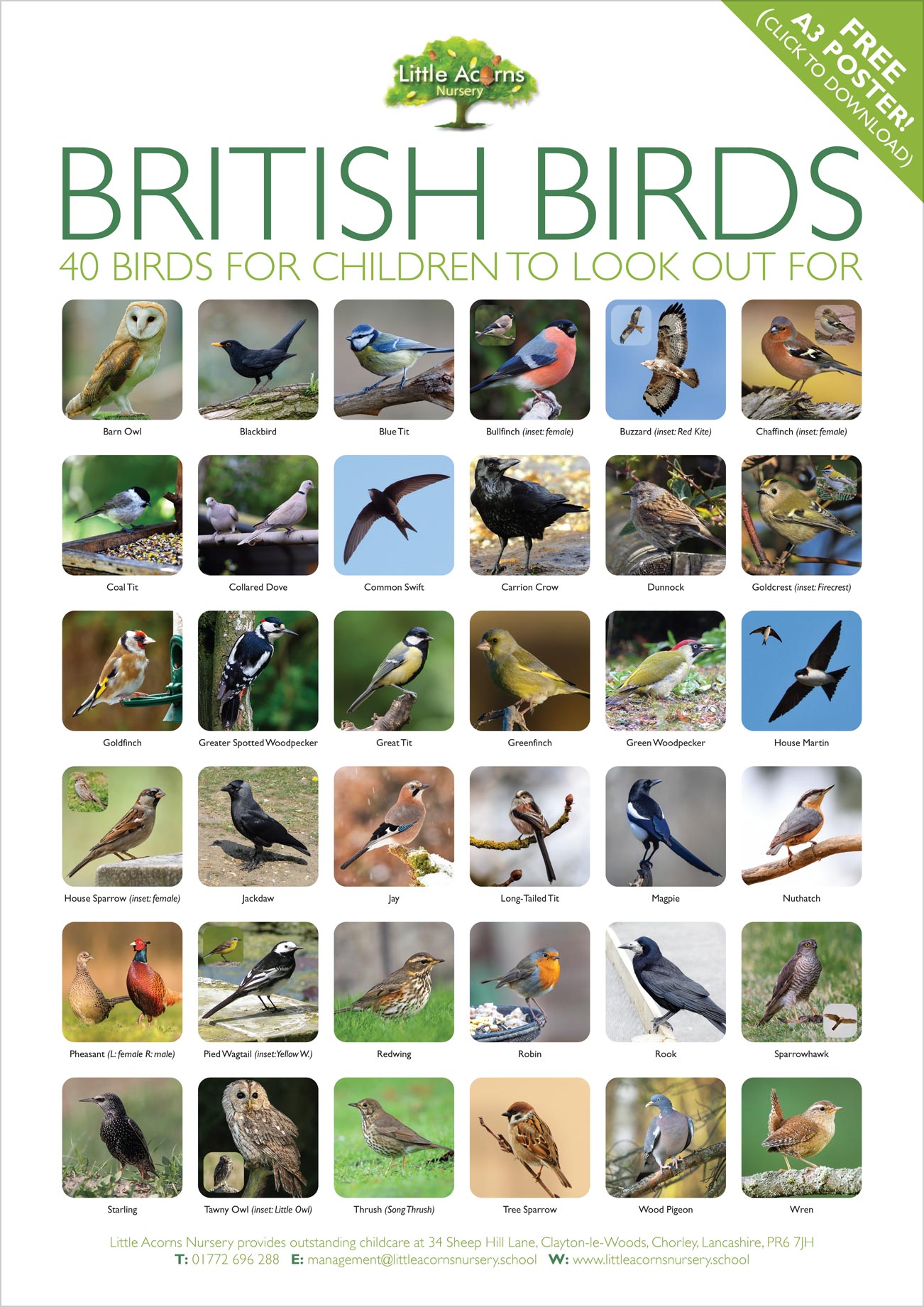

 Today, we look at how early years childcare providers like Little Acorns Nursery can help children under five if they have special educational needs and disabilities. This is often referred to as ‘SEND’ or in longer forms like ‘SEN and disabilities’. Let’s explore the topic to get an overview of some of the help available.
 Actually identifying an area of special need or disability is, of course, the first, crucial step in being able to help a child. If an area of special need is suspected, early years providers can work with parents and sometimes other professionals, for example health visitors, speech and language therapists, paediatricians and so on. Involving such professionals will help with any diagnosis.
 This is important. Early years providers can create an inclusive environment that welcomes and supports children of all abilities. Encouraging the inclusion of children in social groups and in the making of friends, for example, is of huge benefit to children’s well-being. Childcare settings can also provide special equipment or adapt the environment to make it more accessible for children with specific physical needs.
 Early years providers like Little Acorns Nursery adapt the individual learning and development plans and activities to suit each child. In this way, they’re custom-designed to meet the needs of every child individually, including those with special needs. This is done as a matter of course as part of
  Later, each child will similarly have an ‘EYFS profile’ completed during the final term of reception year. However, as we’re focusing this article on children under five, we’ll not go into detail about that here.
 It may be useful for parents and carers to note that local authorities have a duty to publish what’s known as a ‘Local Offer’. This outlines the help available in the area for children with SEND, including how to access that support.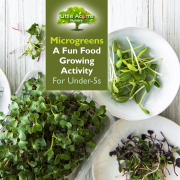

 As promised in our recent
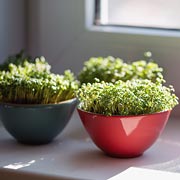
  Microgreens, also known as micro leaves, are the young shoots of growing plants that are edible. Examples include the seedlings of herbs like basil and coriander, red cabbage micro leaves and the shoots from root vegetables like beetroot. When growing, the seedlings form a thick and rich ‘carpet’ of shoots that, when ready, can be snipped off en masse and used in meals as salads or garnishes. What’s more, they’re delicious, highly nutritious and make meals look amazing. The entire activity can also be accomplished indoors in any home. You do not need to have a garden because a well-lit windowsill or counter top will more than suffice.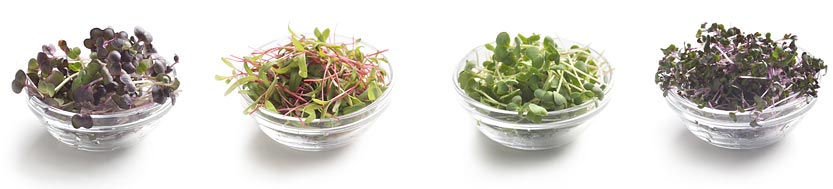
 Microgreen seeds. These are available inexpensively online or at places like garden centres and even some supermarkets. You can buy microgreen mixed seeds or choose seeds for rocket, beetroot, spinach, red cabbage, fennel, broccoli, radish or mustard. Each has a distinctive look, when growing, and flavour, when eaten. Read the packets for more detail or just have fun and experiment!
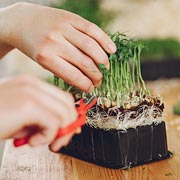 Different microgreen seeds grow at different rates but usually a dense carpet of growing shoots and tiny leaves will cover the trays or pots within one or two weeks. Generally speaking, when you can see small, immature leaves at the top of shoots about 1 to 1¼ inches tall, they are about ready to be harvested. For young children in particular, snipping them off is best done by parents, to avoid injury. The carpet of microgreens can be snipped off, using scissors, low down near where the shoots begin. It’s best to snip them off rather than to pull them up by the roots because then they have the chance to regrow and give you/your child a second crop later on. The microgreens can then be washed in a fine colander, under a cold tap, to remove any remnants of soil.
 Your child can then continue the fun by helping with meal preparation (with adult supervision for safety). Microgreens make wonderful garnishes, are lovely in salads and sandwiches and can also be added to things like soup, risotto, pasta, baked potatoes and burgers. They are incredibly attractive to look at, jazzing up any meal and also giving children extra nutrients to consume. They are also a great way to encourage children to try new tastes and food textures.
 October sees one of the year’s biggest traditions in the form of Halloween, which arrives on the 31st. Halloween, which is short, in effect, for “All Hallows’ Eve”, has it’s historical roots in Christian and, many believe, Celtic, Gaelic and Pagan festivals. Broadly speaking, these festivals were events to remember the dead, including saints (a.k.a. “hallows”). However, for virtually all children these days, it’s simply a traditional time for some themed fun. And what fun it can be! Today we’ll therefore take a look at the activities and opportunities that Halloween has for little ones at this time of year.
 Halloween Costumes — Dressing Up Fun!
 Edward Scissor Hands is another favourite. Try taping teaspoons or kitchen foil to your little one’s fingers to simulate Edward’s hands — but only if they’re old enough to be able to control movements so they don’t hurt themselves or others.
 Halloween Parties
 Parents and children can prepare for such parties, or when staying at home for the evening, with a range of Halloween-themed party food. This is also great fun and may even encourage little ones to eat foods they may not normally try (as appropriate for their age, of course). Try baking plain biscuits in Halloween themed shapes. Some can be made to look like pumpkins, bats and ghosts, for example, with suitable icing. Use whichever recipe is your favourite for the actual biscuits. Children will love the theming, which will make the food fun!
 Carved pumpkins are, of course, a great tradition for Halloween and one that children will love. For the safety of little ones, though, parents/adults will need to do the carving. Children can get involved in emptying out the pumpkin flesh and perhaps saving seeds, which they can later grow into new pumpkin plants for next year. They can also get involved in decorating outside of the carved pumpkins with paint or Sharpie pens. Red or green food dye can also be used to paint the inside. A good hand wash will be needed after all of this.
 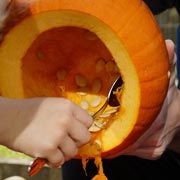 A lit candle (or an LED equivalent) can be placed inside by the adult and this will shine through and illuminate the design or face. Then the finished pumpkin can be placed somewhere safe — where little ones cannot endanger themselves if a real flame is used — for example out in the garden or on the front drive.
 Pumpkin Picking Locally
 Another pumpkin farm that’s open to families is also in Leyland, again less than 4 miles away from Clayton, at Moss Lane, Farington Moss, Leyland PR26 6QD. To pick your own pumpkin there (weekends only in October), call 07701 082 482 or get
  Trick or treating is the Halloween tradition of knocking on neighbours’ doors, shouting “trick or treat?” and hoping that some sweets or similar will be handed over to children by kindly neighbours. That would be the ‘treat’ element. The ‘trick’ element is more rarely used today, especially with the younger children. However, it still occasionally involves funny tricks being played on those neighbours who didn’t offer sweets. This ‘trick’ element is to be used only with particularly friendly households, though, and perhaps only with those that have been forewarned by the parents involved. If not handled with care, it can backfire and cause terribly bad feeling or even be thought of as antisocial behaviour. For that reason, forewarning neighbourhoods about any group trick or treat sessions is wise, including agreeing a way for them to opt out if they prefer.
 Every 2-year-old attending registered childcare settings in England is subject to what’s known as a ‘Progress Check at 2’. Today we explain what it entails, who is involved and how it benefits little ones. Here’s our rough guide to the Progress Check at 2:
 The Progress Check at 2 should not be confused with the Healthy Child Programme’s 2-Year Review that 2-year-olds also undergo around the same age. While the ‘Progress Check at 2’ looks at the child’s learning and development progress and is the topic of today’s guide, the separate ‘2 Year Review’ is more about the child’s health and wellbeing and is undertaken by healthcare professionals like health visitors. They will look at things like overall health, immunisation uptake, physical and mental health and development, overall wellbeing and support levels from parents, carers or guardians.
 The three ‘prime’ areas of the Early Years Foundation Stage (EYFS) curriculum are also the core focus areas of the Progress Check at 2. Hence, the checks will look to see how well the child is progressing primarily in their:
 The core idea behind the Progress Check at 2 is to discover whether progress is at expected levels for the child’s age and development.