

Tag Archive for: babies

15 Fascinating Facts About Babies

Human babies are incredible. Indeed, the more we learn about them, the more we realise just how incredible they are! Not only are they little bundles of joy that have evolved in less than a year, but they also conceal some amazing secrets. Did you know, for example, that babies have gills (kind of), fur and a tail during their development in the womb — and that they have three times more taste buds than adults when they’re first born? In today’s article, we explore some fascinating baby facts that surprised us — and may surprise you! Take a look.

We Remember Nothing Before the Age of 3

Scientists are not completely sure why, but none of us tend to have memories that go back beyond the age of three. Can you recall anything from when you were 2 or 3 years old? The vast majority of us can’t, and it is believed to be because of two possible reasons. One possibility is that we can’t remember our earliest years because the memory system in our brains was not developed enough at that time. The other possibility is that it’s because memory could be tied to language, and our language skills were not sufficient to store memories until the age of three. It could also be a mixture of the two, perhaps.

Newborn Babies have Heart Rates Twice as Fast as Adults

Newborn babies have a heart rate of somewhere between 120 and 160 beats per minute. That’s around double that of adults!

4.44 Babies Are Born Every Second!*

Every second, an average of 4.44 new babies are born around the world*. That’s about 266 babies per minute and almost 16,000 per hour. On a daily basis, it works out to over 383,600 new babies per day and about 140 million every year. The world population is currently growing at a rate of 0.9% annually.

The Birth Rate in England & Wales is Falling

In England and Wales, 591,072 babies were born in 2023 according to the latest Office for National Statistics (ONS) data(¹). That is the lowest birth rate for the region since 1977, as well as being the first time the rate was below 600,000 since 2002. Indeed, women in England and Wales give birth to an average of just 1.44 children over their lifetimes in the latest data, which is the lowest on record.

September is the Most Popular Month for Baby Births

September remains the most popular month for births in England and Wales, according to the same ONS data. The most popular day for births was 28 September, a date that has been in the top ten days for births since 2021.

Boxing Day Has the Lowest Birth Rate

Boxing Day, 26 December, has the lowest birth rate for the whole year, according to the ONS. What’s more, this has been the case for 11 years in a row!

Parents Are Getting Older When Babies Are Born

Data analysed by the ONS over the last 50 years shows that, for babies born in England and Wales, parents are gradually getting older. In the last count (for 2023), a new baby’s father was, on average, 33.8 years of age, while mothers were 30.9.

Over Half the World’s Babies are Born in Asia*

Almost 53% of births happen across the continent of Asia, 30.7% across the African continent, 10.7% in the Americas and just 0.7% in Oceania. That compares to 5% of births that occur in Europe.

Babies Have Gills in the Womb (Kind of)

There has been much debate about whether foetuses — developing babies — have gills when they’re in the womb. The answer is ‘kind of’ according to many experts, including the late Dr Michael Mosley/BBC(). While they do have tiny gill-like folds called pharyngeal arches, which may be evidence that humans evolved from fish, they are not gills in the true sense of the word. The so-called ‘gill slits’ can be found on the foetus’s neck in the very early stages of development, but are not for breathing. Instead, the structures migrate and evolve into the top lip, palate, and jaw of the baby.

Human Foetuses Have Tails

In the early stages of development in the womb, human foetuses have tails, which even have vertebrae. However, around the 7th and 8th week of gestation, those vertebrae fuse together, and the tail disappears, leaving only the ‘tailbone’ or coccyx that we’re all born with.

Babies Grow Fur in the Womb

Lanugo is a soft, fine, usually colourless body hair that’s grown by babies in the womb and that eventually covers the baby’s whole body. In tandem with the creamy covering of vernix caseosa that babies are born with, the Lanugo fur’s purpose is to help protect the developing child and help regulate its temperature. Developed from about the 14th week and visible on the foetus’s skin from the 21st week of pregnancy, it is usually shed by about week 35, before birth. It is replaced by vellus hair, which is commonly known as ‘peach fuzz’ on newborns. That said, up to 30% of babies are born with lanugo hair still evident somewhere on their bodies, and this is especially true for premature babies. (Source).

Babies Have 3 Times More Taste Buds Than Adults

Did you know that newborn babies have three times more taste buds than adults? It’s true! Newborn babies have around 30,000 taste buds, whereas adults have no more than 10,000. However, in a newborn, the taste buds are distributed not only over the tongue, but also the palate, throat lining, and tonsils. It is thought that this helps them better identify advantageous foods over potentially toxic ones. That said, the number of taste buds gradually reduces as the infant gets older, eventually being present only on the tongue, as with adults.

Babies Have Almost 50% More Bones Than Adults

Similarly, babies are born with many more bones than adults. It may surprise you to learn that a baby has 300 bones in their body when born, whereas an adult has only 206. As they mature and grow, however, some bones in children fuse together to form single bones. A great example of this can be found in the human skull, which, in babies, consists of several separate bones which, come adulthood, have fused together into a single bone. It is through this kind of process that humans reduce the number of bones in their bodies by almost one-third.

Babies Do Not Cry Tears When First Born

We all know that a baby’s first cry is an important milestone and one that signals that the child is breathing. However, not all of us may notice that most babies do not cry actual tears during the first part of their infancy. That’s because their tear ducts — or lacrimal glands — are not yet fully mature. As such, it may be several weeks or even as long as 2 or 3 months before normal tears are evident when a baby cries. Premature babies usually take the longest to exhibit full tears when crying.

Babies’ Brains Double in Size in the First Year

During the early years, a child’s brain grows rapidly. In the first year alone, babies’ brains double in size and, by the time they’re three, are already four-fifths the size of an adult’s. By the age of five, they’re usually nine-tenths the size of an adult’s brain. That said, traditional wisdom suggests that the human brain continues to develop right into a person’s mid-twenties. However, some experts now believe that some areas of the brain continue to mature right into the thirties.

We hope you found today’s list of fascinating baby facts interesting. We may follow up with another set of fascinating baby facts in a future post, so watch this space!

High-Quality Childcare in Clayton-le-Woods

Little Acorns Nursery: a first-class weekday childcare service for Under-5s near Chorley
Little Acorns Nursery, Clayton-le-Woods, ChorleyLittle Acorns Nursery is rated as a 'Good Provider' by Ofsted.Little Acorns Nursery provides families with a first-class childcare service in Clayton-le-Woods, Chorley. We have a Good Ofsted rating and support free childcare funding schemes for eligible working families with children as young as just 9 months of age. Little Acorns represents a fabulous choice for weekday childcare, which we provide for babies and children under five. Contact us today to apply for a nursery place or to learn more — we’d love to hear from you.

Located in Clayton-le-Woods, Little Acorns Nursery will also be conveniently close for families in Clayton Brook, Clayton Green, Thorpe Green, Pippin Street, Buckshaw Village, Whittle-le-Woods, Farington, Bamber Bridge, Lostock Hall, Euxton, Leyland, and Penwortham.

* (Correct at the time of writing — 12 December 2025 — according to the Live Birth Counter).
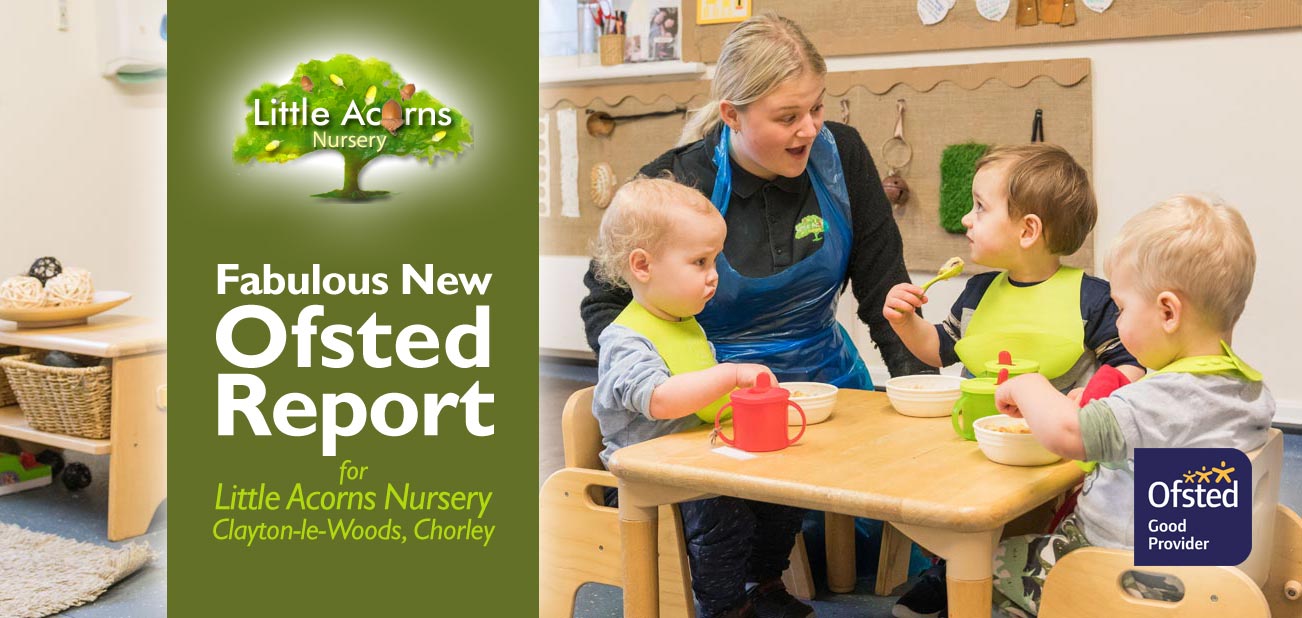
Fabulous New Ofsted Report for Little Acorns Nursery, Clayton-le-Woods, Chorley
A fabulous new Ofsted report is out for Little Acorns Nursery, Clayton-le-Woods, Chorley. Published on 30 September 2025, it follows an inspection earlier that month. Parents and local families will be delighted to learn that, once again, Little Acorns Nursery was rated as ‘Good’ across all categories. That’s a high rating for overall effectiveness, the quality of education, the behaviour and attitudes of those attending, the personal development of staff, and the quality of leadership and management at the setting. A clean sweep! It’s news that will instil confidence in families that are considering enrolling a child at the nursery, and a clear demonstration that little ones who attend will benefit enormously — and be kept safe.

“What is it like to attend this early years setting?”

“The provision is good” — Ofsted.

  • Ofsted's latest report (Sept 2025) rates Little Acorns Nursery 'Good' in every category.Overall effectiveness: Good
  • The quality of education: Good
  • Behaviour and attitudes: Good
  • Personal development: Good
  • Leadership and management: Good

Let’s take a look at some of the positive findings and encouraging comments from the Ofsted Inspector who prepared this latest report.

  • Children Feel Happy, Settled,
    Safe & Secure at the Nursery

    The Ofsted Inspector could clearly see that children at Little Acorns are happy and feel at home at the nursery:

    “Children are happy and settled at the nursery… Staff help children to learn important language, such as to describe their feelings. This helps children to feel safe and secure at the nursery.” — Ofsted.

    She later also remarked that staff “are responsive to children’s needs, feelings and moods” and “encourage children to express and say what they feel,” later concluding in the report that “Children’s well-being is supported effectively.”

  • A Positive Attitude to Learning

    As the Ofsted Inspector said in her report, “Children make good progress in their learning of the nursery’s curriculum”, and she recognised the positive approach to children’s learning at the setting:

    “Leaders are ambitious for children’s learning and development. They are clear about the knowledge that they want children to learn and why.” — Ofsted.

    And, with that in mind, it was clear to the Inspector that children’s learning and development are nurtured well by thoughtful and attentive staff:

    “Staff know the children well. They provide meaningful learning opportunities that build on children’s interests effectively… Children demonstrate a positive attitude to their learning.” — Ofsted.

  • Children’s Personal Development is Promoted Well

    Ofsted’s report also points out that children’s personal development is nurtured very effectively, resulting in them becoming independent and “confident in their own abilities.”

    “Leaders make certain that staff promote children’s personal development well. Children benefit from the many opportunities that staff provide to help them to become independent.” — Ofsted.

  • Help Making Friends

    The Ofsted Inspector also recognised the nursery’s positive role in helping babies and children socialise and make friends:

    “They develop important knowledge about how to make friends because of staff’s skilful help. Babies show curiosity and are inquisitive about others. Older children are confident when meeting new people.” — Ofsted.

  • Help Developing Physical Skills

    The way the nursery and its practitioners help children develop physical skills was also picked up in the latest Ofsted report. The Inspector sang the praises of the ‘thoughtful’ early years practitioners and the appropriateness of equipment:

    “The nursery provides plenty of opportunities for children to develop essential physical skills. For example, staff working with babies provide climbing equipment, such as low-level steps, for babies to explore how they can move their bodies. Staff working with older children provide them with access to large equipment, such as the outdoor slide and wheeled ride-on toys. Children delight in testing out how strong they have become because of the thoughtful help of the nursery.” — Ofsted.

  • Strong Safeguarding at the Nursery

    Ofsted’s inspector applauded the nursery’s “effective” safeguarding arrangements:

    “There is an open and positive culture around safeguarding that puts children’s interests first.” — Ofsted.

    She also recognised recent safeguarding enhancements. With regard to possible allergens, for example, she remarked:

    “The provider ensures that known allergies for children are identified, understood and managed well… It is now a nut-free nursery. Staff have attended relevant training and leaders have strengthened risk assessments.” — Ofsted.

    And, with regard to security, she noted the excellent measures in place:

    “The provider ensures that the premises are safe and secure […] additional locks and entrance bells have been added to the nursery’s external gate. Staff understand their responsibility to ensure that external doors are locked and that they adhere to the nursery’s risk assessments. Leaders ensure that children are adequately supervised. This ensures the safety of children.” — Ofsted.

  • Staff Recognised

    Another key area that Ofsted inspectors look at is staffing. For example, are staff happy, are they adequately supervised and managed by leaders, and are they given the opportunity to grow? Well, as the ‘Good’ ratings for ‘Personal Development’ and ‘Leadership & Management’ in this latest report testify, it was a resounding ‘yes’ on all counts. The Inspector recognised that the leaders ‘ensure the smooth running of the nursery’ and support the work of staff. She went on to report:

    “leaders ensure that supervisions for staff are effective and include opportunities to discuss individual staff’s training and development needs. Staff receive effective coaching from leaders that improves the quality of education that children receive.” — Ofsted.

Click here to view/download the September 2025 Ofsted Report for Little Acorns Nursery, Clayton-le-Woods, Chorley.

Little Acorns Nursery: a High-Quality Childcare Service in Clayton-le-Woods, Chorley

Little Acorns Nursery, Clayton-le-Woods, ChorleyLittle Acorns Nursery is rated as a 'Good Provider' by Ofsted.As the latest Ofsted report testifies, Little Acorns Nursery is a great choice if you’re looking for a high-quality childcare service in Clayton-le-Woods, near Chorley. We’re open virtually all year round, support funded childcare places for children aged 9 months to 4 years (inclusive), and give under-fives the best start in life. Contact us today to arrange a guided visit to the nursery, ask any questions, or enrol your child for a nursery place. We can’t wait to meet you!

Little Acorns is an award-winning nursery in Clayton-le-Woods, near Chorley, Central Lancashire, and may also represent a convenient choice for families living nearby in Clayton Brook, Clayton Green, Thorpe Green, Pippin Street, Buckshaw Village, Whittle-le-Woods, Farington, Bamber Bridge, Lostock Hall, Euxton, Leyland, and Penwortham.

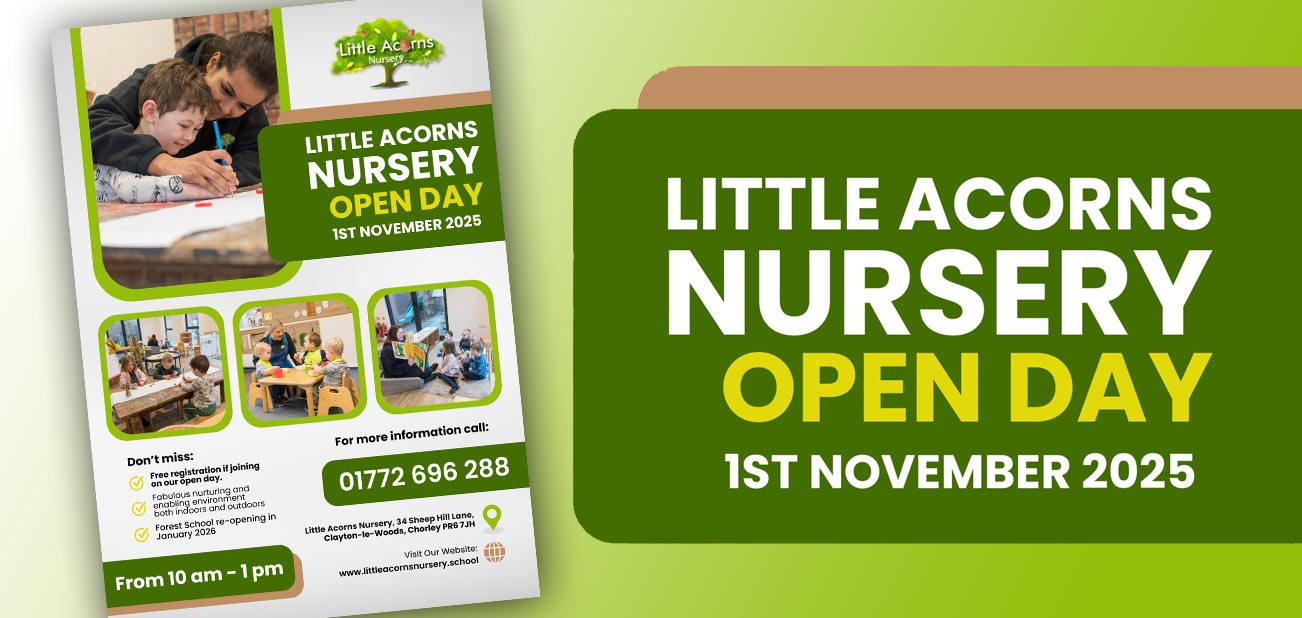
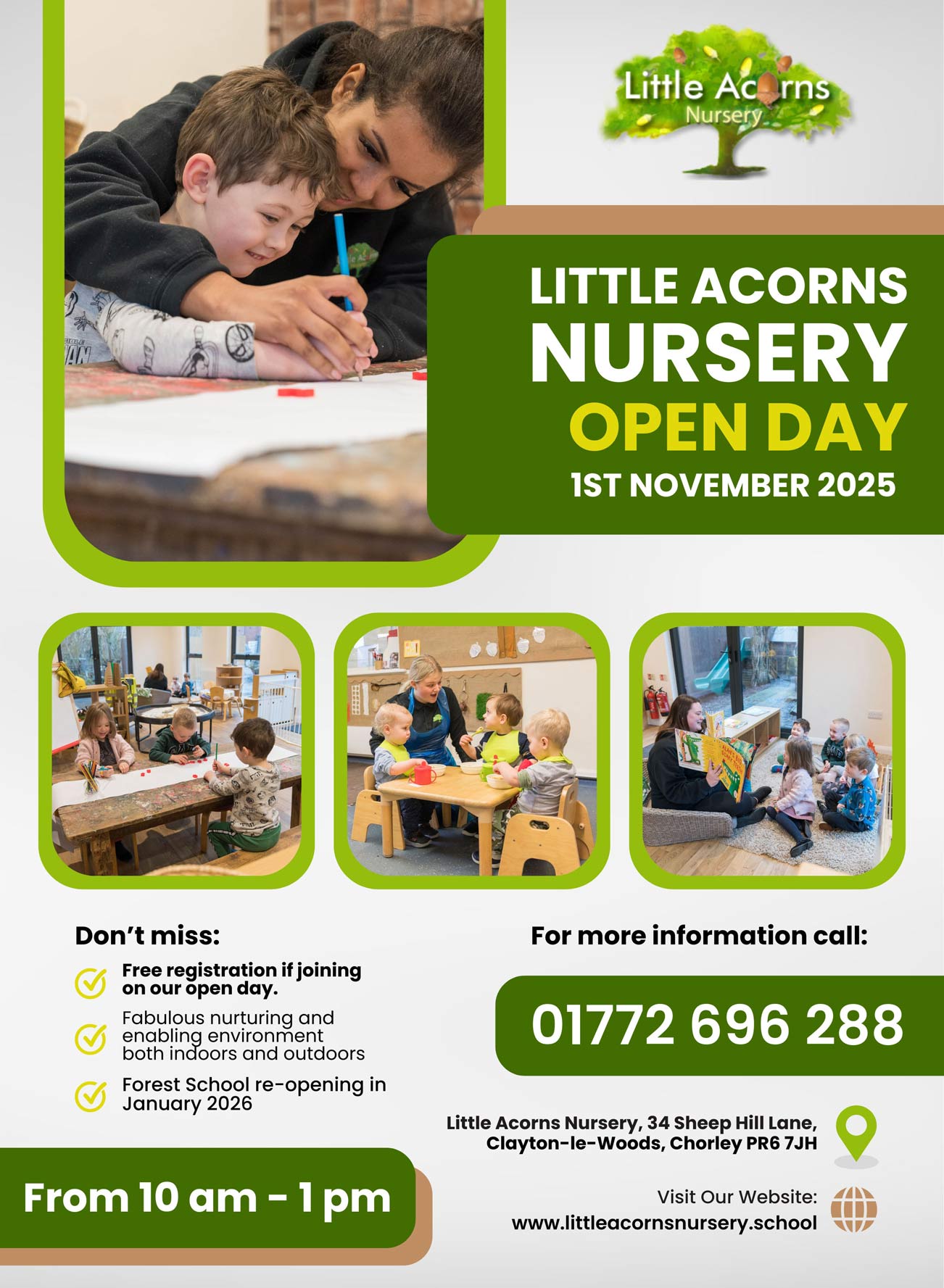
Little Acorns Nursery Open Day: Saturday 1st November 2025

Little Acorns Nursery is rated as a 'Good Provider' by Ofsted.Little Acorns Nursery is holding an Open Day on Saturday, 1 November 2025. We’ll be opening our doors to Lancashire families, so they can see this wonderful childcare setting in person. There’s no need to book — you are welcome to come along at any time between 10 a.m. and 1 p.m. What’s more, being on a Saturday, it should prove more convenient for working families. On the day, our team will be available for guided tours. We can show families the rooms, excellent facilities, and well-equipped outdoor areas, and answer any questions that you might have. Saturday is a non-working day at the nursery, so you’ll have our undivided attention. Why not bring your own child with you, so they can see the setting too — and get a feel for how well they would fit in? Come along — we’d love to meet you!

“A fabulous enabling environment, indoors and outdoors.”

Alert Alert

Come Along — And Save!

If you sign up for a nursery place on the day, we’ll waive the registration fee!

Nursery Open Day: Saturday 1 November 2025, 10 am – 1 pm

Little Acorns Nursery Open Day: Saturday 1st November 2025, 10 a.m. to 1 p.m.

Little Acorns Nursery, Clayton-le-Woods, ChorleyLittle Acorns is a wonderful childcare nursery at 34 Sheep Hill Lane, Clayton-le-Woods, Chorley, Lancashire, PR6 7JH. We are a convenient choice for families seeking high-quality childcare near Clayton Brook, Clayton Green, Chorley, Thorpe Green, Pippin Street, Buckshaw Village, Whittle-le-Woods, Farington, Bamber Bridge, Lostock Hall, Euxton, Leyland, and Penwortham. We operate virtually all year round, closing only for Bank Holidays and over Christmas/New Year. We support free/funded childcare places for eligible children aged from just 9 months— great for working families. Little Acorns Nursery is recognised by Ofsted as a Good Provider.

“Children are happy and settled at the nursery.” — Ofsted, September 2025.

‘Good Provider’ status from Ofsted (September 2025 report).
Government-funded childcare places are supported for eligible families.
A nurturing & enabling environment, inside and out.
Forest School re-opening in 2026.
Baby Massage and Baby Yoga sessions planned for 2026 — training already in progress!
5-Star Food Hygiene Rating from the Food Standards Agency (June 2025).
A purpose behind everything we do at the nursery.

“Children demonstrate a positive attitude to their learning.” — Ofsted, September 2025.

We’d love to show you our fabulous nursery and preschool on the 1st of November, so please come along anytime from 10 a.m. to 1 p.m. — we can’t wait to meet you!

Need More Information? Call 01772 696 288

Little Acorns Nursery, Clayton-le-Woods, Chorley - photographs showing activities with children and staff.

(Free ‘30 Hours’ Childcare Scheme for Eligible Working Families)

Don’t Miss Out on Free Childcare This September: Apply NOW!

Don't miss out on the free ‘30 Hours’ childcare funding scheme for eligible working families.In September this year (2025), free childcare for eligible working families expands to 30 hours per week for children as young as just 9 months. Little Acorns Nursery in Clayton-le-Woods is supporting the funding scheme too. Taken usually over 38 weeks* of the year, it means a generous 1140 hours of funded childcare will be available to eligible children in Central Lancashire over the course of a year. For the first time, the funding will cover eligible babies aged from only 9 months and children up to 2, the scheme having previously rolled out to eligible 3-and-4-year-olds last year. An urgent factor to be aware of, however, is that the funding application deadline is only weeks away for those wanting to start in the September 2025 term. So, whether you’re thinking of applying at Little Acorns Nursery or elsewhere, don’t delay your application any longer if you want to access the free funding from September. If your child is eligible and you do not apply by the deadline, your child will not be able to access the free funding for the entire September term. Read on to learn more about the new funding for eligible working families, the deadlines for applications, and the rules that apply.

Calendar Calendar

When is the Application Deadline for the September Term?

— & What if you Miss it?

The application deadline for September 2025 childcare funding is the 31st of August 2025. At the time of writing (late June 2025), that’s just a few weeks away. If you miss the August deadline, your child will not be able to access funding for that term even if, in theory, they had been eligible. You will then either need to pay for childcare during the September term or defer your funding application to the following one. That begins in January 2026 with an application deadline of 31 December 2025. Similarly, if you miss that deadline, you’ll need to cover childcare costs yourself or defer to the subsequent term, which will start in April 2026. The funding application deadline for the April term will be 31 March 2026.

Is Little Acorns Nursery, Chorley, Accepting ‘30 Hours’ Funded Applications?

Yes, Little Acorns Nursery in Clayton-le-Woods will be supporting the newly expanded free childcare scheme. That means we’ll be able to look after eligible Lancashire children, including babies aged from just 9 months, free of childcare costs for 30 hours* per week subject to available places.

† While the free childcare hours are funded by the government scheme for eligible working families, extras like the cost of trips, nappies, food/drink, and any additional hours are not usually covered. Ask your specific childcare provider for clarification.

Why is the Free Childcare Available?

The newly expanded childcare funding scheme for working families has several aims and stems from plans made originally during the Spring Budget of 2023. Although the governing party changed in the intervening time, the new Government has continued to support and implement the funding scheme. The main aims of the childcare funding expansion include:

  • The '30 Hours' childcare funding scheme helps eligible working families, their children, and the economy.Helping to make childcare more affordable for working families;

  • Helping children to begin their early years education earlier (this has been shown to significantly increase outcomes in studies);
  • Helping parents, particularly mothers, return to the workplace, or extend existing working hours, after having time off to look after a young child;
  • Helping the economy as a whole by filling job vacancies.

The scheme will save eligible families significant sums. With eligible children aged 3 to 4 having been able to access the ’30 hours’ funding since September 2024, this September’s further expansion will mean that eligible children will be able to access free childcare hours from 9 months right up until school age. Fabulous!

“Eligible children will be able to access free childcare hours from 9 months right up until school age.”

Is Your Child Eligible for the ‘30 Hours’ Funded Childcare for Working Families?

The main eligibility requirements are that the child’s parent, and their spouse/partner, if applicable, are each earning:

  1. the equivalent of the National Minimum Wage (or Living Wage) for at least 16 hours per week over the next 3 months and;
  2. no more than £100,000 per annum (current tax year).

Other rules and caveats apply but the above represent the two key rules for eligibility. Learn more here.

Pencil Pencil

How to Apply for Childcare Funding for Eligible Working Families

When to Apply

The application deadline for September 2025 childcare funding is the 31st of August 2025.You can apply for funded childcare for eligible working families as soon as your child reaches the age of 23 weeks (that’s just over 5¼ months). If successful, they’ll be able to start using their free childcare hours the term after they reach the age of 9 months. Depending on when that occurs, they’ll be able to start accessing the funded childcare from either the 1st of September, the 1st of January, or the 1st of April, with application deadlines for each being the day before.
Please note that there are other rules concerning when you can apply if, for example, you’re returning to work following maternity/paternity leave and similar, or you are starting a new job. Learn more here.

Where to Apply

To access childcare funding for working families, you’ll need to apply for it via your Childcare Account on the Gov.uk website. You can use that same link to create a Childcare Account if you don’t already have one. Have your National Insurance (‘N.I.’) number, your Unique Taxpayer Reference (‘UTR’) if self-employed/applicable, and your child’s UK birth certificate reference number at the ready when you apply. Confirmation of your application’s success — or otherwise — is usually immediate but may take up to a week in some circumstances.

Rocket Rocket

How to Access Your Free Childcare Hours

If your application for the ’30 Hours’ childcare funding is successful, you’ll receive a code to your Childcare Account. You’ll need to give the code to your chosen childcare provider along with your child’s date of birth and your own N.I. number. You will need to do so before the deadlines, which are explained in the information box near the beginning of this guide. So, as we said before, if you are applying for the September term, don’t delay — you must apply by the 31st of August or you will miss out on that entire term’s funding.

Is That Everything?

Not quite; you’ll need to reconfirm your details and eligibility every three months. You should do so via your Childcare Account. On success, a new code will then be provided via the account for you to pass on to your childcare provider.

Apply for a Childcare Place at Little Acorns Nursery

High-Quality Weekday Childcare in Clayton-le-Woods, Chorley, Central Lancashire

Little Acorns Nursery, Clayton-le-Woods, ChorleyLittle Acorns Nursery is rated as a 'Good Provider' by Ofsted.Little Acorns Nursery welcomes new applications for childcare places in Clayton-le-Woods, Chorley. We’re a highly-regarded nursery with a Good Ofsted rating and support many different childcare funding schemes for eligible families. As well as serving local families from Clayton-le-Woods and Chorley, we also represent a convenient choice for those in nearby locations like Clayton Brook, Clayton Green, Thorpe Green, Pippin Street, Buckshaw Village, Whittle-le-Woods, Farington, Bamber Bridge, Lostock Hall, Euxton, Leyland and Penwortham.

Get in touch today to explore a possible nursery place for your baby, toddler, or preschooler at Little Acorns Nursery. We’ll be happy to hear from you, show you around, and answer any questions. Get started via one of the following:

* The ’30 hours’ free childcare scheme usually covers 38 weeks of the year and a maximum of 1140 hours per year. Whether the free hours can be spread out a different way, for example using less than 30 hours per week but over more weeks of the year, will depend upon availability from your chosen childcare provider. Ask your provider about availability.

Glowing Ofsted Feedback for Little Acorns Nursery, Chorley

Our post today spotlights some of the many glowing comments made by the Ofsted inspector following her recent visit.Today we look at the wonderful Ofsted report published recently for Little Acorns Nursery in Clayton-le-Woods, Chorley. Ofsted is The Office for Standards in Education, Children’s Services and Skills. Their inspector visited this fabulous Lancashire childcare setting in late August and released its official report a month later on 25 September 2024. Our post today spotlights some of the many glowing comments made by the inspector therein, following her visit. It also highlights the reasoning for ‘good provider’ ratings across all areas of the Ofsted report. Take a look and you’ll see why babies, children under five, and those with special educational needs and/or disabilities absolutely thrive at Little Acorns.
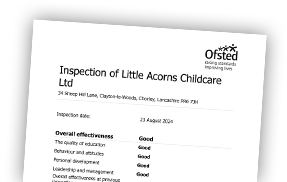
How Does Ofsted Rate Little Acorns Nursery, Chorley?

It’s a clean sweep across all sectors of the Ofsted report:

“The provision is good” — Ofsted

  • Ofsted report for Little Acorns Nursery, Clayton-le-Woods, Chorley, LancashireOverall effectiveness: Good
  • The quality of education: Good
  • Behaviour and attitudes: Good
  • Personal development: Good
  • Leadership and management: Good

Let’s look at some of the wonderful comments made by the Ofsted inspector in her latest report for the setting:

  • Children are Happy at Little Acorns Nursery

    It’s great to see that the Ofsted inspector picked up on just how happy children are at Little Acorns Nursery, Chorley:

    “Children are welcomed warmly by the friendly staff. They arrive happily and are excited to spend time with staff and their peers.” — Ofsted

  • Little Acorns Children are Confident

    We also do everything we can to ensure that children feel confident and valued at Little Acorns and it’s good to see that this was also abundantly clear to the Ofsted inspector:

    “Children are confident, and those who need reassurance receive it in abundance from staff. This helps to enhance children’s self-esteem.” — Ofsted


  • Tailored Learning & Support for Children with Special Needs/Disabilities

    Little Acorns Nursery’s support for children with special educational needs and/or disabilities (‘SEND’) was particularly well regarded by the Ofsted Inspector. In her report, she commented:

    “All children, including those with special education needs and/or disabilities (SEND), make good progress from their starting points.” — Ofsted

    And later …

    “Staff are knowledgeable about the individual needs of all children attending the nursery, including those with SEND. They ensure that, if needed, children are referred to other professionals in a timely manner. Staff work collaboratively with a range of outside agencies. This helps to ensure that the curriculum meets children’s individual needs. — Ofsted

  • Safeguarding — Child Safety at Little Acorns Nursery

    The safety and well-being of children is of paramount importance in any setting. Ofsted recognised the good safeguarding policies and measures taken at Little Acorns Nursery, where staff ensure child safety at all times, including mealtimes:

    “The arrangements for safeguarding are effective […] There is an open and positive culture around safeguarding that puts children’s interests first.” — Ofsted

    “Staff notice and minimise risks to children’s health and safety in the nursery. They complete effective risk assessment and take swift action when they identify hazards. Staff show a good understanding of children’s dietary requirements and allergies. Each mealtime, staff check that children only receive food appropriate for their dietary needs.” — Ofsted

  • High-Quality Staff

    The quality of staff at childcare settings is critically important in so many ways. The Ofsted inspector’s comments demonstrate the quality and suitability of the team at Little Acorns Nursery:

    “… staff ensure the smooth running of the setting […] Children are welcomed warmly by the friendly staff.” — Ofsted

    “Staff form close bonds with children. Their nurturing interactions help children settle quickly into nursery routines.” — Ofsted

    Being a good role model to children is also hugely important, especially in the early years. Little Acorns Nursery staff were recognised in this regard as well as in respect to the high-quality curriculum that’s tailored for each child:

    “Staff are positive role models.” — Ofsted

    “Staff create an ambitious curriculum for all children.” — Ofsted

  • Good Behaviour at Little Acorns Nursery

    Nurturing good manners and appropriate behaviour amongst little ones benefits everyone including the children themselves.Any good nursery or childcare provider will ensure that children understand right from wrong and are mindful of the effect their actions have on others, including peers. Nurturing good manners and appropriate behaviour amongst little ones benefits everyone including, of course, the children themselves. Ofsted’s latest report recognised that Little Acorns is very successful in this regard:

    “Staff are positive role models. They help children learn how to share the toys and resources […] children behave well, they understand some rules such as having kind hands. ” — Ofsted

  • Good Support for Children’s Emotional Development

    Sound emotional development goes hand-in-hand with good behaviour. Staff were recognised by the Ofsted inspector for facilitating good emotional development in the children under their care:

    “Staff support children’s emotional development well. Pre-school children […] take turns to discuss what makes them feel happy and why. Children understand about different feelings and they are learning how to regulate their own emotions.” — Ofsted

  • Encouraging Creativity

    Staff provide plenty of opportunities for children to engage in a variety of activities that boost creativity, motor skills and more.Children find messy play hugely rewarding as well as being immense fun. Messy play nurtures children’s imaginations, creativity, dexterity, and self-expression and benefits them in many other ways. It is therefore a crucial part of early years learning and development — and more important than it perhaps sounds. Ofsted picked up on the quality of messy play activities at Little Acorns Nursery within its report:

    “[Staff] provide plenty of opportunities for children to engage in messy play. For example, babies splash in the raspberry filled water tray and explore the lemon and flowers inside. Pre-school children dip their fingers in paint and create their own colour monster. ” — Ofsted

    What’s more, such activities are good for their motor skills and coordination:

    “These opportunities help to develop children’s hand muscles in readiness for early writing.” — Ofsted

  • Nurturing Physical Development in Children

    Physical development is a crucially important part of a child’s early years and, as such, staff at Little Acorns Nursery are always keen to nurture it amongst children under their care:

    “Babies have plenty of space to crawl and to learn to walk. They beam with joy as they climb up the steps before coming down the indoor slide … Toddlers use spades to scoop up sand and fill their buckets. Pre-school children practise their hand eye coordination as they throw balls through hoops with staff outdoors. This helps to develop children’s larger muscle movements.” — Ofsted

  • Nurturing Independence

    Learning how to be more independent is hugely important for children, particularly in their early years. Not only does it help them learn to be more self-sufficient, but it also boosts confidence and self-esteem and helps to better prepare them for school.

    “Staff promote children’s independence well. Toddlers try to put their own superhero costumes and masks on as they dress up. Pre-school children serve their own food at mealtimes. Children are learning how to manage their own personal hygiene. These opportunities help children to feel proud of the tasks they can complete by themselves.” — Ofsted

  • Well-Promoted Communication & Language Skills

    Communication and language are two of the major keystones of child development. Without such skills, children will really struggle. It is therefore heartening to see that the Ofsted inspector recognised the successes of our approach at Little Acorns:

    “Children’s communication and language skills are promoted well.” — Ofsted

  • Good Partnerships with Parents

    Early years education is more successful when all the adults in a child’s life are pulling in the same direction. That’s why staff at Little Acorns Nursery nurture partnerships with children’s parents and it’s good to see both Ofsted and parents recognising this:

    “Overall, partnerships with parents are good. Staff work closely with parents to share updates on their child’s development using the parent app. Parents discuss the positive relationships staff have built with children.” — Ofsted

View or download the full [September 2024] Ofsted Report for Little Acorns Nursery here.

[2025 UPDATE]: A later Ofsted report was released at the end of September 2025. Learn more about the excellent findings here.

Little Acorns Nursery: a Good, Caring Childcare Provider in Clayton-le-Woods

Little Acorns Nursery, Clayton-le-Woods, ChorleyLittle Acorns Nursery is rated as a 'Good Provider' by Ofsted.As you can see from the wonderful Ofsted comments in their latest report, Little Acorns is a high-quality nursery in Clayton-le-Woods, Chorley. Children have a fabulous start at the setting, in a warm, loving, caring and nurturing environment where the best is brought out in each child in readiness for school. If this sounds like something you’d like for your baby or child under five, contact us, register for a place, or request a free guided visit today:

As an award-winning childcare provider located in Clayton-le-Woods, near Chorley, we may also suit those living in Clayton Brook, Clayton Green, Thorpe Green, Pippin Street, Buckshaw Village, Whittle-le-Woods, Farington, Bamber Bridge, Lostock Hall, Euxton, Leyland, Penwortham and Central Lancashire.

Free Childcare for Children Aged 9 Months+ (for Eligible Working Families Living in England)

Since September 2024, eligible children as young as 9 months have been able to access free childcare in England.With September 2024 arriving, eligible children aged as young as 9 months can now access free childcare in England. The new childcare ‘hours’ are available where working families are eligible for the support and, in tandem, where local childcare providers are set up with appropriate staffing ratios and capacity. The good news, however, is that Little Acorns Nursery, in Clayton-le-Woods, supports the new scheme. It’s therefore with great pleasure that we’re now beginning to welcome children as young as just 9 months of age for free childcare hours at the Chorley setting.

In today’s guide, we’ll explain who is eligible and how much free childcare they can access right now — and in a year’s time when the scheme expands further.

When Does the New Childcare Support Start?

The new childcare support began at the start of September 2024, so it is already available for eligible children. It will expand yet further in September 2025 and we clarify what that means below.

What Free Childcare Can Babies (9m +) & Children of Eligible Working Families Access?

  • From September 2025, eligible children aged from 9 months to 4 years (incl.) will be able to take 1140 hours of free childcare per year.From September 2024 (so already active), eligible children aged from 9 months to 3 years of age can access 570 hours and eligible children aged 3 and 4 can access 1140 hours of free childcare support per year. The free hours are usually taken over the course of 38 weeks (equating to 15 and 30 hours per week respectively). However, some childcare providers may allow the hours to be spread over more weeks of the year by reducing the number of hours per week. Speak directly to your specific childcare provider about the availability of this more flexible option.

  • From September 2025, eligible children aged from 9 months to 3 years will also be able to take 1140 hours of free childcare per year, again usually taken as 30 hours per week. As before, it may be possible to spread the hours out over a greater number of weeks of the year by reducing the number of hours taken per week. Again, speak with your specific childcare provider to see if that option is available if it’s of interest.

Summary:

Available NowAvailable From Sept ’25
Eligible* children 9 months – 3 years570 hours (usually 15 per week)1140 hours (usually 30 per week)
All children 3-4 living in England (‘Universal Entitlement’)570 hours (usually 15 per week)570 hours (usually 15 per week)
Eligible* children 3 to 4 years1140 hours (usually 30 per week)1140 hours (usually 30 per week)

* Subject to eligibility criteria outlined below. Additional charges may apply (e.g. for food/nappies – ask your provider if these cost extra).

Note that some 2 and 3-year-olds are also eligible for 570 hours of childcare funding under a different scheme where they fall into certain ‘additional needs’ categories or their parents receive qualifying government benefits. Today’s guide, however, focuses primarily on the more widely available scheme for eligible working families.

*Eligibility Criteria for Working Families

The free childcare scheme for children aged from 9 months to 4 years (inclusive) applies to children of eligible working families. But what constitutes an eligible working family? The following rough guide explains:

As a rough guide, to be eligible, both you and your partner (if you have one):

  • Families need to meet certain criteria to be eligible for the free childcare hours.Must not have an adjusted net income above £100k in the current tax year;
  • Must each expect to earn at least the equivalent of the National Minimum Wage or Living Wage for 16 or more hours on average per week, over the next 3 months;
    – for those aged 21 or over, this currently equates to £183 per week and £2,380 over 3 months;
    – for those aged 18-20, it currently equates to £137 per week and £1,788 over 3 months;
    – for those either under 18 or in an apprenticeship, it currently equates to £102 per week and £1,331 over 3 months;
    Figures are before tax and are correct at the time of writing (September 2024)
  • Must have a National Insurance number;
  • Must be applying, of course, for a child of the appropriate age for the scheme.

There are additional rules around specific scenarios, for example, for foster carers, those starting a new job, those whose earnings do not form a regular pattern, the self-employed, and those receiving one or more government benefits. Immigration status is also a factor. Learn more about the eligibility rules here.

“Some children from working families can now receive free childcare from just 9 months old until they begin school.”

Get Started!

Learn more about when and how to apply and when you can start using the free childcare hours here. Staff at Little Acorns Nursery in Clayton-le-Woods, Chorley, are also happy to discuss the childcare needs of local parents, including the various funding options available to those who are eligible.

High-Quality Childcare Services in Clayton-le-Woods, Chorley

Little Acorns Nursery, Clayton-le-Woods, Chorley, Central Lancashire

Little Acorns Nursery, Clayton-le-Woods, ChorleyAn outstanding childcare providerLittle Acorns is a wonderful childcare nursery in Clayton-le-Woods, Chorley, Lancashire. We provide a high-quality childcare and ‘early years’ education service for babies and children aged up to five, giving them the very best start in a home-from-home environment. As well as being perfectly located for local families in Clayton-le-Woods, we may also suit families living nearby in Clayton Brook, Clayton Green, Thorpe Green, Pippin Street, Buckshaw Village, Whittle-le-Woods, Farington, Bamber Bridge, Lostock Hall, Euxton, Leyland and Penwortham.

Register your child for a nursery place today, arrange a guided tour, or ask us any questions — we’ll be happy to help:

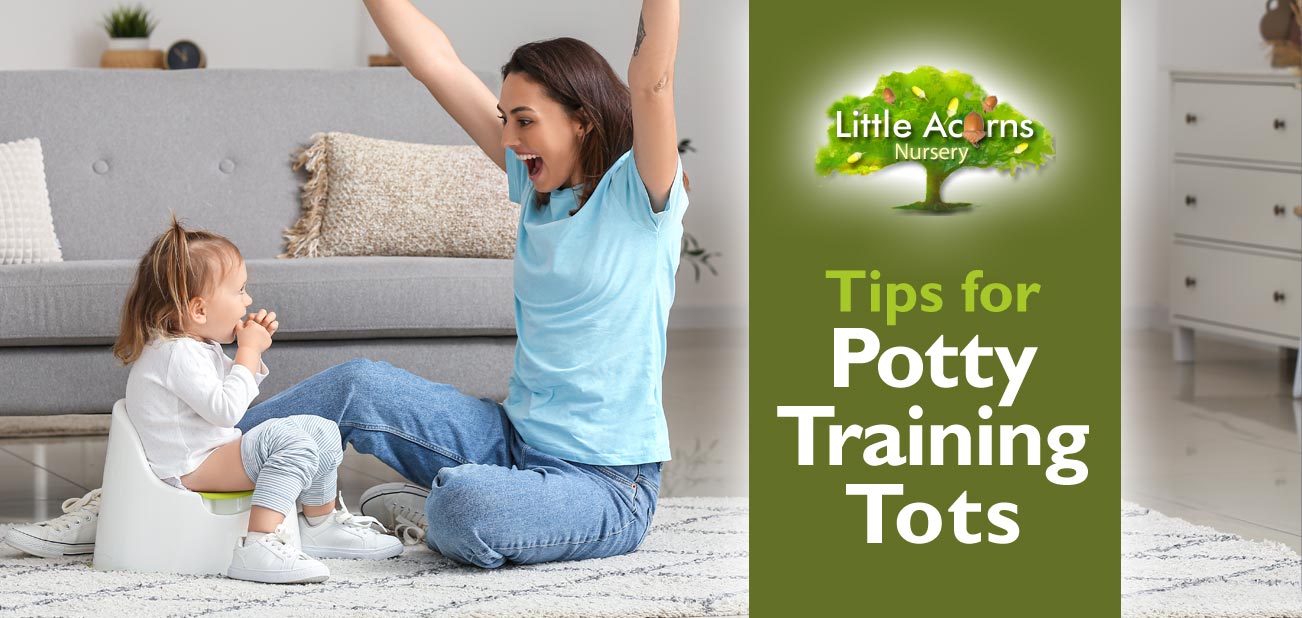
Tips for potty training tots: when to begin, how to encourage toddlers, toileting aids and more.

Achieving potty training success will improve the quality of life for the child, the parent, and other guardians involved in the child's care.One of the key tasks all tots must face, in tandem with parents, is potty training. It’s something we all had to master as toddlers and therefore we know it’s 100% achievable — despite it sometimes seeming to be rather a challenge. Achieving success, though, will improve the quality of life for the child, the parent, and other guardians involved in the child’s care. Learning to master the use of the potty and later the toilet will also be a major boost to self-confidence and independence when the child is at nursery, preschool, and later school. With that in mind, today’s guide outlines our top tips for successful potty training.

First: Some Toileting Milestones

Appropriate timing for starting potty training varies from child to child and situation to situation. That said, the following are rough guidelines for the milestones for many:

  • Most tots stop doing number twos at night by the age of 12 months.
  • Between 2 and 3, some children become dry during the day.
  • By the age of 4, most are completely dry during the daytime.
  • By the age of 6, most are avoiding accidents during both the day and nighttime.
  • Some children, however, may still wet the bed at night beyond the age of 5.

Children cannot help occasional accidents and may indeed be upset by them. It’s essential, therefore, not to scold them or make a fuss about such incidents.

When Should You Begin Potty Training?

Potty training can start any time from 18 months to the age of 3 but most begin between the ages of 2 and 3.Children become ready for potty training at different times — every child is different in that respect, with some starting as early as 18 months and others not training until the age of 3. That said, the majority of little ones begin potty training between the ages of 2 and 3. There are some signs to look out for that will help parents decide when the time is right and we’ll look at those below.

One of the biggest clues that a child is ready to begin potty training is when they become obviously aware of what’s in their nappy. They may, for example, take a peak when being changed, or make it clear they are not comfortable when in need of a change. It could also be as simple as indicating that they are aware when they’re going to the loo in the nappy. Some children may show this by going somewhere quiet and more private when going. Others may do the opposite and make strong eye-to-eye contact with a parent as if to let them know that something is afoot! Such awareness may be key to starting potty training.

Children may also take a lead from parents/relatives or even other children:

A 2½-year-old, who had begun potty training, recently wanted to sit on the “big boy’s toilet” because he’d seen slightly older children doing so at nursery. This was a toileting turning point following what had been, until then, quite a challenging process. (Anecdote from a parent)

There are some practical considerations too. For example, quite a few parents will begin potty training in the warmer months of the year. At such times, there will be fewer clothes worn by children day-to-day, less, therefore, to wash if an accident happens, and likely a working washing line outside to dry everything on. So, by starting during the summer, you can cut down on the workload and potentially save on water and energy.

Encouragement

There are lots of ways to encourage children when potty training.Ensuring children understand the language around toileting is helpful, of course. So, it’s healthy to help children learn the various terms involved, whether talking about a potty, wee-wees, or anything else. Learning appropriate words will empower children to ask for what they need, at appropriate times.

Getting them involved when shopping for toileting products may also give them a deeper interest in potty and toilet training. For example, they may like the look of a potty with a dinosaur on it, or perhaps one featuring their favourite TV character. Other children may like the idea of one of those potties that plays a song when it’s been successfully used.

If there are challenges, families can often get some great success using a reward system. When the youngster successfully uses the potty, they could be awarded a sticker on a colourful, fun-looking potty training chart. Such things are available commercially if you do a quick web search. Another type of reward to be used sparingly could be to award the child a piece of their favourite snack when successful. There’s no doubt this works as an incentive for some little ones.

Another method of encouraging toddlers to use the potty is to walk the child to the potty every 30 to 60 minutes to see if they’re ready to go. The length of time between visits can be gradually extended once that’s working. Visits to the potty are also wise before and after bedtime, following daytime naps, and immediately after mealtimes.

Potty Training/Toileting Aids

Various toileting aids may help with potty and toilet training. Examples include:

  • Various toileting aids may help with potty and toilet training.Potties with designs that are attractive to toddlers e.g. dinosaurs, licensed TV characters etc.

  • Musical potties where a sing-along song is activated on successful use.
  • Portable travel potties — some look like a child’s travel case.
  • Clip-on trainer seats, which attach to adult toilets.
  • Steps to help children reach trainer seats attached to toilets, also allowing them to reach the sink to wash hands afterwards.
  • Pretend toilets and potties that children can use to ‘toilet train’ their own dolls and toys. Such activities can greatly encourage little ones in their own toilet training.
  • ‘Pull-ups’, which are somewhere between nappies and pants/knickers. These may be useful early on or when a child still has occasional accidents but no longer wears nappies.
  • Interestingly, toilet training-themed videos, books, games and songs can also be useful tools to encourage little ones when toilet training as they ‘normalise’ the process.

More Tips for Potty Training Success

  • Making sure that potty training times are fun will help.Only start potty training when your child shows signs that they’re ready. (See the When Should You Begin Potty Training? section above for details).
  • It’s best to start during a quiet time, so there are no distractions.
  • Set a potty training schedule and try to stick to it, so you’re consistent in your message.
  • Try to ensure that your potty training schedule does not conflict with your child’s existing routines.
  • Make potty training fun! (See the Encouragement section above for ideas).
  • Let your child choose their own potty at the store.
  • Buy more than one so you have one in each bathroom/cloakroom and a travel potty.
  • Keep a potty in the bathroom and encourage your little one to use it (or initially even just sit on it) when you pay a visit yourself.
  • Reward your child when successful. Sticker books using fun stickers and a colourful toileting chart can work wonders, for example.
  • Praise your child and their output – it will encourage them.
  • Accidents will happen but don’t make a fuss when they do. Potty training needs to be as stress-free as possible for little ones.
  • Last but not least, remember to encourage good hygiene in your toddler, through handwashing etc.

We hope that our potty training tips are useful and help your child transition smoothly. As we said before, success will lead to more self-confident, independent, and happy children. What’s more, it will also improve the quality of life for parents and caregivers.

An Outstanding Childcare Service in Central Lancashire

We are an outstanding nursery in Clayton-le-Woods, Chorley

An outstanding childcare provider

Little Acorns Nursery, Clayton-le-Woods, Chorley

We are an outstanding nursery in Clayton-le-Woods, near Chorley and offer babies and children under five the very best start in life in a warm, nurturing, home-from-home environment. We also support a range of Government-funded hours and childcare schemes for eligible families. If you’d like to explore a possible childcare place for your child in perhaps the best nursery in Central Lancashire, please get in touch:

As well as being perfectly located for babies and children under five in Clayton-le-Woods (PR6) and Chorley, Little Acorns Nursery is also convenient for those requiring childcare in nearby towns and villages. These include Clayton Brook, Clayton Green, Thorpe Green, Pippin Street, Buckshaw Village, Whittle-le-Woods, Farington, Bamber Bridge, Lostock Hall, Euxton, Leyland and Penwortham.

Significant New Childcare Funding Announced for Families.

A Guide to the Game-Changing Childcare Funding Initiatives Announced in the Chancellor’s Spring Budget 2023

Generous and far-reaching childcare funding reforms were announced in the Spring Budget 2023 last month. The Chancellor of the Exchequer’s new funding plans should give more parents, including those of even younger children, access to significant help with childcare costs going forwards. The new initiatives will:

  • allow Generous childcare funding was announced in the Spring Budget 2023, giving more parents, including those of even younger children, access to significant help with childcare costs.parents to return to the workplace sooner after the birth of their child if they so choose;

  • help fill vacant jobs in the workplace;
  • allow parents (particularly women) to progress their careers sooner after starting a family;
  • help to boost the UK economy, and;
  • perhaps most importantly give more children access to a good early years education, starting potentially at a younger age. Beginning no later than the age of 2 has been shown to better prepare children for the transition to school, boost children’s education overall, improve GCSE grades, improve career prospects and even increase earning potential once they reach adulthood. Learn more about the benefits of a good early years education here.

So, the new childcare funding should make a huge difference for those families that are eligible. Let’s take a look at the 3 key childcare funding initiatives announced…

Significant New Childcare Funding for Children Aged 9 to 36 Months

Many parents will already be aware of the existing, free, Government-funded childcare hours available to all 3 and 4-year-olds in England (plus some disadvantaged 2-year-olds). Well, in the biggest news from the Spring Budget, free childcare funding will soon extend to much younger children, aged from just 9 months of age if they suit eligibility requirements. Here’s how the free childcare will be rolled out:

  1. From April 2024,Significant new childcare funding has been announced for children aged from 9 to 36 months. children aged 2 from eligible working families will be able to claim 570 hours of free childcare each year. This is typically taken as 15 hours of free childcare each week over 38 weeks, although exactly how it’s taken may be agreed otherwise between the family and the childcare provider.

  2. From September 2024, just five months later, the same free childcare scheme will be extended to eligible children aged from just 9 months of age. This comes later so that childcare providers have time to adapt to the extra capacity.
  3. A year later, from September 2025, eligible children aged from 9 to 36 months will be able to claim double the amount of free childcare hours, taking their annual free childcare allowance up to 1140 hours. These will typically be taken as 30 free hours per week for 38 weeks of the year, but it may vary if childcare providers can offer flexibility.

In each case, eligibility for children aged from 9 to 36 months will use the same criteria as for those 3- and 4-year-olds receiving 30 hours of free childcare for 38 weeks of the year in the existing scheme. That scheme will continue to run too, meaning that children from 9 months to the age of four (inclusive) are all supported, right up until they start school. It should make a huge difference to working families and particularly benefit women, who have commonly found it difficult to return to careers following maternity leave.

Significant Improvements to Childcare Funded Through Universal Credit

Significant improvements have been unveiled for childcare funding through Universal Credit.Until now, 87% of those eligible to claim childcare support through Universal Credit were not doing so. One of the main reasons for this was that it’s geared towards low-income families yet required them to pay childcare fees in advance — and later claim them back. Paying in advance is not so easy when household income is low, as is typically the case for households that would otherwise be eligible. For this reason, another of the Chancellor’s initiatives announced in the Spring Budget 2023 is to roll out the following improvements:

  1. The Government will pay for childcare costs, subsidised through Universal Credit, in advance and;
  2. They will increase the amount eligible families can claim in childcare costs, through Universal Credit, by almost 50%. This will increase the amount of free childcare funding available through the scheme from £646 to £951 per month for a single child, and from £1,108 to £1,630 per month for two children. The increase will take effect from July 2023 and the rates paid may be linked to the Consumer Price Index until 2027/28.

The two measures combined should make a tangible difference to cash-strapped parents who would like to get back into the workplace, increase existing working hours, or boost household income. It will also mean, of course, that more children have access to an all-important early years education.

Significant Improvements to Funded Childcare Hours for Children at School

The Wraparound ‘Pathfinder’ Scheme

The Wraparound Pathfinder Scheme would fund childcare hours from 8 am until the start of the school and up to 6 pm after the school day ends.The final childcare-related initiative in the Chancellor’s Spring Budget aims to fix another key problem for parents: how to juggle their own longer working hours with their child’s shorter school hours. When a child attends school, they often finish their school day several hours before their parent is finished at work, for example. There is therefore a childcare requirement to bridge the gap and this may be required both at the start and end of the child’s school day. In view of this, the Chancellor announced the piloting of a new Wraparound Pathfinder Scheme, which would fund childcare hours from 8 am until the start of the school morning and, later in the day, fund childcare for the mismatched afternoon hours up to 6 pm. The pilot will test the scheme to see how well it works. If successful, the Chancellor aims to roll it out to the whole of the UK from September 2024.



A Good Early Years Education at Little Acorns Nursery, Clayton-le-Woods, Chorley

An outstanding childcare provider

Little Acorns Nursery, Clayton-le-Woods, Chorley

Little Acorns Nursery is an outstanding nursery and, with its incredible national award for childcare, offers babies and children possibly the best childcare provision available in Lancashire. So, if you are looking for the best nursery or preschool for your baby, toddler or child under five in Clayton, Chorley or Central Lancashire, please get in touch. We support all Government childcare funding and free childcare hours for eligible families and are a Forest School setting too. We’d love to show you and your little one around, register your child for a place or answer any questions that you may have. Please select an option below to take the next step and we’ll be happy to help.

Little Acorns Nursery is a high-quality nursery and preschool in Clayton-le-Woods, Chorley, near Clayton Brook, Clayton Green, Thorpe Green, Pippin Street, Buckshaw Village, Whittle-le-Woods, Farington, Bamber Bridge, Lostock Hall, Euxton, Leyland and Penwortham.

Follow Little Acorns Nursery on Social Media – for Nursery News, Early Years Information & Expert Insights.

Keep up-to-date with everything happening at Little Acorns Nursery and in early years news and research - subscribe to our social media channels.Are you are a parent or carer of a child under five? If so, you could learn a lot about childcare, parenting and early years learning and development by following Little Acorns Nursery on social media. We’re active across multiple social channels including Twitter, Facebook, Pinterest and Instagram and share high quality content useful to parents of under-fives. That includes parents of children at Little Acorns although, actually, parents anywhere will find the content educational and useful. Our high quality content includes unusually informative ‘early years’ articles and information. For example, a whole range of guides, the findings from various studies, suggested activities for kids and overviews of things like childcare funding schemes with eligibility guidelines. Also, of course, the social media channels include posts relating to the exciting activities happening at the nursery in Clayton-le-Woods, Chorley.

Following is an overview of where you can find — and follow — Little Acorns Nursery and what you can expect to see if you do …

Follow Little Acorns Nursery on Twitter

Follow Little Acorns Nursery on TwitterFollow Little Acorns Nursery on Twitter. There, you’ll see links to some great topics that relate to early years education. You’ll also see regular tweets and posts showing the exciting play and activities that children are taking part in at the nursery.

Follow Us on Facebook

Follow Little Acorns Nursery on FacebookOn Facebook, we share our ‘bigger’ guides and articles from our blog as well as showing interesting content from third parties. Also, of course, we post regular photos and updates for all the goings-on at Little Acorns Nursery in Clayton-le-Woods.

Follow our Pinterest Pins & Boards

Follow Little Acorns Nursery on PinterestWe love Pinterest! Its simple, pictorial approach makes it easy to just pick out something that interests you and save it to your own Pinterest pin board, so you can simply save it or share with others. We’ve got lots of pin ‘boards’ on our Pinterest profile, where we’ve pinned images and links to articles that interest us as early years practitioners. We think you’ll like them too. Board topics include nature activities, sensory activities for under-5s, early years parenting, Forest School, outdoor play, preschool, nursery school activities and, of course, Little Acorns Nursery itself.

Follow Us on Instagram

Follow Little Acorns Nursery on InstagramIf you’re on Instagram, check out our photo gallery on our own Instagram profile. It shows images of the children playing and learning at the nursery as well as featured images that link to our highly interesting blog posts.

Our Google Profile

See photos of the childcare setting, view a location map, read about us, find links to our blog posts and check out our customer reviews. Speaking of which …

Review Us

Review and rate Little Acorns Nursery on Google or FacebookIf you have used our childcare service and were pleased, please review and rate us on Google, or alternatively rate us on Facebook. Of course, though, if there’s anything at all that you’re not happy with, please contact us so that we can rectify the situation right away. We’re here to help!

Bookmark our Blog

Bookmark Little Acorns Nursery's blogWe’re active here on our Little Acorns blog too. Here, you’ll find larger articles that tend to cover the ‘bigger’ topics that parents and carers of children under five will find useful. These are well-researched, detailed and often very educational articles that will keep parents well-informed. For example, we cover topics like childcare funding schemes, help available to children with special educational needs or disabilities, educational food growing activities for under-fives, a myriad of ways parents can super-charge children’s reading and education, wonderful outdoor activity ideas for little ones, and a whole host of guides, how-to articles, activity ideas and useful information relating to parenting or early years learning and development. We’re adding to these great articles and guides regularly each month. So, if you haven’t already done so, bookmark our main blog page and come back regularly — our blog is a real treasure trove of information for parents! Follow the bold links for more information.
Little Acorns Nursery may add more social channels in the future, so watch this space.

An Outstanding Nursery & Pre-School in Clayton-le-Woods, Chorley

An outstanding childcare providerLittle Acorns Nursery, Clayton-le-Woods, ChorleyIt’s official, say Ofsted: Little Acorns is an outstanding nursery and pre-school. We provide exceptional, award-winning childcare in Clayton-le-Woods, Chorley, Central Lancashire (PR6). We are also conveniently located for those in the following towns and villages nearby: Clayton Brook, Clayton Green, Thorpe Green, Pippin Street, Buckshaw Village, Whittle-le-Woods, Farington, Bamber Bridge, Lostock Hall, Euxton, Leyland and Penwortham. If you would like your child to have the very best start in life, Little Acorns Nursery represents the ultimate childcare choice for families in Central Lancashire.

To register your child for a place, ask a question or to see the nursery in action, please click an appropriate button below:

Help for Children with Special Educational Needs & Disabilities (SEND)

Today, we look at how early years childcare providers can help children under five if they have special educational needs or disabilities.Today, we look at how early years childcare providers like Little Acorns Nursery can help children under five if they have special educational needs and disabilities. This is often referred to as ‘SEND’ or in longer forms like ‘SEN and disabilities’. Let’s explore the topic to get an overview of some of the help available.

Childcare Help for Children with Special Educational Needs & Disabilities

Early years and childcare providers can support children under five in a variety of ways if they have special educational or developmental needs, and/or a disability. Indeed, helping affected children as early as possible in their lives is of paramount importance:

“Early identification of needs and the timely provision of appropriate support, together with high aspirations, can help ensure that the vast majority of children who have SEN or disabilities can achieve well and make a successful transition into adulthood.” (DfE)*

The specific strategies used will depend on the child’s individual needs and the resources available to any particular provider. That said, typical examples of ways that early years childcare providers — and others — can support children with special needs include the following:

Identifying Children with Special Needs

If an area of special need is suspected, early years providers can work with parents and sometimes other professionals to get an assessment and support if needed.Actually identifying an area of special need or disability is, of course, the first, crucial step in being able to help a child. If an area of special need is suspected, early years providers can work with parents and sometimes other professionals, for example health visitors, speech and language therapists, paediatricians and so on. Involving such professionals will help with any diagnosis.

It’s worth bearing in mind that the presence of a special need may not be crystal clear in many cases, especially when children are very young. As an example, it would not be possible to diagnose dyslexia until a point when a child’s understanding of language is sufficiently developed to actually begin the process of reading text. However, the involvement of such external expertise may make the initial identification of a child’s special need or disability more feasible.

Following such a diagnosis, the various parties surrounding the child can then, together, develop a plan of how best to support that child during their early years and potentially beyond. For our part as a nursery and childcare provider, we will also ensure that we regularly review the support that an affected child receives, making adjustments and taking further actions etc. when appropriate. 

Creating an Inclusive and Supportive Environment

It's important for early years providers to create an inclusive environment that welcomes and supports children of all abilities.This is important. Early years providers can create an inclusive environment that welcomes and supports children of all abilities. Encouraging the inclusion of children in social groups and in the making of friends, for example, is of huge benefit to children’s well-being. Childcare settings can also provide special equipment or adapt the environment to make it more accessible for children with specific physical needs.

Creating a positive and responsive culture is also crucial, so that children feel comfortable to express themselves, irrespective of any differences or abilities/disabilities that they may have.

Additional Support and Resources Through Funding

In some circumstances, childcare providers can access special funding in order to provide additional support and resources to children with special educational needs or disabilities. Examples include the hiring of additional staff to provide one-to-one support, providing extra resources to support learning, or offering additional activities to extend children’s experiences. Access to the specific funding will, though, require eligibility criteria to be met. Often, such funding applications may require a team effort between parents/carers, childcare settings and potentially other types of early years professional mentioned above.

Tailoring Learning & Development Plans & Activities to Meet Individual Needs

Learning and development plans and activities are tailored to suit each child. This is designed to meet the needs of every child individually, including those with special needs.Early years providers like Little Acorns Nursery adapt the individual learning and development plans and activities to suit each child. In this way, they’re custom-designed to meet the needs of every child individually, including those with special needs. This is done as a matter of course as part of the Early Years Foundation Stage (EYFS) approach to early years education and development. The tailored approach helps to level-up the playing field and, in effect, encourage equal opportunities for each child. It also helps them to reach their own personal bests in every area of their learning and development.

Progress Checks

The EYFS approach means that our early years practitioners use a continuous assessment approach in regard to every child’s progress, whether or not they have special needs or any disabilities. However, for those affected by SEN or disabilities, such an approach is even more crucial.

Special education provision for children, including those with SEN or disabilities, follows four stages of action: “Assess, Plan, Do and Review.”

In tandem with this, all children receive a Progress Check at 2 and this will highlight whether progress is on track, additional support is appropriate and indeed whether there is a SEND-related issue. Either way, tailored activities and strategies will be planned and put in place to address any issues and help optimise every child’s progress.

Special education provision for children, including those with SEN or disabilities, follows four stages of action: “Assess, Plan, Do and Review.Later, each child will similarly have an ‘EYFS profile’ completed during the final term of reception year. However, as we’re focusing this article on children under five, we’ll not go into detail about that here.

The SENCo

As well as having a ‘Key Person’ allocated to each child, early years providers like Little Acorns have a Special Educational Needs Coordinator (SENCo). The SENCo oversees the setting’s tailored support for children, under their care, who have special educational needs or disabilities. Similarly, the local authority will have an Area SENCO. They will advise and help coordinate support for children with special needs between the local authority itself, the child’s parents, early years and education settings, health and social care services and so on. The Area SENCO will also help when the time comes to transition the under-five child to school.

Communicating with Parents and Other Professionals

Communication is key. Childcare providers like Little Acorns Nursery will communicate regularly with parents/carers and, when appropriate, local authorities, health visitors, paediatricians and other healthcare professionals. This is to ensure that everyone is aware of the child’s progress and any additional support that may be needed. Ensuring that all parties are pulling in the same direction is crucial to outcomes for each child, particularly if they have special needs and/or disabilities.

“When a child is very young, or SEN is first identified, families need to know that the great majority of children and young people with SEN or disabilities, with the right support, can find work, be supported to live independently, and participate in their community.” (DfE)*

EHC Assessments and Plans

In the event that a child does not make the expected progress despite everyone’s best efforts and high quality support, there is recourse to request an Education, Health and Care (EHC) needs assessment via the local authority. If such a request is made by a childcare setting, it would only be done with the knowledge of the child’s parent(s) and after discussion with them. Basically, such an assessment may result in a brand new plan to support the child, if that’s deemed appropriate. It’s a big topic in its own right, so we may follow up separately to explain more about EHCs in due course.

The ‘Local Offer’ from the Local Authority

The 'Local Offer' from local authorities outlines the help available in the area for children with SEN or disabilities, including how to access that support.It may be useful for parents and carers to note that local authorities have a duty to publish what’s known as a ‘Local Offer’. This outlines the help available in the area for children with SEND, including how to access that support.

A good example is the Local Offer published by our own local authority (Lancashire County Council), which can be found here. (Note that the early years childcare section of that particular Local Offer can be found here). A quick search there for SEND services will indeed reveal Little Acorns Nursery as an outstanding provider of childcare services, including for children with special educational needs and disabilities.

Free Funded Childcare Places for Children with SEND

While all 3- and 4-year-olds in England have access to free childcare provision each week, 2-year-olds with SEND may also be eligible for a significant number of free childcare hours if they get a Disability Living Allowance (‘DLA’), have a valid Education, Health and Care (‘EHC’) plan or have been referred through the local authority’s Portage service. Follow the bold links or speak to us at Little Acorns Nursery if you are local to Clayton-le-Woods, Chorley, and would like to learn more more about the options.

Outstanding Childcare in Clayton-le-Woods, Chorley

An outstanding childcare providerLittle Acorns Nursery, Clayton-le-Woods, ChorleyChildren get the very best start at Little Acorns Nursery. Little Acorns is an outstanding nursery and pre-school in Clayton-le-Woods, Chorley, Central Lancashire (PR6). We are also close to Clayton Brook, Clayton Green, Thorpe Green, Pippin Street, Buckshaw Village and Whittle-le-Woods. Farington, Bamber Bridge, Lostock Hall, Euxton, Leyland and Penwortham, so may suit those living/working in any of those nearby locations. Trust your child’s early years education and childcare to an award-winning nursery/pre-school and a nursery recognised by Ofsted as an Outstanding Provider

To register your child for a place at Little Acorns Nursery, to ask a question or to see the nursery in action, please contact us:

* Quotation references: DfE, ‘Early Years: Guide to the 0 to 25 SEND Code of Practice’