


World Wildlife Day arrives in early March each year — just around the corner at the time of writing. The annual event is hugely important and very worthwhile. It is also a great opportunity to inspire children to get more interested in the natural world. By doing so, they will benefit wild animals and plants — as well as themselves through fun, learning and discovery. What’s more, many of the nature-inspired activities that we’ll suggest today are totally free.
Spending time in and around nature is incredibly good for children and World Wildlife Day offers families many opportunities to get much closer to it. As well as being great fun, such activities can open children’s eyes to humanity’s impact on the planet and help them understand the importance of looking after nature’s incredible flora and fauna. Learning about the plight of some of the Earth’s wild animals and plants will also nurture a greater respect for the natural world. It will help to encourage greener values, greater empathy, and a sense of responsibility in even the youngest children. It is also likely to instil in them a love for the great outdoors and encourage outdoor play, which is also hugely beneficial to children. With all that in mind, let’s dive into what World Wildlife Day stands for and then explore some of the children’s activities inspired by the initiative. Families right across the UK can take part, explore and discover. In so doing, they will self-improve, become more responsible citizens, and evolve into more effective stewards of this irreplaceable planet.
About World Wildlife Day
World Wildlife Day (‘WWD’) always arrives on the 3rd of March. In 2025, that will fall on a Monday, then in 2026 it’s a Tuesday — and so on. WWD is an initiative born in late 2013 at the United Nations General Assembly and is closely related to CITES, which is all about the conservation of endangered species of wild flora and fauna. So — it’s incredibly worthwhile and families can each play their part in raising awareness.
“UN World Wildlife Day has now become the global annual event dedicated to wild animals and plants.”
Activity Ideas for Children & Families
Children and families can get involved in World Wildlife Day in a variety of ways. For example, they can simply get out for walks in local parks and countryside to see some of nature’s flora and fauna, embark on activities to attract wildlife to their own gardens or, if the weather is inclement, get creative at home with some wildlife art. The only limit for possible wildlife-related activities is the imagination! That said, we’ve got some suggestions below to inspire families and children to get started.
Create Some Wildlife Art!
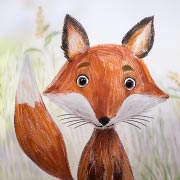 Children will love creating wildlife art. Whether it’s drawing animals and plants, making a collage, or constructing an animal out of cardboard or origami, wildlife art is a wonderful way to get children involved. What’s more, they will get a sense of satisfaction from the activity and it can help them appreciate wildlife more.
TIP: Use IFAW’s International Youth Art Contest art competition as possible inspiration. Although it’s now closed in 2025 for judging in readiness for the March event, you can view some previous entries to give your child inspiration (scroll to the bottom of that linked page to see the full gallery of examples).
Another great wildlife-related art activity is to challenge children to combine 2 or more creatures, thereby creating their own, new hybrid animal. Results can be inventive, endearing, or sometimes hilarious! [Examples].
Support a Wildlife-Related Charity
 Another incredibly worthwhile activity that children can get involved in is fundraising for a wildlife-related charity. This can be done, for example, through a sponsored activity of some kind. That could be a sponsored walk, hop, swim, or whatever children and families choose (under supervision, of course, for the youngest). A sponsored fundraising activity will not only raise funds for a wildlife charity of choice but also spread the word. Furthermore, children will get an enormous sense of achievement at the end when their actions raise vital funds for animals or conservation. Volunteering for local wildlife charities is also hugely worthwhile, of course, but it is more suited to when children are older.
“With over 1 million species estimated to be threatened with extinction, and facing the intensifying triple planetary crisis, innovative finance for wildlife conservation is more urgent than ever.”
Storytelling With a Wildlife Theme
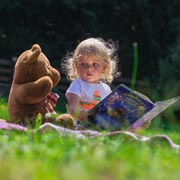 Challenging children to create stories involving wildlife and nature is both creative and fun! Adults/parents can lead by example, to begin with, so that the youngest children can get the idea. Whether the story involves feeding hungry squirrels in the forest, swimming with dolphins, going on an adventure in the jungle, or something entirely different, it’s sure to pique children’s interest. It will stimulate children’s imaginations and natural spirit of adventure as well as helping to raise awareness of some of the issues facing wildlife.
Challenge the Family to Live More Sustainably
 World Wildlife Day brings into focus the enormous challenges that affect nature’s flora and fauna. Sadly, many of those challenges are caused by humans, whether it’s due to habitat loss, global warming, or something else. By raising awareness through World Wildlife Day activities, children and families can also challenge themselves to live more sustainably. This is a whole topic in itself! However, some easy measures can be things like:
- cutting out food containing palm oil, which is responsible for the clearance of huge swathes of forests and jungles;
- stopping the use of harmful chemicals in the home and garden (slug killers, pesticides and weedkillers, for example);
- eating more vegetarian and vegan food options, which is better for the environment and, of course, animals;
- recycling more waste;
- using more sustainable, wildlife-friendly products in the home;
- and reducing the use of plastics.
It’s a huge topic, so some research will be needed although our examples are a great starting point and are good things to bring to children’s attention.
Visit a Local Zoo or Wildlife Sanctuary
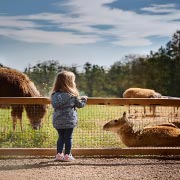 Children can also get closer to wild flora and fauna if they live near a wildlife sanctuary (or zoo) or somewhere like a national park. Nothing can really replace seeing animals and plants in real life and so it’s worth researching to find somewhere to visit close by. In Lancashire, just five miles from Little Acorns Nursery, for example, is Turbary Woods Owl & Bird of Prey Sanctuary, which is well worth a visit. There, kids can see owls, falcons, hawks and more. Visiting will support this non-profit enterprise, educate little ones and give them a wonderful day out.
Plant & Food Growing
 Teaching children how to grow their own plants and, better still, food is a wonderfully educational and fulfilling activity. As well as learning to appreciate wild plants growing in parks and the countryside, learning how to grow their own, at home, is also great fun. Luckily, we have a whole blog post dedicated to Food Growing for Kids, so do take a look.
Take Children on a Nature Scavenger Hunt!
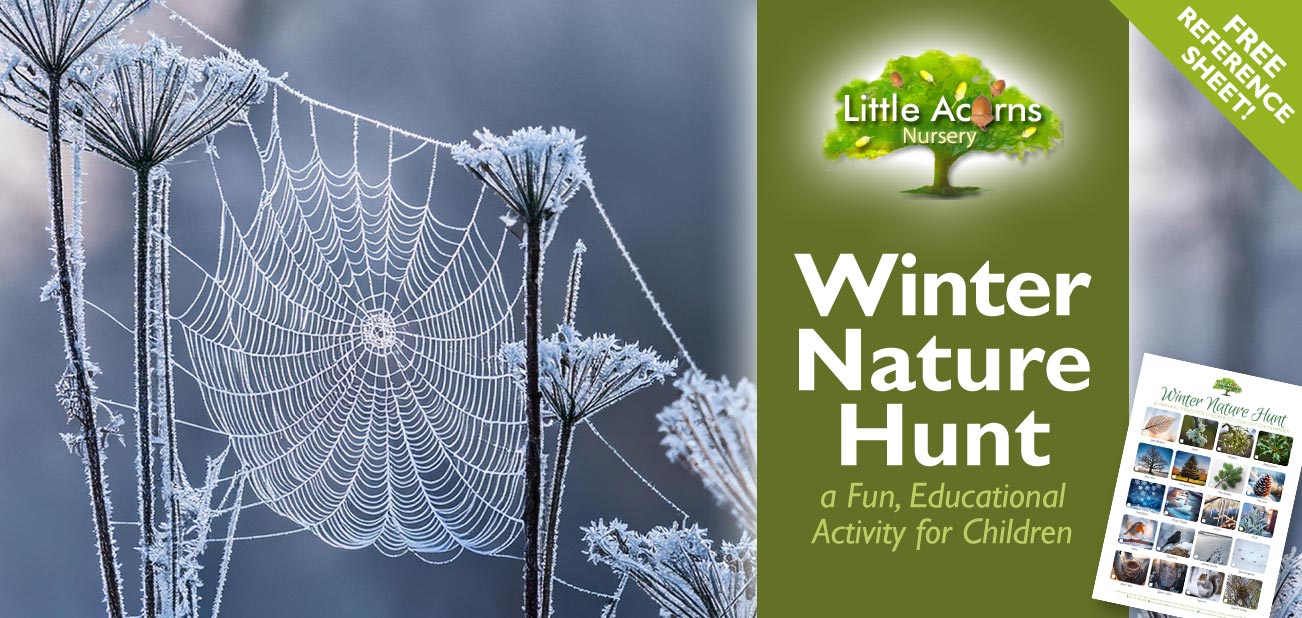
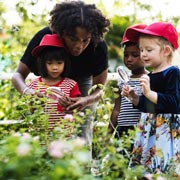 A nature scavenger hunt is also great fun and is sure to get children interested in nature, wildlife, and the outdoors. The activity involves looking out for specific natural things, for example, a pine cone, a robin, a squirrel’s drey (i.e. nest), a winged seed, or animal tracks. It will also give children exercise and get them closer to nature in a fun, engaging activity. To make it easier, check out our free Nature Hunt activity reference sheets; our Winter Nature Hunt activity is here and, for later in the year, our Autumn Nature Hunt can be found here. We’ll be adding more to that series in due course.
Animal & Bird Spotting
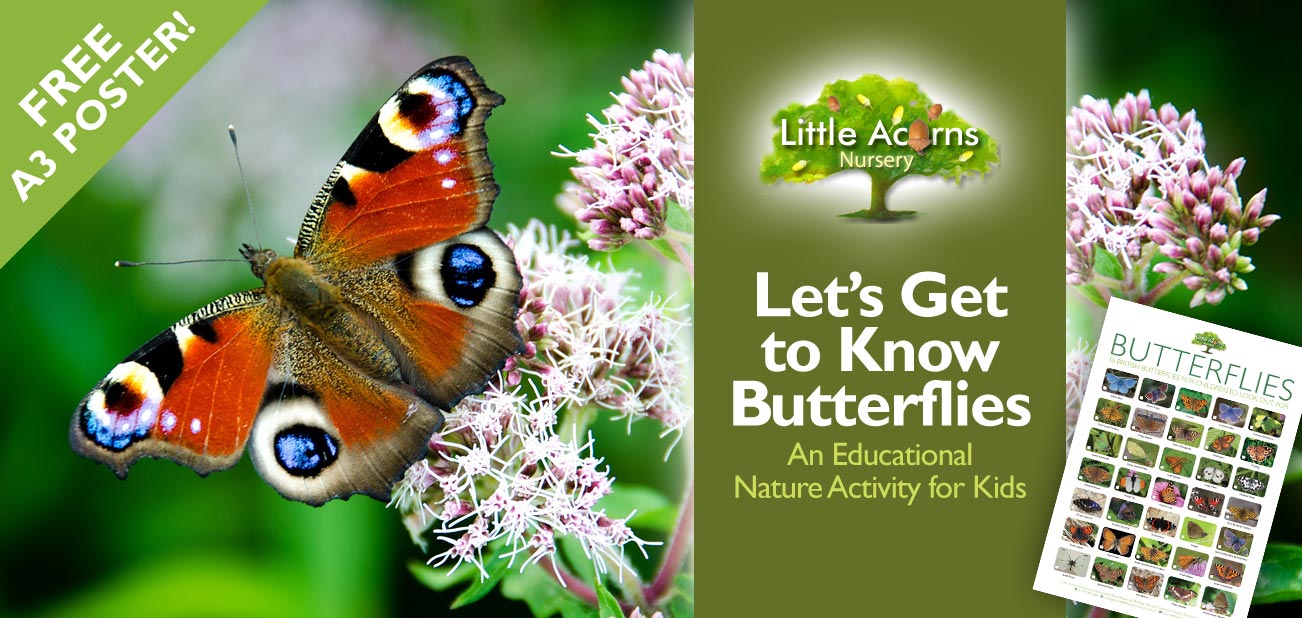
 Encouraging (and supervising, where appropriate) an activity where children try to see different types of animals, birds, and insects is also a wonderful way to get them interested in nature. To make it easier, we have published some free, downloadable reference sheets, which also double as posters, for families to use during this activity. These include one for British birds, another for British land mammals, one for British butterflies, and one for minibeasts that children are likely to find in gardens and compost heaps.
Attracting Wildlife to Your Garden
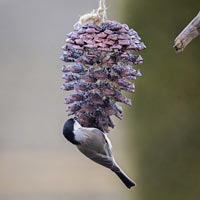 If children like the idea of attracting birds and other wildlife to their own garden, there are many easy ways to make this possible. As well as putting out suitable food to attract birds, children can help make a quiet, wild area with a compost heap to attract minibeasts. There are so many ways to attract wildlife so, to get you started, check out our wildlife-friendly flower-growing activity here, our make-your-own bird feeders activity and then be sure to read our guide to bird feeding for under-fives. And don’t forget — ditch the harmful chemicals like weedkillers, pesticides, slug and snail killers. After all, if a bird or animal eats something affected, it will also then be in danger from such poisons — and beautiful pollinators like bees and butterflies are being decimated by pesticides. Our children are tomorrow’s stewards of the planet, so it’s important to educate them to form good habits and show empathy towards wildlife.
These are Learning Opportunities
As a parent, you’ll notice that these activities are learning opportunities for children and also include many teachable moments. Through such activities, children will begin to understand the impact that they have on other living things around them and the environment as a whole. They can then adopt greener values, improve feelings of empathy, and understand how to be more responsible citizens. In short, they can self-improve while making the world a better place. Such is the power of the opportunity that World Wildlife Day offers to families who celebrate it. Enjoy!
A Childcare Place at Little Acorns Nursery, Clayton-le-Woods
Weekday Childcare for Babies, Toddlers & Preschoolers Near Chorley
 The staff at Little Acorns Nursery in Clayton-le-Woods hope that families enjoy today’s post and the activities suggested therein. We know how important nature is to children and, indeed, have our own gardens where children can connect with nature and enjoy the freedom of outdoor activities.
If you’d like to consider a possible nursery place for your baby or child at Little Acorns, please get in touch using one of the options below. We support many of the government’s childcare funding schemes including free childcare for eligible babies from 9 months of age. As well as being a nursery and preschool for families in Clayton-le-Woods and Chorley, we may also suit those nearby in Clayton Brook, Clayton Green, Thorpe Green, Pippin Street, Buckshaw Village, Whittle-le-Woods, Farington, Bamber Bridge, Lostock Hall, Euxton, Leyland and Penwortham.
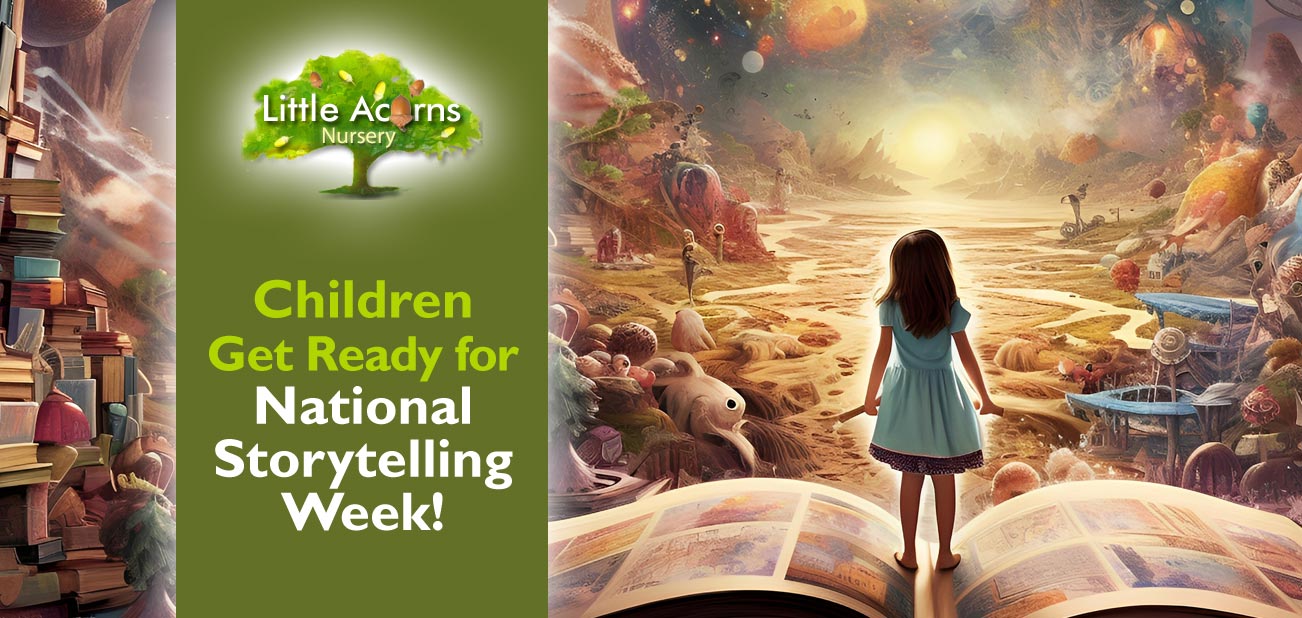
 With the start of the new year now behind us, it’s time for children to get ready to take part in National Storytelling Week. This year it begins on Saturday the 1st of February and ends on Sunday the 9th. It’s a wonderful initiative that brings children and families together to use their imaginations, get creative, and entertain one another. What better time of the year to do that than during mid-winter? National Storytelling Week is perfectly timed to be a fabulous antidote to cold, blustery, winter days and is a wonderful way for children to escape through the power of the mind.
 Whether listening to another’s story or creating it themselves, storytelling is a fun activity for children and adults alike. In either case, imagination is a powerful thing that will allow children to immerse themselves in new worlds, new situations, and new adventures. What’s more, it can even allow them to temporarily become someone or something else. That’s hugely powerful!
 With a theme as open-ended as reimagining their world, children have free reign to come up with all kinds of storylines and scenarios. When it comes to creating stories the world is, as they say, their oyster and it’s only limited by their imaginations. They could perhaps come up with some kind of fantasy with colourful landscapes, magic, and weird, wonderful creatures. Or perhaps the story revolves around a futuristic city where travel by hoverboard is the norm. Or maybe the storyline is something more simple and subtle that’s not so different to reality. It’s entirely their choice and, for supervising adults and parents, it’ll certainly be interesting to see what they create.
 First-time storytellers may better grasp the idea if an adult/parent first tells a story as an example. This will help them see what’s possible — and indeed show that anything is possible.

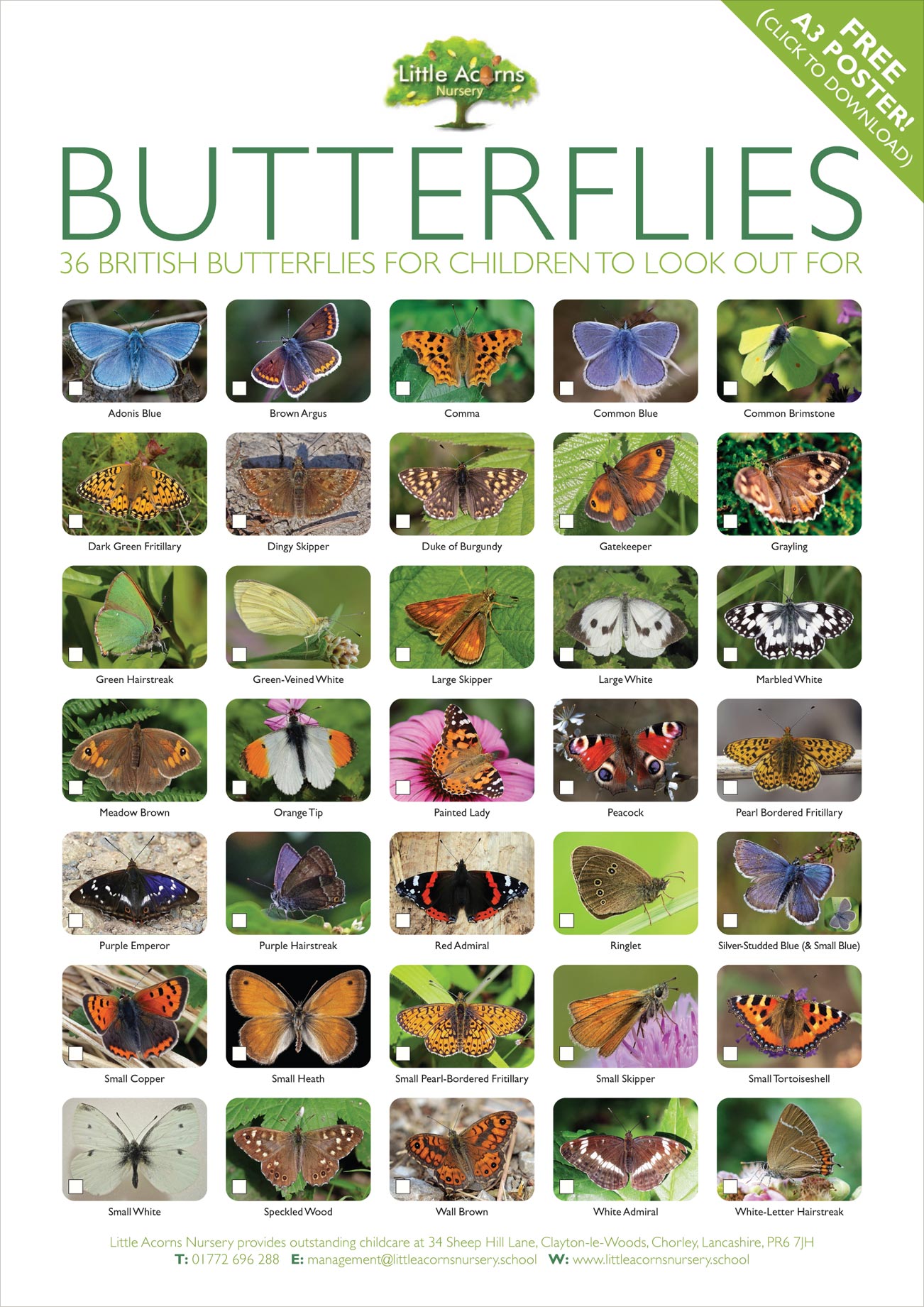
 For many species, population numbers have plummeted over recent decades. Introducing your child to today’s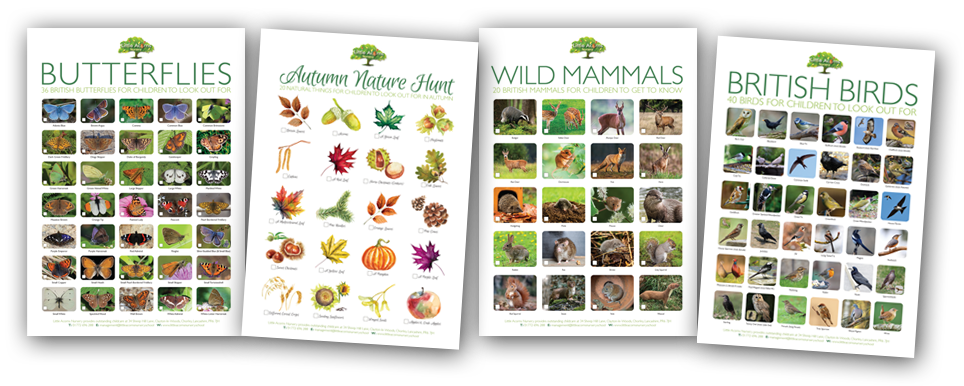



 Children and childcare staff at Little Acorns Nursery love nature. So, with World Wildlife Day coming earlier this month and Spring now upon us, it’s the perfect opportunity to release our free Wild Mammals poster. Shown in full colour and printable in high resolution at A3 or A4, it features 20 British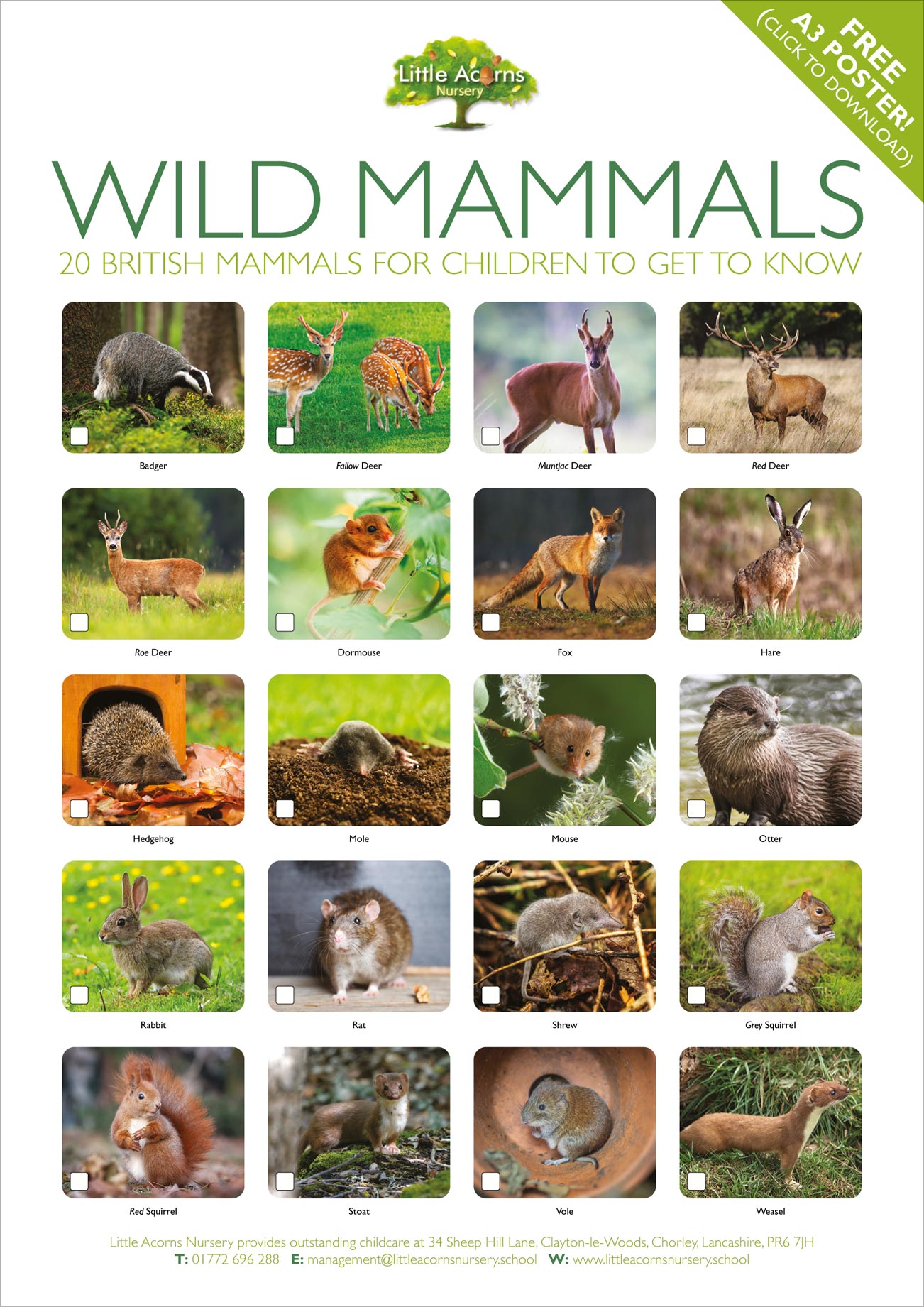



 With Chorley Football Club being only 4.8 miles and a 14-minute drive from
  Participation in sports benefits children in many different – and often profound – ways. That’s especially true for children in their early years, being a stage when they learn fundamental skills like jumping, running, throwing and catching balls, etc.
 Sports and active hobbies will also help little ones hone balance, agility, coordination and motor skills. That’s incredibly important during early childhood as these key skills are still developing and, as the old proverb goes, “practice makes perfect.”
 Sport is a great socialiser too. Through sport, they’ll get used to interacting with other children as well as coaches, teachers, or childcare professionals. Moreover, children not only make new and deeper friendships through sport, but also learn social skills before, during and after such play. These skills and benefits will stay with them for the long term and will help to enrich their lives in profound ways.
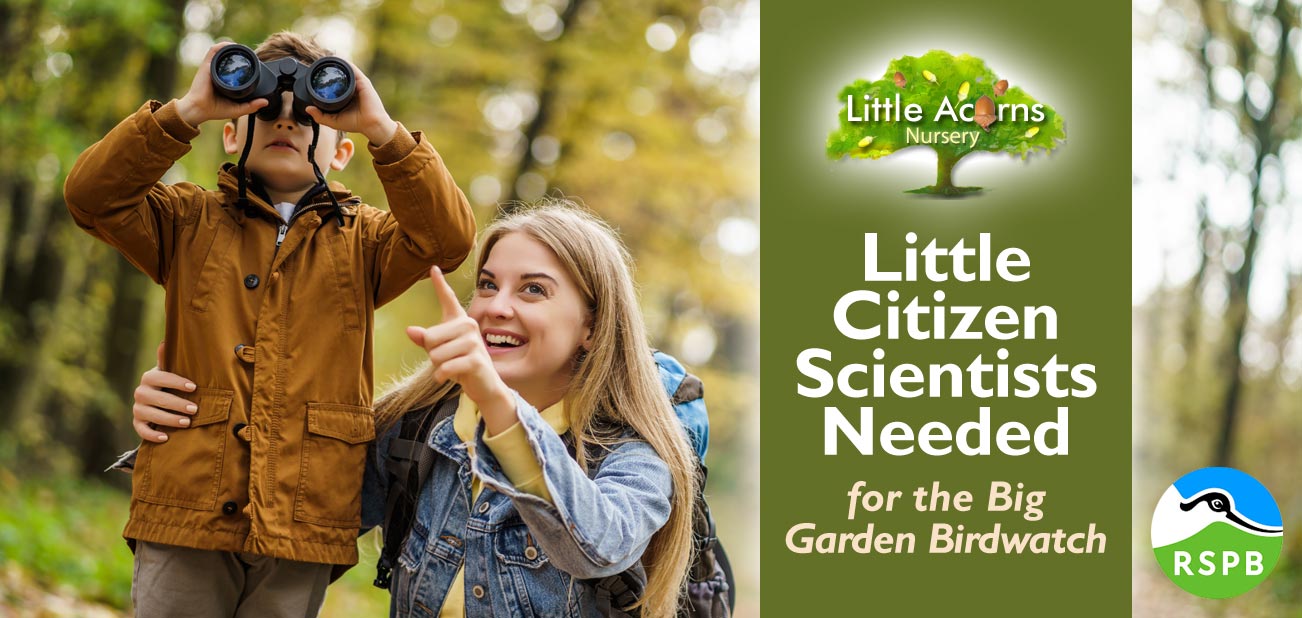
 January’s Big Garden Birdwatch is a perfect home learning opportunity where children can find out about wild birds and get a better understanding of nature itself. What’s more, it’s a hugely worthwhile event that will benefit birds, conservation efforts, and children themselves. The activity also demonstrates how easy it is for little ones to become citizen scientists. With that in mind, let’s explore today the Big Garden Birdwatch, explain what it is, how to take part, and why it’s important for families to get involved.
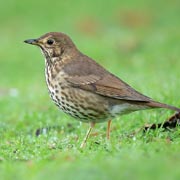 The idea of the Big Garden Birdwatch is to understand how garden birds are faring in the UK. Sadly, many bird populations are in decline, with some species facing huge declines over recent decades. Some 38 million fewer birds are now seen compared to 60 years ago. Song Thrush populations, for example, are down by 80% since the survey started in 1979. Even House Sparrow numbers have more than halved during that time. By studying the bird populations each year, trends can be identified including whether any bird species are in danger. Then the RSPB and other conservation organisations can work out what the problems are and how we might go about rescuing the situation as a nation. It also follows that, if there is a problem with bird populations, then there is likely to be a wider problem in nature too. This could be, for example, due to disease, over-intensive farming methods, habitat loss, invasive species, climate change, use of chemicals in gardens and farmland, and so on. Gathering data across the UK each January will help guide the nation to improve things — and children can help by getting involved in the Big Garden Birdwatch each January.
 — it’s quick, easy and free to do so. Once registered you’ll receive detailed instructions in your free guide to the event, which includes your free bird identification reference sheet. This will be useful to you and your children so each bird species can be recognised more easily.
 This wonderful activity is a great way to encourage families outdoors, where children benefit from nature in a myriad of ways. From lower stress and increased well-being to improved academic performance, stimulated imaginations, and better sleep,
 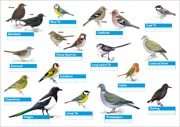 Together with the RSPB, we also have bird identification covered for children. The first option is the RSPB’s free bird reference sheet, which families will receive when they register for the event. Their digital version is best because it’s more environmentally friendly, is quicker to access, and usually shows a larger list than is shown on their printed version.
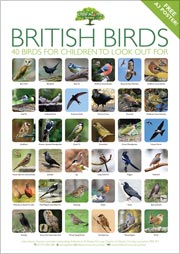 However, don’t forget that Little Acorns Nursery also published
 As we discussed in our recent post
  Designate an area in your home for play. It doesn’t need to be elaborate — even a corner with a few age-appropriate toys, books, and art supplies may be sufficient. Ensure, of course, that the space is safe and free from hazards before your child embarks on their play activities.
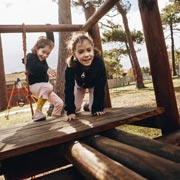 Outdoor play also offers a wealth of learning opportunities. It promotes physical health, stimulates the senses, and allows for unstructured exploration, which all contribute to holistic development. Take your child to the park, explore nature, or simply play with them in the back garden if you have one. Outdoor activities will also foster an appreciation for the natural world. Indeed, we wrote a whole post about
  Reading is a wonderful way to support learning through play. Choose age-appropriate books, of course, and be sure to engage in interactive storytelling. Ask and encourage questions about the story, encourage your child to predict what might happen next, and ask them what they might do if it were them in the story. Books and reading teach children so many things and, like pretend play above, truly encourage their imaginations and get their creative juices flowing.
  Arrange play dates with other children or involve siblings in play activities at home. Social play helps children learn essential social skills like cooperation, sharing, and conflict resolution. It’s also a great way to make new friendships, learn from each other, and become a closer member of friendship circles.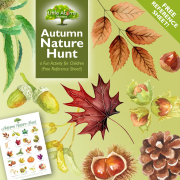
 By mid-November, autumn is in full swing and leaves are turning a myriad of different colours. Scenes of green, yellow, red and golden trees can be breathtakingly beautiful and the air is often crystal clear at this time of year — that’s great for photos! The autumn season also brings with it a treasure trove of fascinating natural things that children can discover if they take the time to look. Indeed, an autumn nature hunt is the perfect excuse for little ones to spend some time outdoors, where they will also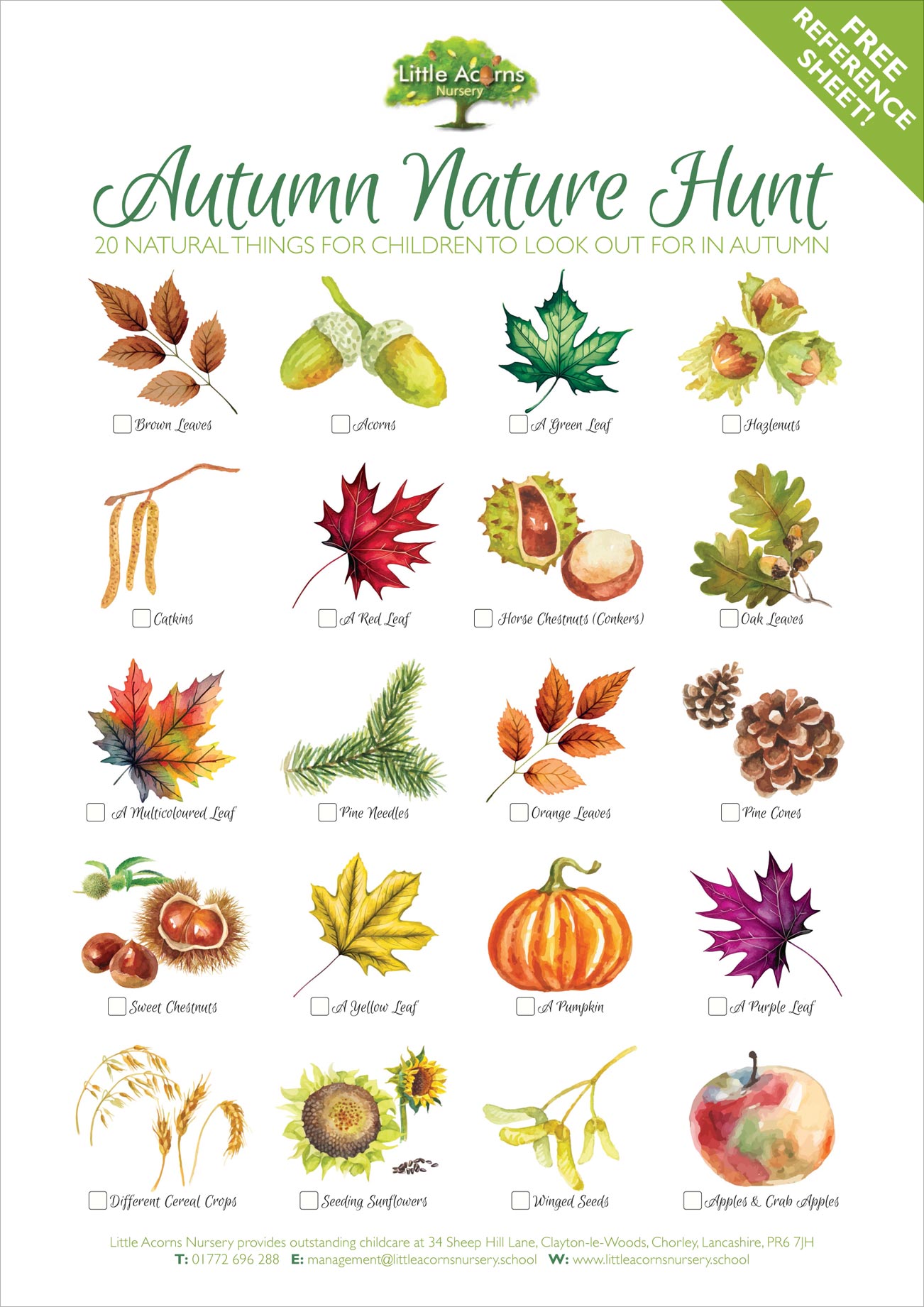
 Ensure children, particularly the very young, receive appropriate adult supervision at all times. Although fascinating and fun, the outdoors holds many hazards for the unwary. Therefore, children will need to be closely monitored by a responsible adult in order to safeguard their well-being.
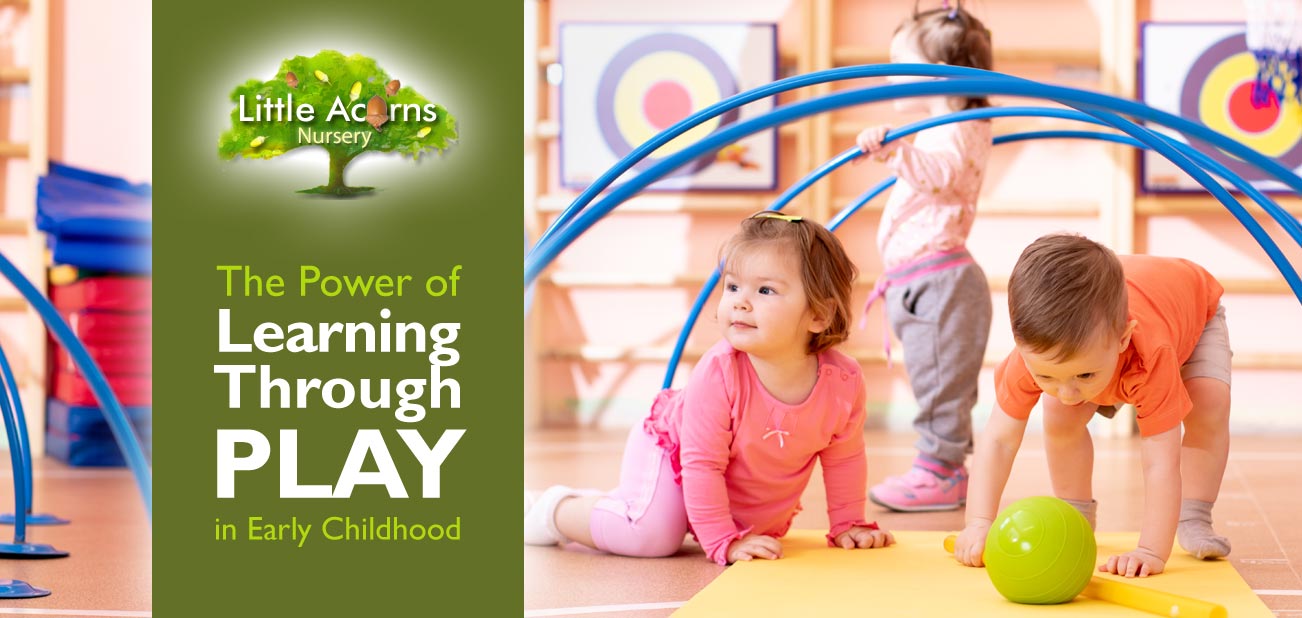
 In the world of child development and early education, there is a simple yet profound truth: children learn best when they are learning through play. Play is the universal language of childhood and, indeed, it transcends both borders and cultures. Whether it’s building sand castles on a sunny beach or arranging blocks on the floor at home, play is the gateway through which children explore, discover, and grow.
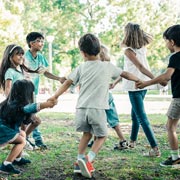 As adults, we often associate learning with classrooms, textbooks, and structured lessons. However, for children, the process of learning is a dynamic and ever-evolving adventure, with play being their very best companion during the journey.
 Do babies benefit from play? Absolutely. Play is the first way through which infants start understanding their world. They use their senses to explore toys, grasp objects, and make sense of the environment around them. Sensory play, such as touching different textures or listening to soothing sounds, stimulates their developing senses and lays the groundwork for future learning.
 During the run-up to the age of 5, play is integral to children’s development. During this phase, children are like little sponges, soaking up information from their surroundings. Play allows them to experiment, make connections, and refine their cognitive and many other skills. Skills enhanced through play include:
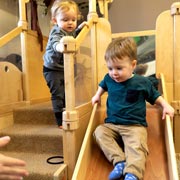 Creating playful environments — we understand the importance of a conducive environment for learning through play. With that in mind, we provide carefully designed play spaces that are rich in stimulating materials and resources. These spaces allow children to engage in various types of play, from imaginative to sensory, in a safe and supportive setting.