— A Fun & Educational Activity for Children (with Free Reference Poster!)
 It’s wonderful for families when spring arrives: the coldest weather is behind us, the sun is out more often, and there is so much beauty to see outdoors. As spring progresses, more and more flowers appear, providing colourful displays, and all kinds of plants and leaves are sprouting forth. Following spring’s arrival, we’ll see more animals, birds and insects too. They’re likely to include delightful bumblebees attracted by newly-blossoming flowers, adorable snails and minibeasts on the look-out for food, and swifts flying acrobatically through the air, having returned to the UK after wintering overseas. Everywhere we look, nature is teaming with life once again.
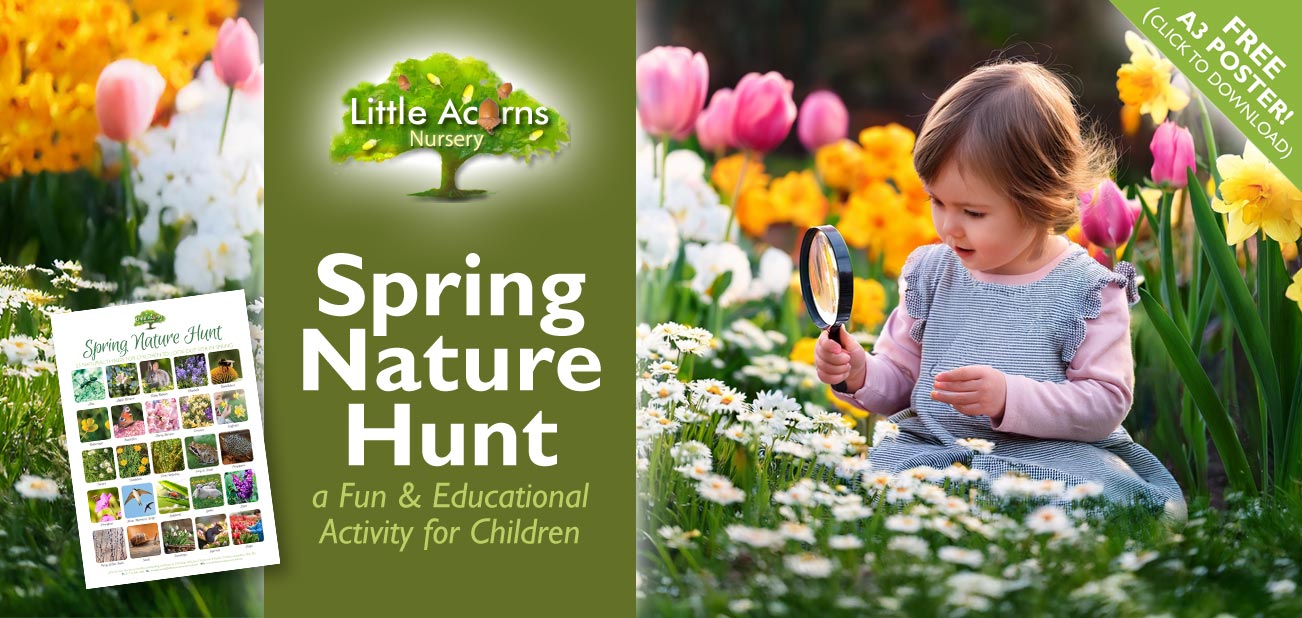
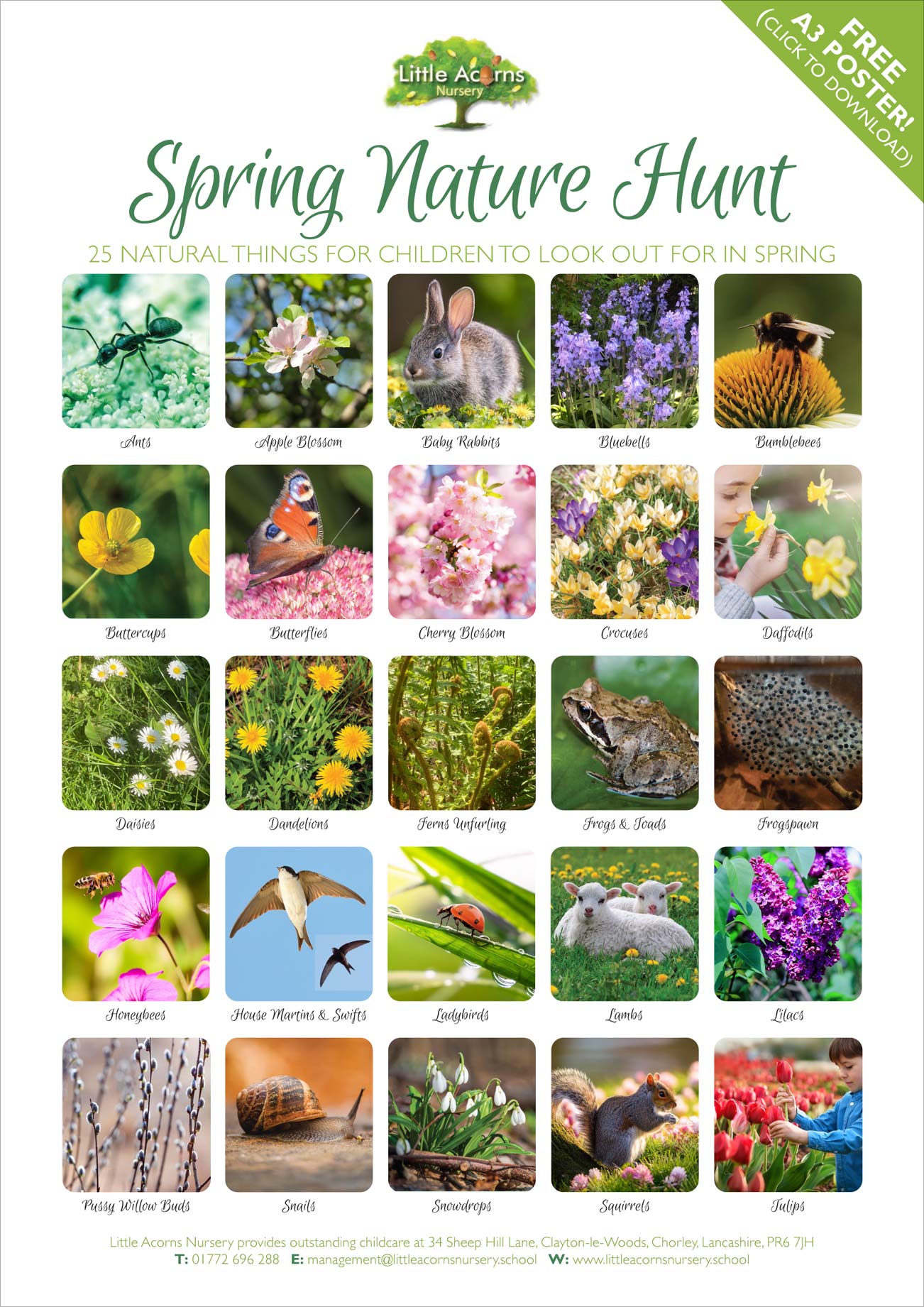
 With this in mind, it’s a wonderful opportunity to encourage children to get outside once more, enjoy nature and the fresh air, and embark on a Spring Nature Hunt. The activity is both fun and educational for little ones. Spending time in nature is also very good for children’s health and well-being. And the icing on the cake? Today’s activity comes with an attractive reference poster depicting 25 natural things for children to look out for — and it’s free for families to download.
Download Your Free Spring Nature Hunt Reference Poster
Click the poster preview image below to save the poster in high-resolution Acrobat PDF format. Whether you left- or right-click will depend on your device’s settings. Print it out, and give it to children as reference for some of the many natural things they can discover in this wonderful season.
How Many of the Wonderful Spring Things Can Your Child Spot?
After printing out the poster as reference for you and your child, challenge them to go into the garden, local open space, or on a walk with you and see how many of the wonderful spring things they can discover. They can perhaps tick each one off as they are spotted.
Some of the easiest things to find are flowers like daisies, dandelions, and buttercups, which can be found throughout most of the spring season. Other flowers, like crocuses and snowdrops, and things like pussy willow, bloom very early in spring and may not be visible later in the season. Butterflies, bumblebees, honeybees, and ladybirds, however, should be amongst the insects that are abundant all spring and beyond. The fact that some items will be more challenging to find than others is, however, all part of the fun!
Teach Kindness – Nurture Empathy
It’s best to teach children to simply spot them, not try to collect them. Doing so is more kind and will help them understand their responsibility towards the environment and encourage empathy towards living things.
Nature is Important to Children & Adults Alike
Nature is incredibly important for the world and to us, as humans. Spending time in the natural world is also hugely beneficial to children, including those under five. That’s one of the many reasons why we love Forest School at the Little Acorns Nursery in Clayton-le-Woods, which provides regular Forest School sessions and follows its approach. Learn why nature is so important to children here and discover more about Forest School here.
Enjoy!
Today’s Spring Nature Hunt activity will get children outdoors, away from electronic screens, and give them valuable insights into our incredible flora and fauna. Through such an activity, they’ll learn through exploration, discovery, and play, while also benefiting from fresh air, exercise, and close proximity to nature. Discovering some of the beautiful things in the natural world will also give children a better sense of their place within it and open their eyes to the natural riches that are available when they venture outdoors. Spending time in nature will teach them valuable knowledge and skills, stimulate their senses, benefit their mental and physical health, and so much more.
Your High-Quality Childcare Nursery in Clayton-le-Woods
With its Own Forest School!
 Little Acorns Nursery is located in Clayton-le-Woods, near Chorley. We are an award-winning childcare setting and provide high-quality childcare from Monday to Friday, virtually all year round. We support funded childcare hours for eligible children, provide Forest School sessions, and are graded by Ofsted as a good childcare provider. We also open early each day at 7:30 am and remain open until 6:00 pm, which will be particularly convenient to working parents. And, for our little ones, we provide the very best start, in a well-equipped, warm, loving and stimulating environment that brings out the best in them.
If you’re looking for high-quality childcare with Forest School sessions near Clayton or Chorley, we’d love to hear from you. Select an option below to start your child’s nursery journey with Little Acorns Nursery today:
Little Acorns Nursery is located in Clayton-le-Woods, Clayton Brook, Clayton Green, and Chorley. As such, we may also suit families living nearby in towns and villages like Thorpe Green, Pippin Street, Buckshaw Village, Whittle-le-Woods, Farington, Bamber Bridge, Lostock Hall, Euxton, Leyland, and Penwortham.
Important Safety Note:
Appropriate adult supervision is essential when children, especially the very young, are playing and exploring outdoors. There are many dangers out there, including hazards like ponds, lakes, water, traffic, stranger danger, steep inclines, and so on. So, please remain vigilant at all times when supervising little ones outside. Teach them to recognise and become aware of the dangers, hazards, and potential risks associated with all aspects of the outdoors.
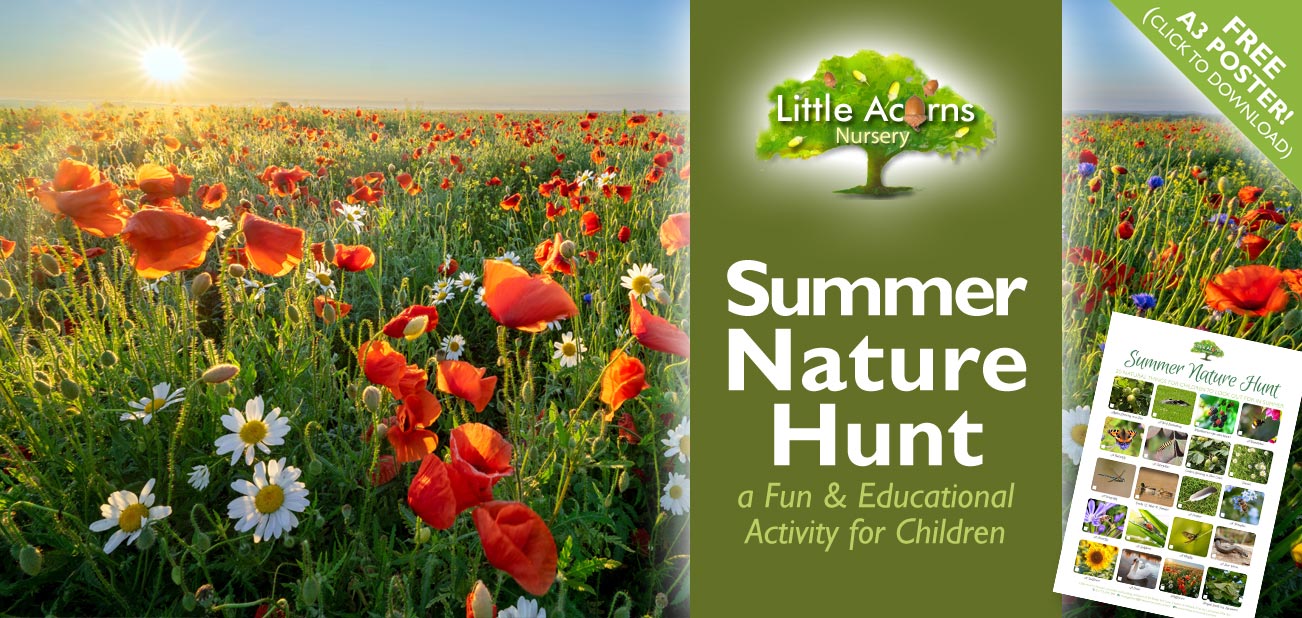
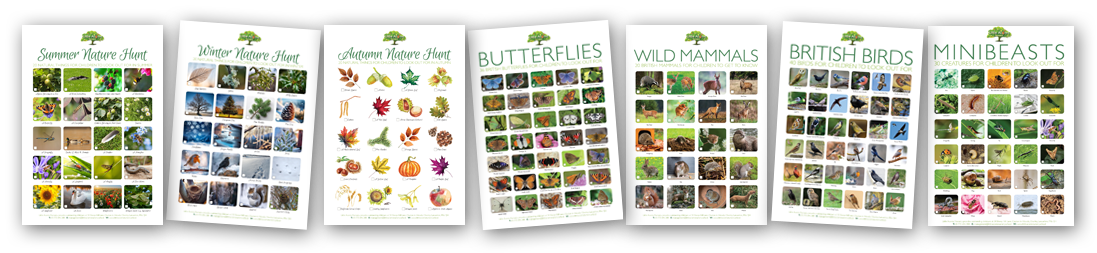
 Summer is a wonderful time for children to get outdoors. There, they can breathe the fresh air, benefit from being closer to the natural world, and escape from electronic screens. Nature is incredibly good for children as well as adults (more about that later). A simple way to encourage little ones outdoors is to take them on an exciting and educational nature hunt! There are many fascinating things to look out for during the summer months including butterflies, caterpillars, bees, beautiful wildflowers and much more. A summer nature hunt will open their eyes and minds to the wonders of nature’s flora and fauna, lead to educational conversations with accompanying adults, and be an enjoyable and educational activity. Within all that in mind, we’ve put together a free Summer Nature Hunt poster that will give children and families an idea of what to look out for during the warmer months of summer — and serve as useful visual reference. The poster is free to download right here in this blog post (see below). Once printed out, it can be displayed large on children’s bedroom walls or taken along during the activity — perhaps reduced to a convenient size like A5. Children can use the little tick boxes to tick off each item that’s been spotted. So, venture out little ones — see how many wonderful things you can spot in the natural world this summer!
 Many of the adorable creatures featured in the poster will be easy to spot at this time of year. Bees, hoverflies, and other pollinators are common to see where flowers are blooming. Butterflies are both stunningly beautiful and at their most abundant during July and August each year, so are sure to delight children with their fabulous colours and patterns. Delightful ladybirds are also rather abundant right now (time of writing: mid-July). Wildflowers like poppies and daisies always make the world a more beautiful place, so they’re a wonderful thing for children to discover too.
 Has your little one ever seen apples growing on a tree? All that blossom from earlier in the year has now given way to little green apples that will grow and ripen as we head further into the year — eventually becoming ready to fall or be eaten come autumn. It’s a great example to show under-fives where some food comes from and explain why pollinators are so important.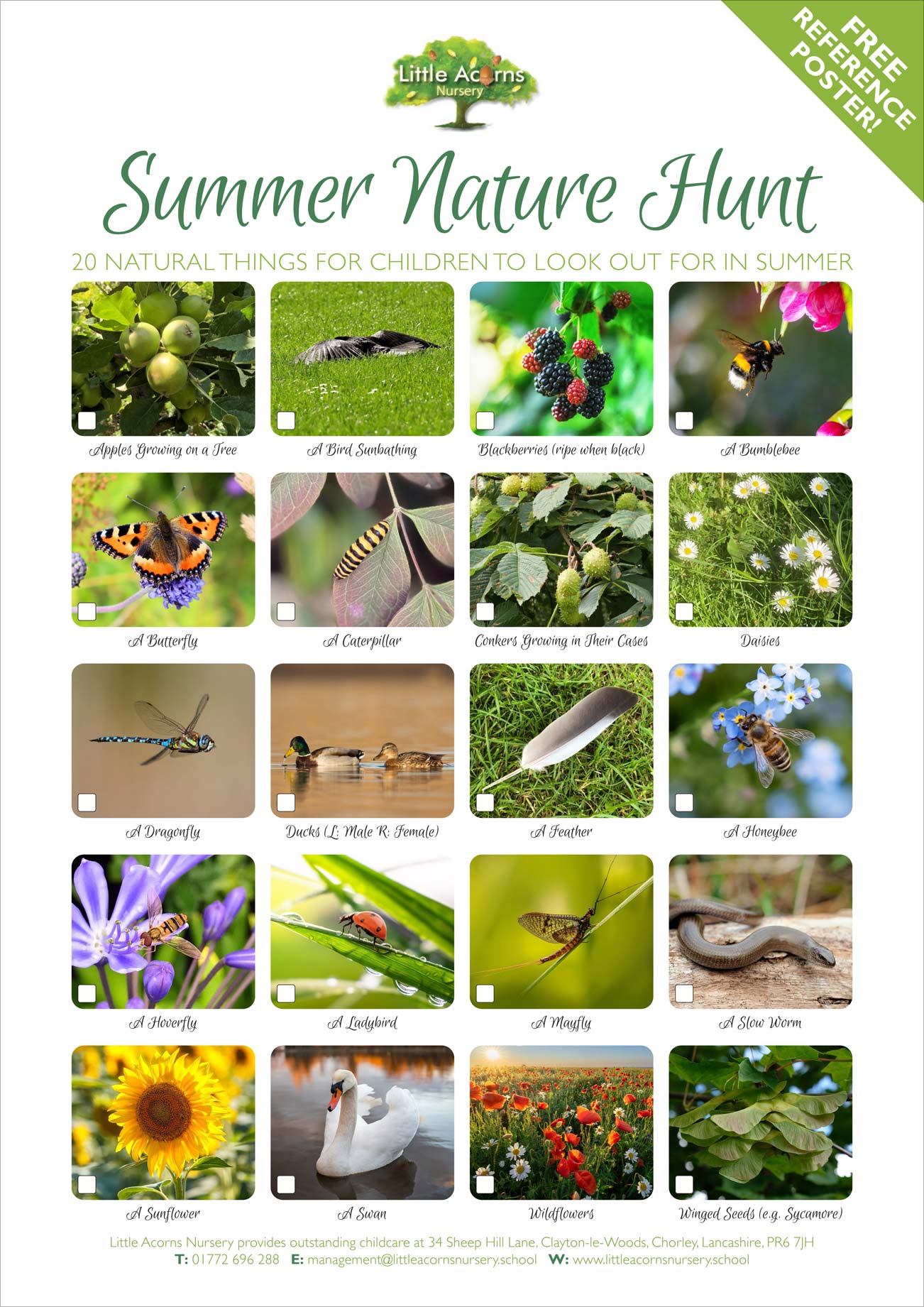
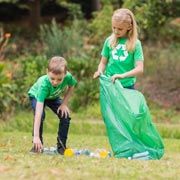 As we said in the introduction, spending time in and around nature is incredibly beneficial to children of all ages. Studies have proven a myriad of benefits, in fact. Just a few examples include a lowering of stress and anxiety, improved motor skills, greater knowledge of the world (and children’s place within it), improved empathy for other living things, a feeling of greater responsibility for nature’s flora and fauna, a development of often lifelong greener values and choices, and even improved academic grades! These are just a few examples — the benefits of spending time closer to nature are incredible. Learn more about