A Simple, Nature-Based Activity for Kids — with a Free Poster!
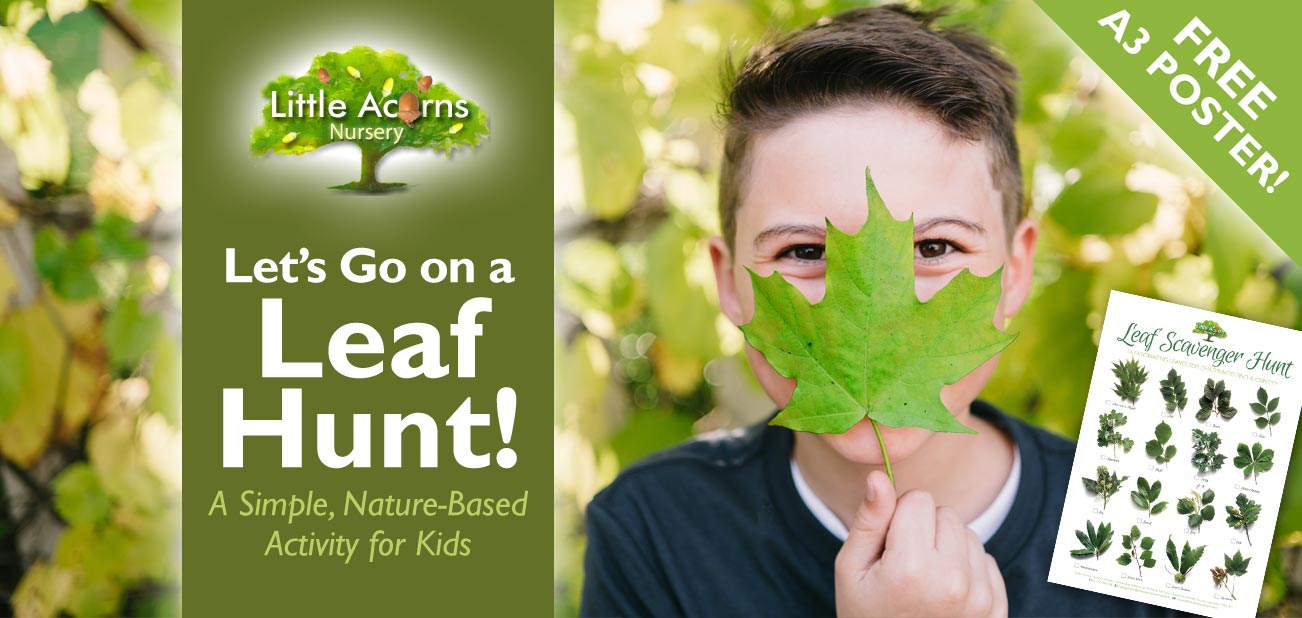
 Summer and autumn are particularly good seasons for children to get outdoors, breathe in fresh air, and enjoy all the benefits of the natural world. Nature is incredibly important to children, and it’s one reason why Little Acorns Nursery runs Forest School sessions as part of its childcare provision. With all that in mind, today’s suggested activity is a leaf scavenger hunt for little ones — and it comes with a free ‘leaves’ poster for families to download. Featuring 16 different types of tree leaves commonly found in England, the poster will serve as an excellent visual reference to inspire children in their search. It also presents children and families with a challenge — how many can they find and identify? Such an activity will encourage children to get outside, closer to nature, and learn about Britain’s trees as they go. Take a look and grab your free poster below.
Download Your Child’s Free ‘Leaves’ Poster
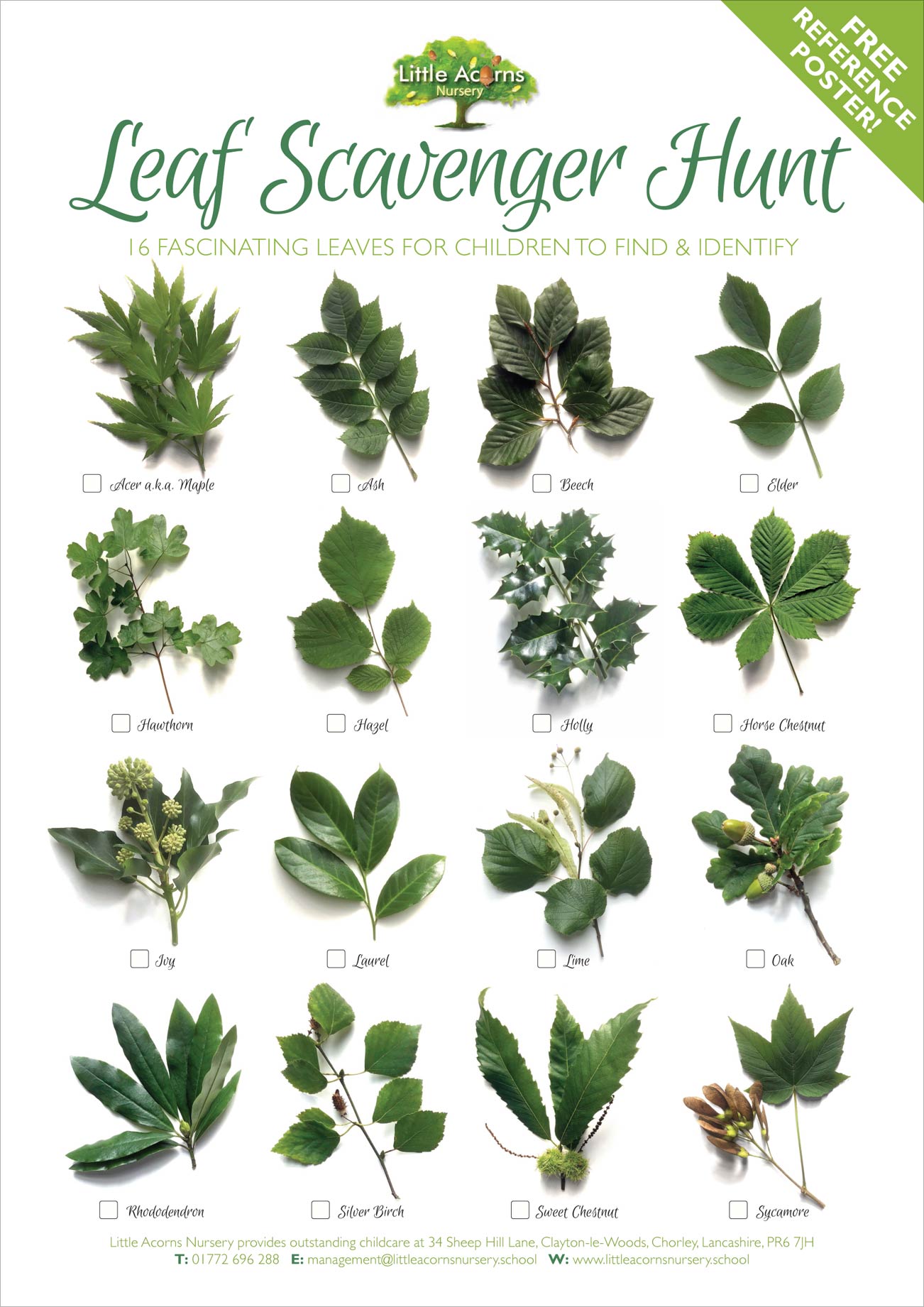
Shown below is a preview of the free poster that we’ve put together for children and families to get them started on their leaf hunt. Simply click the image to open/save the poster in Acrobat PDF format. Then, choose your printer’s highest-quality settings and paper. Print the poster in full colour for the best results. Choose high resolution printing and select A3, A4 or A5 scaling as desired. A3 and A4 are great for displaying on children’s bedroom walls, while A5 may be best suited for children to take with them on their leaf hunt. They can use the little tick boxes provided to tick off each type of leaf as they discover them. See how many of the 16 you and your child can find — enjoy the outdoor adventure together!
Enjoy the outdoor adventure together!
Types of Leaves for Children to Look Out For
 Children may already be familiar with some of the leaves featured on the poster. They may be able to identify oak leaves, for example, especially when acorns are growing amongst them. They may also be able to identify ‘conker tree’ leaves from horse chestnut trees, and perhaps even those from their close relatives, sweet chestnuts — but ensure they’re careful of the spikey sweet chestnut cases! Sycamore leaves, ivy leaves, and hawthorn leaves may also be fairly easy for children to recognise — or soon get to know.
This activity is a great way to teach children to look more closely at the natural world, learn to name different types of trees, and to discover things they’d never taken time to notice before. Nature is full of incredible things and is immensely varied, and today’s activity will help open their eyes to more of its magic!
This activity will help to open children’s eyes to more of nature’s magic!
How Many Different Leaves Can Your Child Find?
 Some types of leaves may be more challenging for children to differentiate between than others. However, that’s all part of the fun and the educational challenge. Hazel and Lime leaves are similar to each other, for example, although unlike hazel leaves, lime leaves have a sheen and the incredibly beautiful seed fronds that you can see on the poster in the third row. Elder and Ash leaves are also similar to one another, although the quite different number of leaves per stem will help children identify which is which (see the first row). Acers (a.k.a. Maples) are often found growing in gardens and parks. Their leaves are very pretty and come in a variety of colours, from deep burgundy or bright green to golden yellow depending on the variety and time of year. Our acer example in the first row should give children a good idea of what kind of shape to look out for in the main, although some acers are even more fancy!
Nature is Hugely Beneficial to Children
 Nature is incredibly important to human beings. Both children and adults experience an incredible array of benefits through spending time in and around the natural world — which is why we have Forest School at Little Acorns Nursery in Clayton-le-Woods. The benefits of nature are holistic and hugely impactful. Just a few examples of nature’s benefits include improving mental well-being, reducing stress, helping to improve sleep, boosting Vitamin D production, enhancing creativity, improving social skills, encouraging creativity, boosting knowledge about the world, and even improving academic grades. Time spent outdoors close to nature also encourages outdoor play and exercise, and thereby helps improve fitness, coordination, and motor skills. That’s all so important for little ones. Learn more about the importance of nature to little ones here.
It’s Why We Have Forest School at Little Acorns Nursery, Chorley
Up Next: Creative Activities Using Leaves
 In a follow-up to today’s leaf scavenger hunt, and in view of autumn beginning in September, we have also published a post that outlines some fun, highly creative activities that use leaves. From leaf painting and leaf rubbing to leaf collages, leaf pressing, and more, check out our wonderful art activity ideas for children that use foraged leaves. They’ll get your child’s creative juices flowing and, once the leaves have been gathered, it’ll be something different for them to do indoors, yet still involving nature.
More Free Stuff for Children & Families
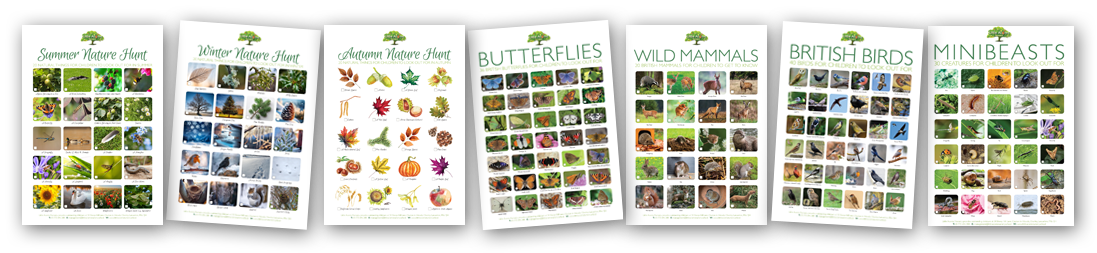
Today’s leaf scavenger hunt poster is just one in a series of free posters that children and families can download here on the Little Acorns Nursery website. Other free posters involving nature-inspired activities include a summer nature hunt, an autumn scavenger hunt, a winter nature hunt, a spring nature hunt, mammal spotting, bird spotting, minibeast spotting, and butterfly spotting. They’re all great activities as well as coming with interesting and informative posters that are free to download for children. Follow the bold links to learn more and to access the posters.

Nursery Places in Clayton-le-Woods, Chorley
High-Quality, Convenient Childcare for Under-Fives

 Do you live in the Chorley area and have a baby or child under five? If so, Little Acorns Nursery in Clayton-le-Woods would be a fabulous setting for their weekday childcare. With excellent facilities for babies and under-fives, a self-contained preschool unit, regular Forest School sessions, a ‘Good’ Ofsted rating, and support for funded childcare places for eligible families, the setting represents a wonderful choice. The nursery is open early too, from 7:30 a.m., also closing later than many at 6:00 p.m., making it even more convenient for working parents, particularly those seeking wraparound childcare.
Get in touch today to book a guided visit, register your child for a place, or to ask any questions. Please choose a button below to get started:
Little Acorns Nursery is located in Clayton-le-Woods, Chorley, so may suit families living nearby in Clayton Brook, Clayton Green, Penwortham, Farington, Bamber Bridge, Whittle-le-Woods, Lostock Hall, Leyland, Pippin Street, Buckshaw Village, Thorpe Green and Euxton.
Safety Note: A responsible and vigilant adult should always accompany children, particularly the very youngest, when they’re exploring outdoors. There are many potential dangers out there, including physical hazards, choking hazards, poisonous or toxic plants, stranger danger, and more. So, always accompany little ones and ensure they learn what to do, what not to do, and the potential dangers to look out for and avoid. Supervising them outdoors and teaching them about safety is also a proactive way to help them learn to assess risk and ultimately learn to keep themselves more safe.
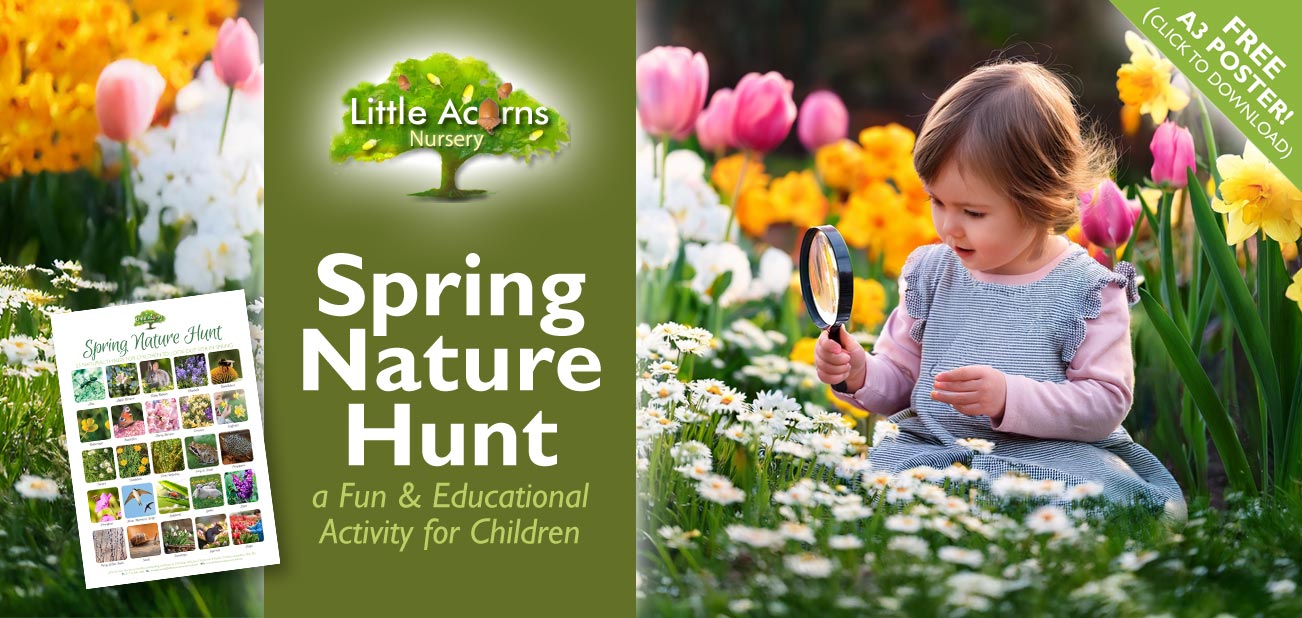
 It’s wonderful for families when spring arrives: the coldest weather is behind us, the sun is out more often, and there is so much beauty to see outdoors. As spring progresses, more and more flowers appear, providing colourful displays, and all kinds of plants and leaves are sprouting forth. Following spring’s arrival, we’ll see more animals, birds and insects too. They’re likely to include delightful bumblebees attracted by newly-blossoming flowers, adorable snails and minibeasts on the look-out for food, and swifts flying acrobatically through the air, having returned to the UK after wintering overseas. Everywhere we look, nature is teaming with life once again.
 With this in mind, it’s a wonderful opportunity to encourage children to get outside once more, enjoy nature and the fresh air, and embark on a Spring Nature Hunt. The activity is both fun and educational for little ones. Spending time in nature is also very good for children’s health and well-being. And the icing on the cake? Today’s activity comes with an attractive reference poster depicting 25 natural things for children to look out for — and it’s free for families to download.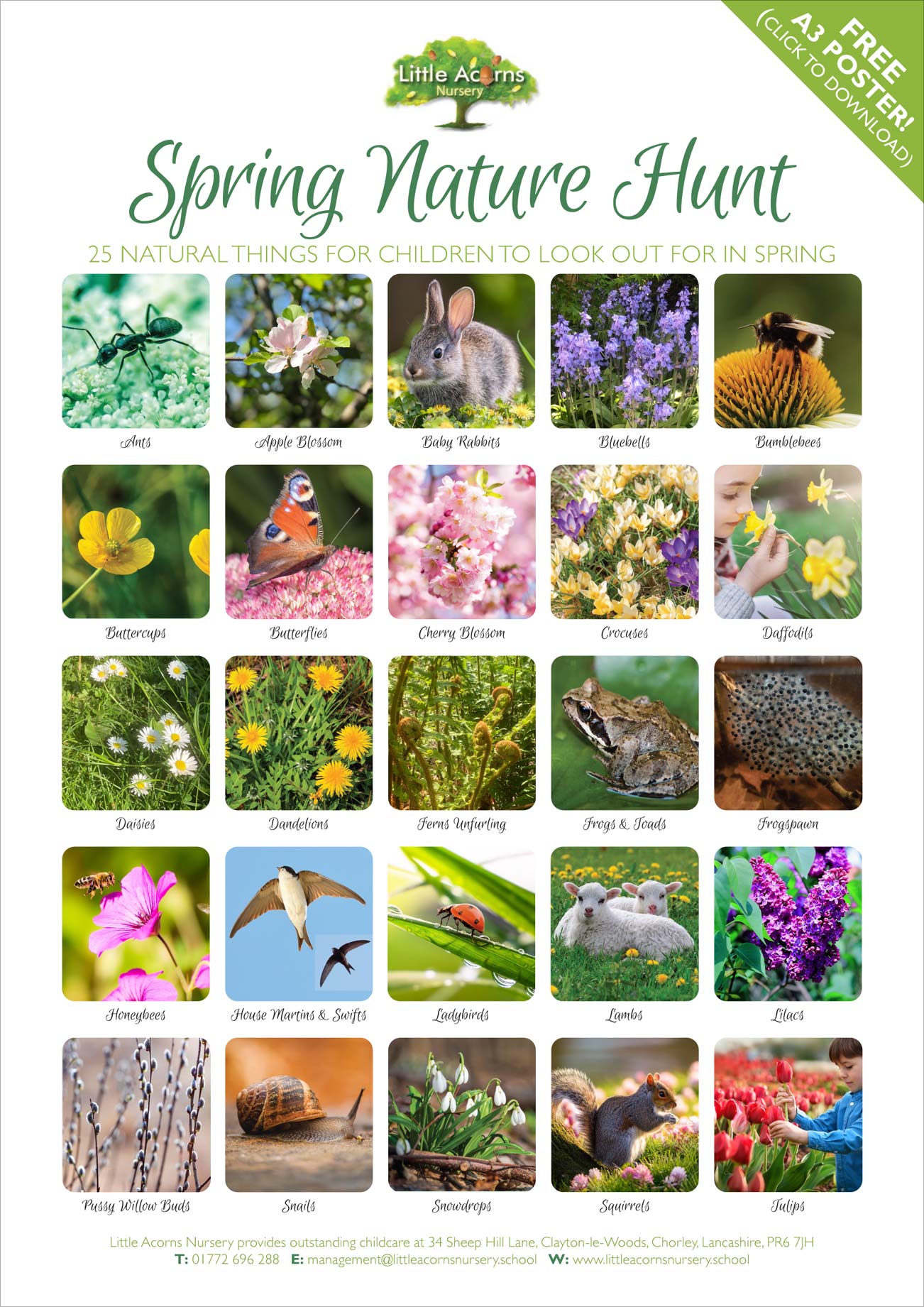
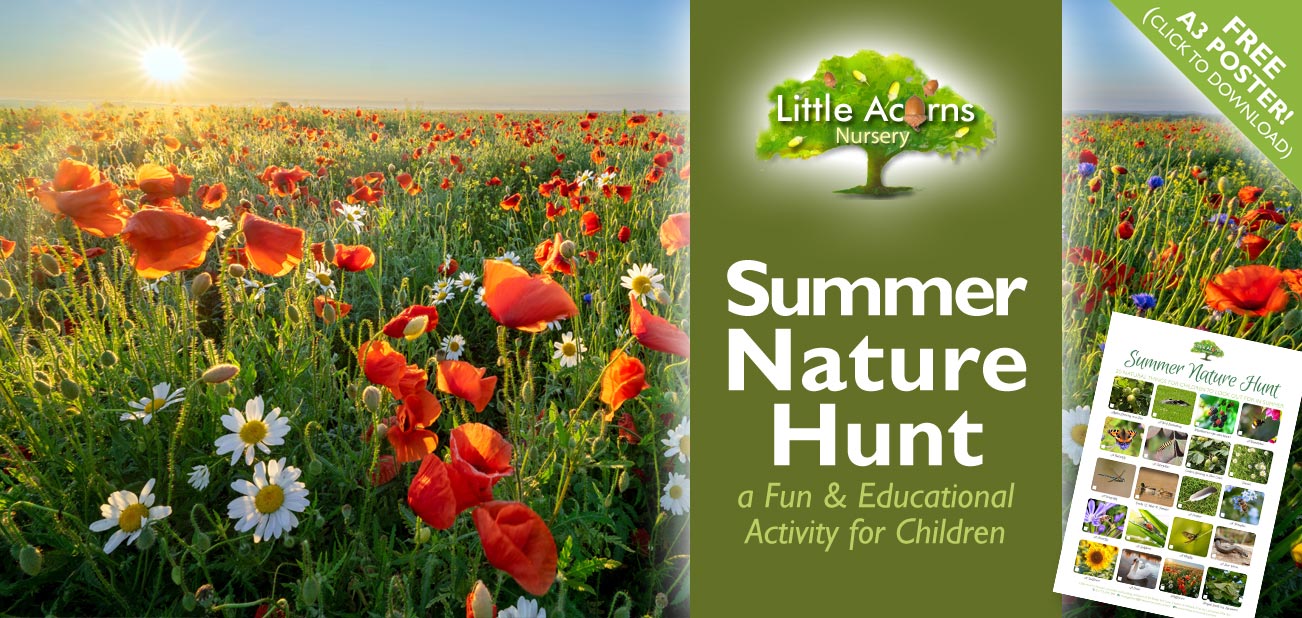
 Summer is a wonderful time for children to get outdoors. There, they can breathe the fresh air, benefit from being closer to the natural world, and escape from electronic screens. Nature is incredibly good for children as well as adults (more about that later). A simple way to encourage little ones outdoors is to take them on an exciting and educational nature hunt! There are many fascinating things to look out for during the summer months including butterflies, caterpillars, bees, beautiful wildflowers and much more. A summer nature hunt will open their eyes and minds to the wonders of nature’s flora and fauna, lead to educational conversations with accompanying adults, and be an enjoyable and educational activity. Within all that in mind, we’ve put together a free Summer Nature Hunt poster that will give children and families an idea of what to look out for during the warmer months of summer — and serve as useful visual reference. The poster is free to download right here in this blog post (see below). Once printed out, it can be displayed large on children’s bedroom walls or taken along during the activity — perhaps reduced to a convenient size like A5. Children can use the little tick boxes to tick off each item that’s been spotted. So, venture out little ones — see how many wonderful things you can spot in the natural world this summer!
 Many of the adorable creatures featured in the poster will be easy to spot at this time of year. Bees, hoverflies, and other pollinators are common to see where flowers are blooming. Butterflies are both stunningly beautiful and at their most abundant during July and August each year, so are sure to delight children with their fabulous colours and patterns. Delightful ladybirds are also rather abundant right now (time of writing: mid-July). Wildflowers like poppies and daisies always make the world a more beautiful place, so they’re a wonderful thing for children to discover too.
 Has your little one ever seen apples growing on a tree? All that blossom from earlier in the year has now given way to little green apples that will grow and ripen as we head further into the year — eventually becoming ready to fall or be eaten come autumn. It’s a great example to show under-fives where some food comes from and explain why pollinators are so important.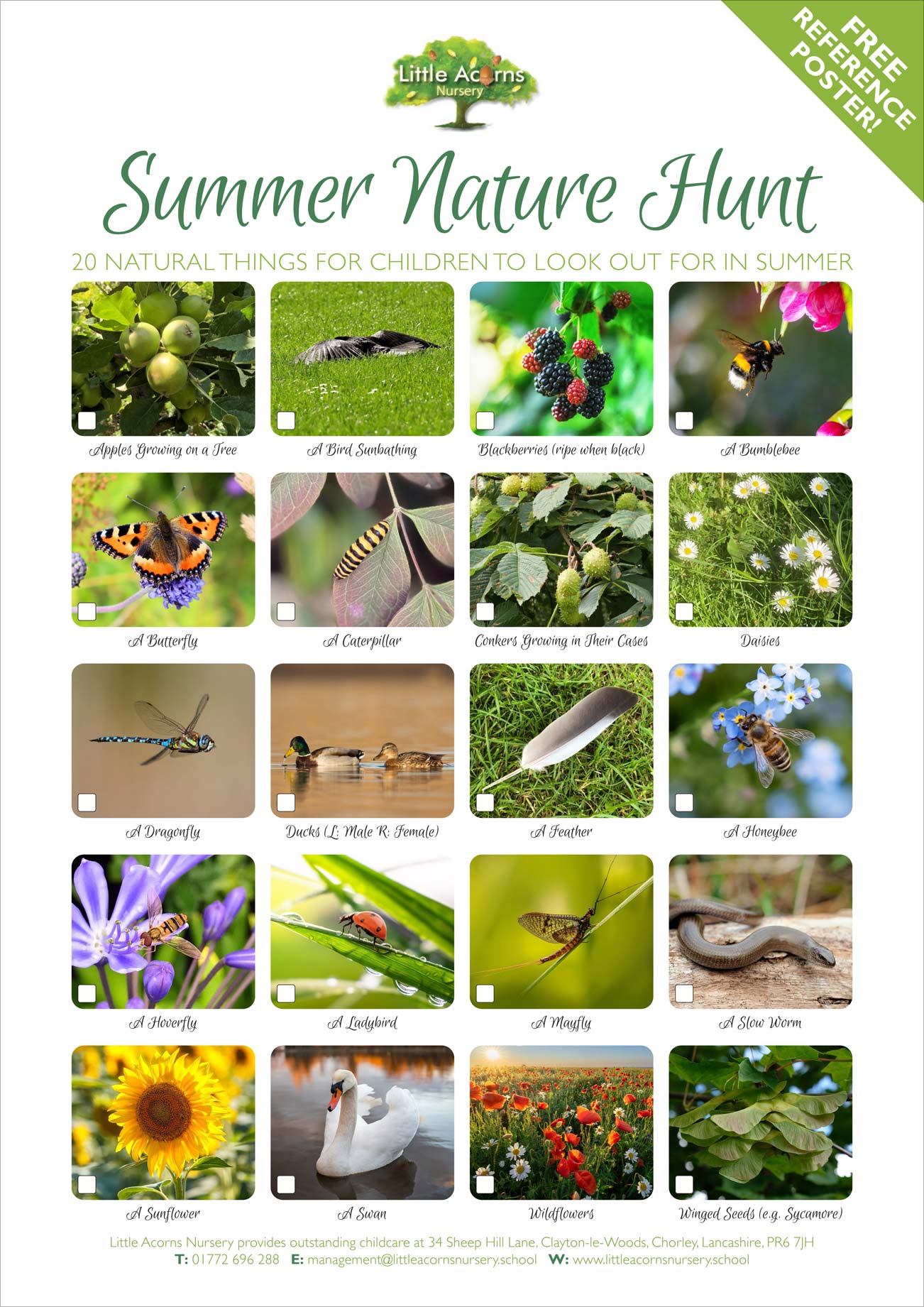
 As we said in the introduction, spending time in and around nature is incredibly beneficial to children of all ages. Studies have proven a myriad of benefits, in fact. Just a few examples include a lowering of stress and anxiety, improved motor skills, greater knowledge of the world (and children’s place within it), improved empathy for other living things, a feeling of greater responsibility for nature’s flora and fauna, a development of often lifelong greener values and choices, and even improved academic grades! These are just a few examples — the benefits of spending time closer to nature are incredible. Learn more about